Most business analyses of Spotify focus on its subscriber growth or its battles with record labels, but PolyMatter makes a far more unsettling claim: the company's entire "grand strategy" is a desperate distraction from a broken economic model that can never be profitable. This isn't just a story about a tech giant struggling to find its footing; it is a forensic look at how a company can burn billions to convince investors it is pivoting, while actually digging a deeper financial hole. For busy leaders watching the audio landscape, the question isn't whether Spotify will survive, but whether its relentless diversification is actually destroying the value of the very content it sells.
The Squeeze Between Giants
PolyMatter begins by dismantling the narrative that Spotify is failing because of competition. The author points out that despite the entry of tech titans like Apple, YouTube, and Amazon, Spotify has not only survived but thrived in terms of user base, now boasting 239 million paid subscribers. The real problem, PolyMatter argues, is structural. The company is trapped between two powerful forces: the record labels that control the content and the tech platforms that control the distribution.
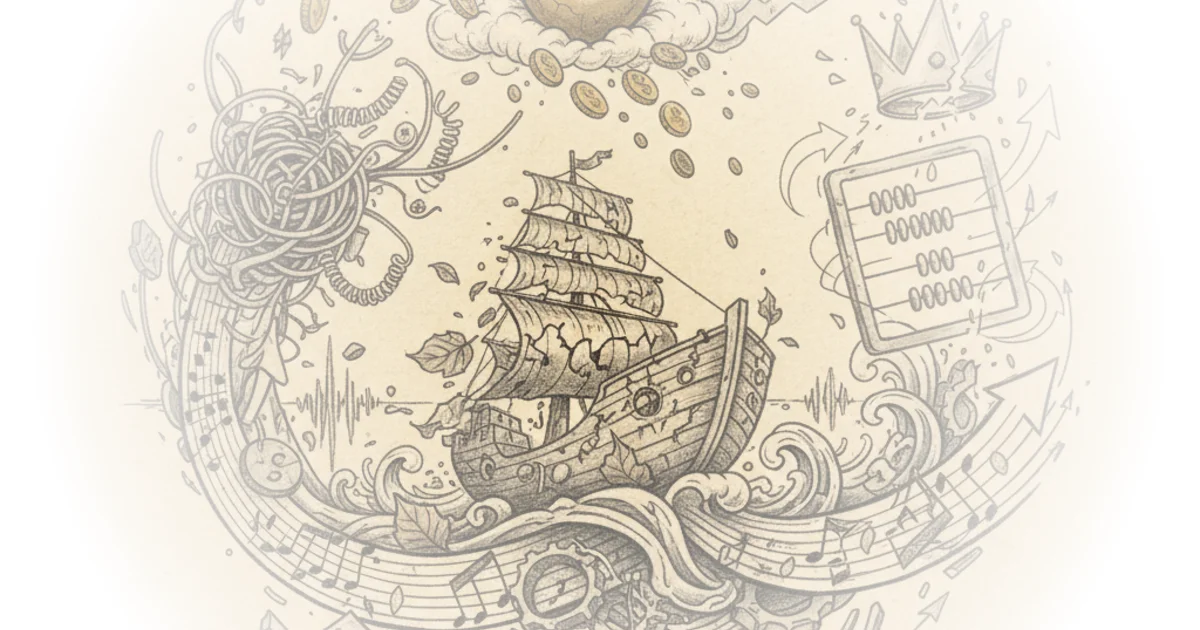
The author writes, "Spotify is simply one too many middlemen in a low-margin business." This framing is crucial because it shifts the blame from poor management to an impossible market dynamic. PolyMatter notes that the company is caught "between two behemoths, platforms like Apple on one side and labels on the other." The labels, controlling roughly 70% of the industry, dictate terms that leave Spotify with razor-thin margins. As PolyMatter puts it, "Spotify therefore virtually has to pay these labels whatever they ask for: 63 cents to be precise for every dollar it collects."
This creates a unique vulnerability that distinguishes Spotify from other streaming giants. While Netflix pays a fixed cost to produce content, meaning every new subscriber is pure profit after the break-even point, Spotify's costs are variable. PolyMatter explains, "More ones and zeros are free for Netflix to produce but not for Spotify... it's still constrained by the laws of physics." This is a brilliant analogy that clarifies why a software company can't simply scale its way to profitability. The more users it adds, the more it owes the labels.
Critics might note that Spotify has successfully raised prices in the past without losing significant market share, suggesting the demand is more inelastic than PolyMatter suggests. However, the author's point about the revenue-sharing model remains the critical constraint: "Any price increase would necessarily annoy customers more than it would benefit the company."
The Podcast and Audiobook Gamble
Faced with an unprofitable core business, the administration of Spotify turned to diversification, betting that podcasts and audiobooks could subsidize the music loss. PolyMatter describes this as an attempt to "find its iPhone," or at least a product that isn't giving away the universe for pennies. The company spent nearly a billion dollars on acquisitions and exclusive deals with high-profile figures like the Obamas, Joe Rogan, and Prince Harry.
The author argues that this strategy was fundamentally flawed because it ignored consumer psychology. "The problem wasn't with the concept of exclusives... but when you don't give them a reason to stay, it just feels like they're being held hostage," PolyMatter writes. The exclusives failed to create a sticky ecosystem because the interface offered no unique value, and the content could easily be found elsewhere. The Obamas left for Audible, and the Harry and Meghan deal was cancelled, leaving Spotify with a massive bill and no return.
The move into audiobooks faces similar headwinds. PolyMatter questions the assumption that users want a single app for all audio. "What if despite their technical similarity as longer or shorter audio files, most people think of Music, podcasts, and audiobooks as entirely different mediums serving different purposes?" This is a sharp critique of the "synergy" argument often used by conglomerates. The author suggests that bundling these distinct experiences might actually devalue them.
"It's not clear that the company has had a net positive effect on podcasts, audiobooks, or their listeners."
PolyMatter warns that by commodifying audiobooks—offering them as a perk rather than a premium product—Spotify risks training users to undervalue the medium. "Eventually the company will surely start charging for those first 15 hours of listening, but by then, will it have done to audiobooks what it did to music: commodifying and thereby reducing their perceived value?" This is a profound insight into the long-term damage of the "free tier" mindset applied to high-value content.
The Distraction Cycle
Perhaps the most damning part of the analysis is the suggestion that these pivots are not genuine strategic shifts, but rather a mechanism to manage investor expectations. PolyMatter argues that the company is stuck in a cycle of "jumping from one unprofitable industry to the next, repeating the same mistakes over and over." The strategy, according to the author, is to "distract investors who reward this short-term behavior as long as there's some breakthrough right around the corner."
The author writes, "Notice how at no point in this process does Spotify actually earn more money." Instead, the company uses its massive spending to generate headlines and cherry-picked metrics that sustain investor faith just long enough to move on to the next big thing. This is a cynical but compelling view of corporate behavior in the tech sector. PolyMatter concludes that "Spotify's real core competency, it seems, is generating large amounts of money for other people," while annoying its own paying customers with features they didn't ask for.
The piece ends with a stark warning: after nearly two decades, Spotify may be running out of useful distractions. The company is forced to reckon with the fact that it will likely never be as profitable as investors imagine, or it will simply invent a new distraction to restart the cycle.
Bottom Line
PolyMatter's strongest argument is that Spotify's financial struggles are not a temporary setback but a permanent feature of its business model, trapped between powerful labels and a consumer base that refuses to pay premium prices for music. The piece's biggest vulnerability is its somewhat deterministic view of consumer behavior, potentially underestimating the network effects of a unified audio platform. However, the warning that commodification could destroy the value of audiobooks and podcasts is a critical insight for anyone watching the future of the audio industry. The real risk isn't that Spotify will fail, but that it will succeed in becoming a massive, unprofitable utility that drains value from the very creators it relies on.