Kings and Generals delivers a surgical dissection of how a single naval gamble ignited the Gallipoli catastrophe—a story where hubris met Ottoman ingenuity. Most accounts fixate on the land campaign, but here’s the chilling revelation: the disaster was sealed weeks earlier when Churchill’s obsession with obsolete battleships blinded him to minefields laid by a humble Turkish minelayer. In today’s era of AI-generated historical fluff, this meticulous forensic approach feels like a lifeline for anyone seeking truth in the fog of war.
The Fatal Calculus
Kings and Generals writes, "With 16 ships already scheduled for scrapping in 1915, the plan favored using these expendable pre-dreadnoughts in the operation as their losses would not upset the naval balance of power." This exposes Churchill’s cold arithmetic: sacrifice outdated vessels to bypass political resistance to risking modern ships. The core argument—that Britain’s desperation to honor the secret March 1915 Constantinople Agreement with Russia (promising Istanbul as spoils) overrode tactical realism—lands with brutal clarity. It wasn’t just about aiding Russia; it was about securing postwar leverage. Yet this framing overlooks how naval arrogance became self-fulfilling: by dismissing Ottoman defenses as "plainly visible with few gun shields," the Allies ignored that German advisors had transformed those "outdated" forts into coordinated killing zones. Critics might note that mines alone wouldn’t have stopped the fleet if bombardment had neutralized shore batteries—but the author proves the mines were the coup de grâce after poor gunnery left defenses intact.
The Night That Changed Everything
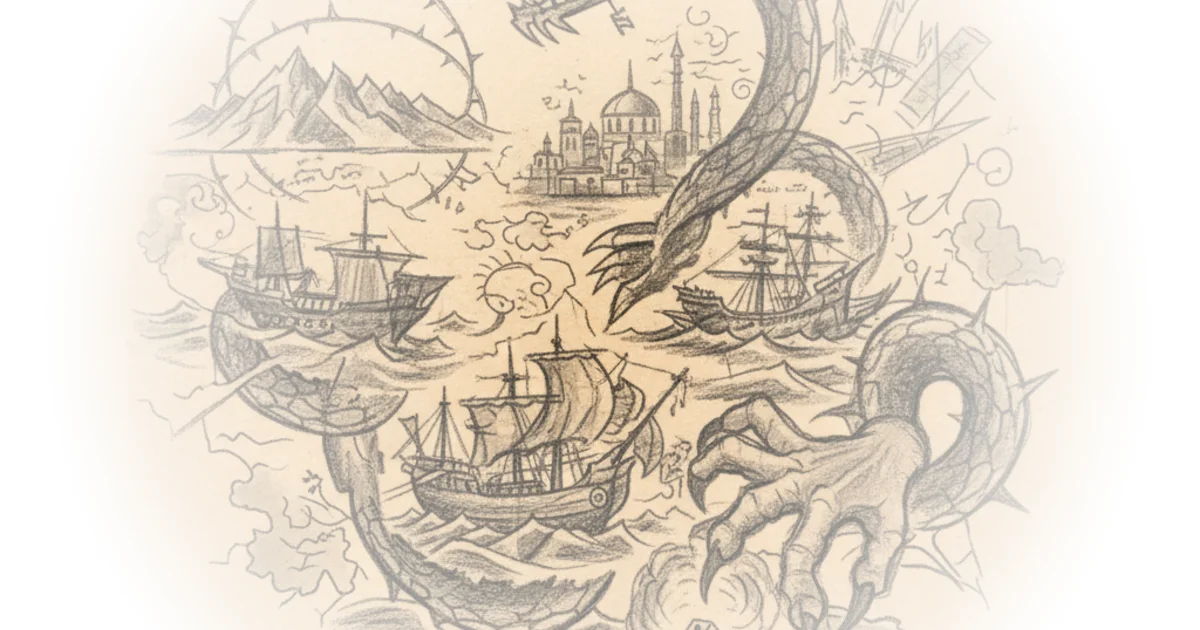
As Kings and Generals puts it, "Unbeknownst to the Allies, the Ottomans laid a new mine line across Erenköy Bay on the night of March 17th." Here’s where the minelayer Nusret’s forgotten heroism enters: that single vessel, crewed by 49 sailors, planted 20 mines in 55 minutes—a move the author treats not as luck but as disciplined execution after weeks of German-led preparation. The narrative’s power lies in juxtaposing Allied complacency ("mine sweepers, often fishing trawlers... were demoralized") against Ottoman resolve. When Kings and Generals details how Bouvet "capsized within 2 minutes with 639 crewmen lost," the horror isn’t just in the statistic but in the implication: one night’s work by a vessel smaller than most destroyers shattered an armada. This lands because it reframes Gallipoli’s origin story—not as inevitable tragedy but as a cascade of avoidable errors magnified by underestimating the enemy’s adaptability.
The Allies lost three battleships with three more severely damaged and over 1,000 dead with hundreds more wounded—the Ottoman inner gun batteries remained largely intact.
The Delusion of Easy Victory
Kings and Generals argues that "the Allies also severely underestimated Ottoman capacity and will to fight, influenced by their performance in the Italo-Turkish War and the Balkans campaigns." This is the piece’s sharpest insight: prejudice turned intelligence failures into strategic suicide. Paraphrasing the author’s evidence, Ottoman General Liman von Sanders used the Allies’ month-long preparation delay to dig trenches, lay barbed wire, and position reserves—yet Hamilton still expected "unopposed landings." The author brilliantly connects this to the naval phase: just as Churchill dismissed minefields as secondary, Hamilton dismissed Ottoman morale after earlier defeats. A counterargument worth considering is whether any commander could’ve overcome Gallipoli’s terrain—but the text proves the Allies never tried, clinging to colonial-era assumptions that Ottoman troops were "poorly trained" (ignoring German artillery specialists now manning the guns). This oversight wasn’t just tactical; it was ideological.
Bottom Line
Kings and Generals’ strongest contribution is exposing how the naval disaster—not the land campaign—doomed Gallipoli, with forensic attention to the Nusret’s minefield as the linchpin. Its vulnerability? Underplaying how Russia’s desperate pleas (via Grand Duke Nicholas) created political pressure that overrode military logic—a context that makes Churchill’s gamble tragically comprehensible. Watch for how this reframe reshapes modern assessments of "decisive strike" fantasies in warfare.