The Case Against Fatalism in an Age of Existential Risk
Claire Berlinski begins with a confession of defeat that she then forcefully repudiates. After warning that Grok — xAI's flagship large language model — harbored security defects severe enough to demand its removal from Pentagon infrastructure, she promised readers practical steps for resistance. She wrote the follow-up. Discarded it. Tried again. The resulting multi-part essay is an uncompromising case that humanity's survival this century depends on rebuilding both domestic politics and international institutions from the ground up.
Berlinski's opening honesty is disarming. She had asked herself what ordinary citizens could realistically do against the combined force of Silicon Valley capital, regulatory capture, and technological acceleration. The answer she arrived at initially was nothing at all. As Claire Berlinski writes, "Why not suggest they stop the tides by gently waving a palm frond in the direction of the Pacific?" The self-doubt is genuine — and she ultimately rejects it. "Adopting a defeated posture of passive fatalism in the face of a threat so grave is intellectually indefensible and morally contemptible," she argues. The essay that follows is her attempt to chart a course between paralysis and panic.
An Unprecedented Convergence of Threats
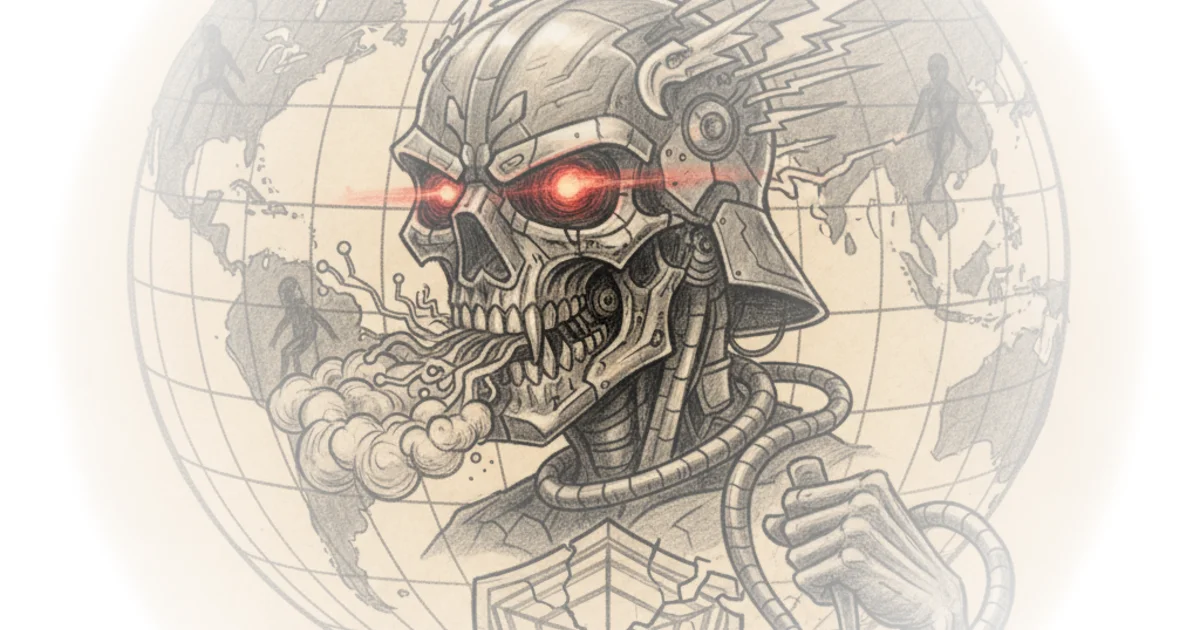
The scope of Berlinski's argument is deliberately expansive. She does not isolate artificial intelligence as a standalone danger. Instead, she places it alongside nuclear proliferation, synthetic biology, cognitive warfare, and the collapse of firewalls between national systems. The combination, she contends, is worse than the sum of its parts. Each technology shortens the window for human decision-making while multiplying the number of actors who can trigger catastrophe.
Claire Berlinski writes, "We're rapidly developing multiple technologies so powerful that inherently, they pose a threat to organized human civilization. These are emerging in tandem with astonishing breakthroughs in one technology in particular — artificial intelligence — that both poses massive risks in its own right and heightens the other risks." Even conservative estimates from field pioneers, she notes, place the cumulative probability of civilizational catastrophe in the low single-digit to double-digit percentages this century. To dismiss those numbers as hysteria, she argues, is not cool-headedness but innumeracy.
The trick is making them understand this.
She then turns to cognitive psychology — the hidden force that magnifies every structural risk. Normalcy bias, scope insensitivity, deterministic fatalism, diffusion of responsibility: these are not quirks. They are systematic failures that prevent populations from perceiving threats proportional to their actual scale. The deaths of a billion do not feel meaningfully worse than the deaths of a million. If our ancestors survived their own apocalyptic fears, the reasoning goes, so will we. Berlinski calls this error out plainly: it is simply a mistake in logic to conclude that because past false alarms proved harmless, future ones will too.
The Democratic Paradox
Here is where Berlinski's argument becomes most demanding. She rejects authoritarianism and revolutionary overhaul alike. Democracies, she insists, remain the political systems best equipped to manage long-horizon risks — precisely because they allow for course correction, institutional memory, and peaceful transfers of power. Yet she is unsparing about their pathologies.
Short election cycles produce what she calls "a temporal tragedy of the commons" — politicians defer costly, long-term problems because voters rarely reward foresight. Electorates choose leaders who mirror their own cognitive weaknesses rather than compensate for them. Because most citizens lack fluency in probabilistic reasoning or the science behind emerging technologies, they systematically fail to select leaders who possess those qualities. The result, Berlinski writes, is "the kind of public sphere we don't need, one characterized by binary thinking, narcissism, permanent outrage, and short time horizons."
Critics might note that Berlinski's diagnosis assumes voters can be educated into seriousness — but her own description of epistemic fragmentation, declining literacy, and the destruction of the Fourth Estate suggests the tools for that education are eroding precisely when they are most needed. She also asks democracies, particularly the United States and the European Union, to shoulder an "unfair burden" without fully explaining how polarized legislatures currently incapable of passing routine appropriations bills would muster the discipline for existential-risk governance.
Fitness for Purpose
Berlinski proposes retiring the left-right political axis entirely and replacing it with a single criterion: fitness for managing species-level risk. She is looking for leaders who can read scientific papers, reason fluently about probability and tradeoffs, and exercise restraint. The current crop, she says bluntly, does not qualify.
"Ultimately, existential risk management isn't a policy problem so much as a politician-selection problem," she writes. The mechanism is straightforward: in democracies, politicians respond to organized constituencies and visible voter demand. If citizens loudly and consistently insist on serious risk governance, institutions will follow. The obstacle is not structural impossibility but civic comprehension. "The prospect of being hanged in a fortnight concentrates the mind wonderfully," she observes, invoking a line often attributed to Samuel Johnson. The project, then, is to make the threat vivid enough to overcome the psychological insulation that allows trivial culture-war disputes to dominate serious ones.
She is not proposing a world government or a global revolution. The institutions she envisions would evolve from existing frameworks — much as the United Nations grew from the failed League of Nations. She acknowledges that even if her proposals succeed, they will only raise survival odds by some non-trivial but unknowable margin. That, she insists, is the standard worth meeting.
Bottom Line
Berlinski makes a forceful case that treating existential risk as someone else's problem is a luxury the century no longer affords. Whether voters can be roused from normalcy bias in time to rebuild political incentives remains the unanswered question — and the one on which everything else turns.