In a week dominated by the noise of local elections, Michael Macleod cuts through the political static to expose a stark reality: a London neighborhood living under the shadow of terror while the rest of the city debates council tax. The piece's most unsettling claim is not the violence itself, but the community's stoic refusal to be paralyzed by it, framing a terrifying new normal as "business as usual." This is not just a crime report; it is a forensic look at how fear reshapes daily life, security, and political discourse in the capital.
The Weight of the Street
Macleod anchors his coverage in the immediate aftermath of the Golders Green stabbings, where a suspect charged with three counts of attempted murder has triggered a "severe" terror threat level. Yet, the author observes a dissonance between the official alarm and the street-level atmosphere. "When it happened, I was there, and the police were shouting and helicopters were coming," recalls local resident Shimon Cohen, yet the community's response was to continue filling up their shopping carts. Macleod writes, "Everyone was just filling up their shopping. We're Jewish, it's what we do."
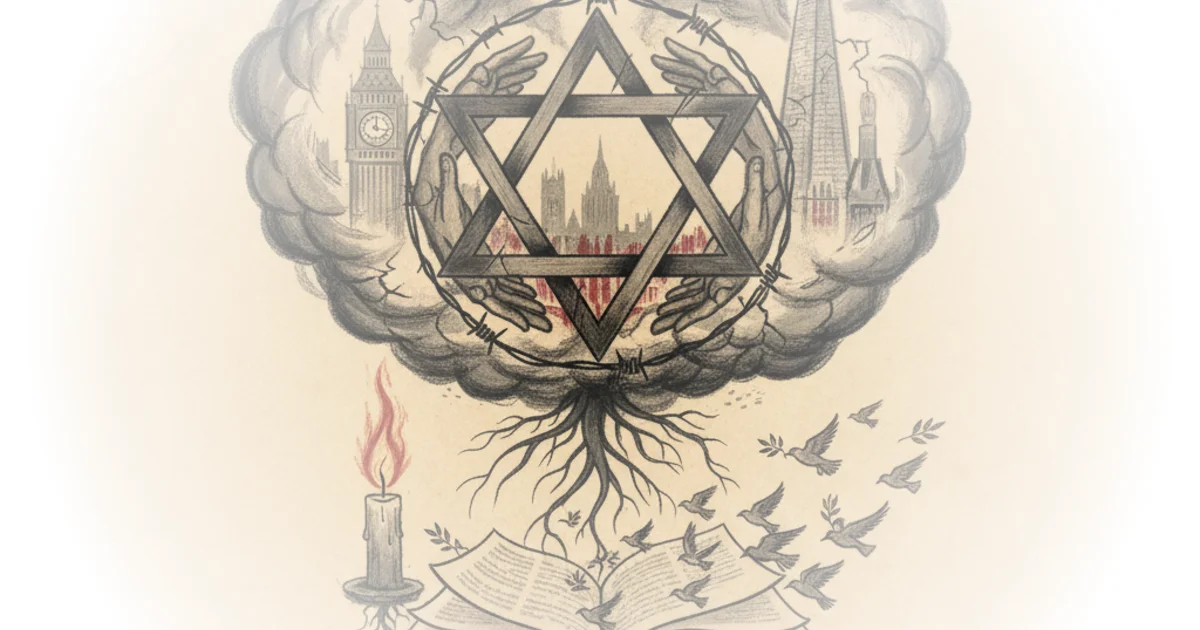
This framing of resilience is powerful, but Macleod is careful not to mistake it for safety. He notes that while children play and scooters tumble, the backdrop includes sniffer dogs at schools and CST (Community Security Trust) wardens stationed every 30 feet. The author captures the psychological toll on parents like Aby, a lawyer who now works from home to stay close to her children. "Nothing says 'Welcome to primary school' like a muzzled security dog," she tells Macleod. This detail is devastating in its simplicity; it highlights how the infrastructure of daily life has been militarized for a specific demographic.
"If you are as old as I am, you remember that the last 50 years will be written up as a golden age of British Jewry. And now it's business as usual."
The piece wisely avoids reducing the attack to a single geopolitical flashpoint. Cohen draws a sharp distinction between political dissent and targeted violence, noting that while people may hate political figures, they do not firebomb fast-food chains or stab commuters. "It's just about Jews," he argues. Macleod uses this to underscore that the violence is an assault on identity, not just a reaction to foreign policy. Critics might note that this distinction can sometimes be hard to maintain in a polarized climate where local tensions are easily inflamed by global conflicts, but the residents' insistence on their British identity remains the piece's moral center.
The Politics of Distraction
While the community grapples with physical safety, Macleod turns his lens to the political machinery of the local elections, revealing a system that often obscures local accountability. He points out a peculiar loophole in campaign spending rules: while candidates are capped at £960, national parties can flood letterboxes with mailers promoting national leaders like Nigel Farage without hitting those limits. "Parties end up fighting ultra-local elections on national issues — whether that's Gaza, the economy, or immigration," Macleod explains.
This observation connects the local violence to the broader political temperature. The article details how Green Party leader Zack Polanski faced intense backlash for a hasty tweet regarding police conduct during the arrest of the suspect. Polanski apologized, acknowledging a "responsibility for lowering the temperature," yet the party defended him by noting he faces "daily antisemitism." Macleod frames this not as a personality clash, but as a symptom of a media environment where "elements of the media and rival politicians were irresponsibly directing criticism" during a crisis.
The coverage also touches on the housing crisis, noting that the ban on "no-fault" evictions has finally arrived, seven years after its initial proposal. However, the author notes a tragic irony: landlords, anticipating the ban, rushed to issue evictions in the final hours, meaning "plenty of Londoners will still be leaving properties over the next few months." This adds a layer of bureaucratic cruelty to the narrative, showing how policy lag often punishes the vulnerable.
Symbols of a Changing City
Macleod weaves in the physical transformation of London's creative spaces to mirror the shifting social landscape. The iconic Village Underground, once a symbol of Shoreditch's artistic renaissance using old Jubilee line carriages, is now seeing those carriages removed. "Twenty years of rain and wind haven't been kind to the carriages," the author notes, but the departure of these symbols feels like the end of an era for the "aspiring creatives" who relied on them.
This section serves as a subtle counterpoint to the violence in Golders Green. While one community fortifies itself against external threats, another watches its cultural landmarks erode due to neglect and cost. The author's choice to juxtapose the removal of the tube carriages with the rise of security dogs at schools creates a portrait of a city under strain, where both the physical and social fabrics are being tested.
Bottom Line
Macleod's strongest achievement is his refusal to let the Golders Green attack become a distant headline; he forces the reader to sit with the residents who are trying to live normal lives while their schools are guarded by sniffer dogs. The piece's vulnerability lies in its reliance on the community's own stoicism, which, while inspiring, risks underplaying the long-term trauma of living in a perpetual state of high alert. The reader should watch for how the upcoming elections will address these security concerns, or if, as the author suggests, national issues will continue to drown out the specific needs of local neighborhoods.