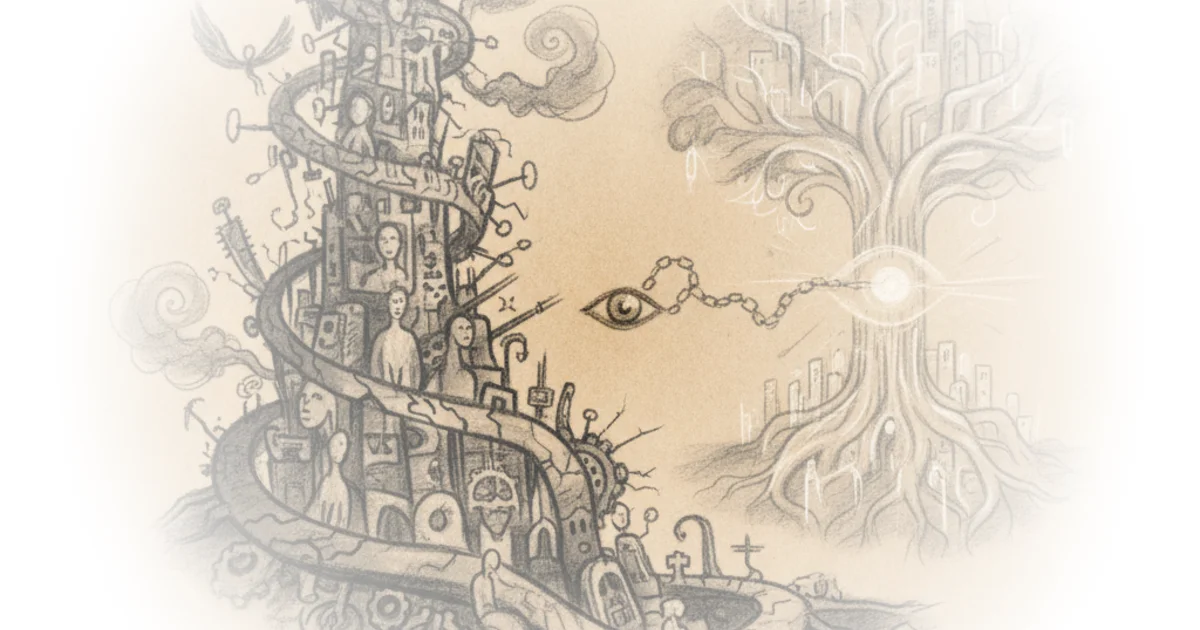
In a cultural moment where artificial intelligence is often framed as an inevitable march toward efficiency, Wayfare offers a jarring counter-narrative: that our rush to adopt these tools may be a modern reenactment of the Tower of Babel. The piece argues that true agency requires not just the power to act, but the wisdom to know when to wait, surrender, and align with natural limits rather than dominate them.
The Illusion of Unchecked Agency
The article opens by invoking Pope Leo's encyclical on artificial intelligence, which presents a stark choice between two futures. "Humanity, created by God in all its grandeur," the text notes, quoting the pontiff, "is today facing a pivotal choice: either to construct a new Tower of Babel or to build the city in which God and humanity dwell together." Wayfare uses this theological framework to critique the prevailing tech ethos on Utah's Wasatch Front, specifically targeting the philosophy of Jon Cheney, founder of the General AI Proficiency Institute. Cheney defines agency as "the choice to act rather than be acted upon," a mantra he believes is essential for avoiding obsolescence in an automated world.
The piece acknowledges the appeal of this message. It resonates with those who fear being left behind or becoming passive consumers of algorithms. However, Wayfare challenges the underlying assumption that action is inherently superior to patience. The argument suggests that Cheney's definition ignores a crucial dimension of agency: "a willingness to surrender to that which is beyond our control." This critique gains weight when applied to local history. The editors draw a parallel between modern tech expansion and the early settlement of Utah, noting how Latter-day Saint settlers "seized control" of Utah Lake and immediately began overfishing it.
"The drive to 'act rather than be acted upon' (again, defined strictly as the active form of agency) caused tremendous harm to my local environment."
This historical lens is vital. Just as early colonizers introduced invasive carp to "fix" a perceived problem and ended up decimating an ecosystem for decades, the current push for rapid AI adoption may be solving short-term efficiency problems while creating long-term existential risks. The piece argues that wisdom involves "the art of sailing rather than the art of rowing," suggesting that aligning with environmental realities is more sustainable than forcing them to bend to human will.
The Hidden Costs of "Progress"
Wayfare shifts from ecological concerns to the human toll of training these systems. The coverage highlights the story of Mophat Okinyi, a Kenyan content moderator paid pennies an hour to filter horrific digital content for AI models. His experience illustrates that the "intelligence" we are building is often purchased with the mental health and dignity of invisible workers. Wayfare reports that after exposure to thousands of disturbing passages, Okinyi's wife left him, noting, "You've changed... I don't understand you anymore." This anecdote serves as a grim reminder that the convenience of AI comes at a steep moral price.
The article also tackles the economic and intellectual implications. It critiques the business model where tech giants train models on copyrighted work without consent, then sell access back to creators. As one commenter quoted in the piece observes, "They stole the internet's knowledge and all the work that went into it and they want to sell it back to us for a fee." Furthermore, the text warns of the cognitive atrophy resulting from over-reliance on large language models (LLMs). Citing an MIT study, Wayfare notes that users who offloaded writing tasks "consistently underperformed at neural, linguistic, and behavioral levels."
Critics might argue that dismissing AI as a threat to human cognition ignores its potential in fields like medicine, where the piece admits models are helping pinpoint early-onset cancer. However, the editors maintain that even beneficial applications cannot justify the systemic lack of wisdom guiding their deployment.
"Without wisdom, what we call 'progress' is, in reality, its opposite—an abandoned tower to nowhere."
The commentary draws a chilling parallel between Utah's water crisis and Lake Urmia in Iran, which has nearly dried up due to mismanaged resources. The fear is that the race for data centers—"water-sucking, electricity-sapping, heat-generating" facilities—is repeating this pattern on a global scale. The piece asks a haunting question: "What if the primary problem we're facing is that 'those who choose to act' aren't as introspective, generous, or wise as they should be?"
Bottom Line
Wayfare's most powerful contribution is its reframing of agency not as relentless action, but as the disciplined capacity for restraint and alignment with natural limits. While the piece occasionally leans heavily on specific religious and local contexts that may feel niche to a broader audience, its core warning—that technological acceleration without ethical wisdom leads to collapse—is universally urgent. The biggest vulnerability lies in offering no clear roadmap for how societies can collectively choose "wisdom" over "progress," leaving readers with a profound diagnosis but limited prescription.