Rick Rubin, the legendary music producer known for his work with everyone from Johnny Cash to Run-D.M.C., turns his attention inward in a raw, unpolished conversation about mortality, metaphysics, and the stories we tell to survive. Rather than offering a polished memoir, Rubin presents a skeptical yet deeply curious exploration of past-life regression, arguing that the value of the experience lies not in its factual truth, but in its utility as a narrative tool for processing grief and identity. For the busy professional seeking a fresh perspective on aging and loss, this piece offers a rare glimpse into how a master storyteller deconstructs his own psyche without the safety net of dogma.
The Architecture of a Soft Landing
Rubin opens by framing his interest in past lives not as a spiritual awakening, but as a structural inquiry into how stories end. He recounts being pushed by his friend, the actress Shirley MacLaine, to visit a facility in Galisteo, New Mexico, where he underwent a five-day regression therapy. The setting was far from serene; Rubin describes a "janky sci-fi movie" aesthetic with shock-white-haired guides and a sweat lodge that felt like being "cooked in a tangerine." Yet, it was in this chaotic, overheated environment that he found a profound clarity about the nature of death.
"You're always trying to figure out what is the satisfying ending for your story like what is the conclusion and you think about life as this journey to death."
This observation is the anchor of Rubin's argument. He suggests that the anxiety surrounding aging and death stems from a lack of a coherent narrative arc. As he notes, modern society often views the physical decline of aging—the loss of hearing, the loss of bodily control—as purely humiliating. Rubin, however, reframes this decay as a necessary part of the "soft landing" he desires for himself and his loved ones. He argues that we must get used to the idea of losing someone slowly, rather than running from the bad feelings that inevitably surface.
"You can run from those bad feelings, but they they they'll find you."
The strength of this section lies in Rubin's refusal to romanticize the process. He admits to being skeptical, describing the experience as a mix of "brain rot" and genuine catharsis. He acknowledges that while he doesn't necessarily believe in the literal mechanics of past lives, the idea is powerful. It allows him to view his current self not as a fixed entity, but as one of many forms in a "protean creation." This perspective, he argues, helps dissolve the fear of death by suggesting that the self is fluid and that we have inhabited other forms before.
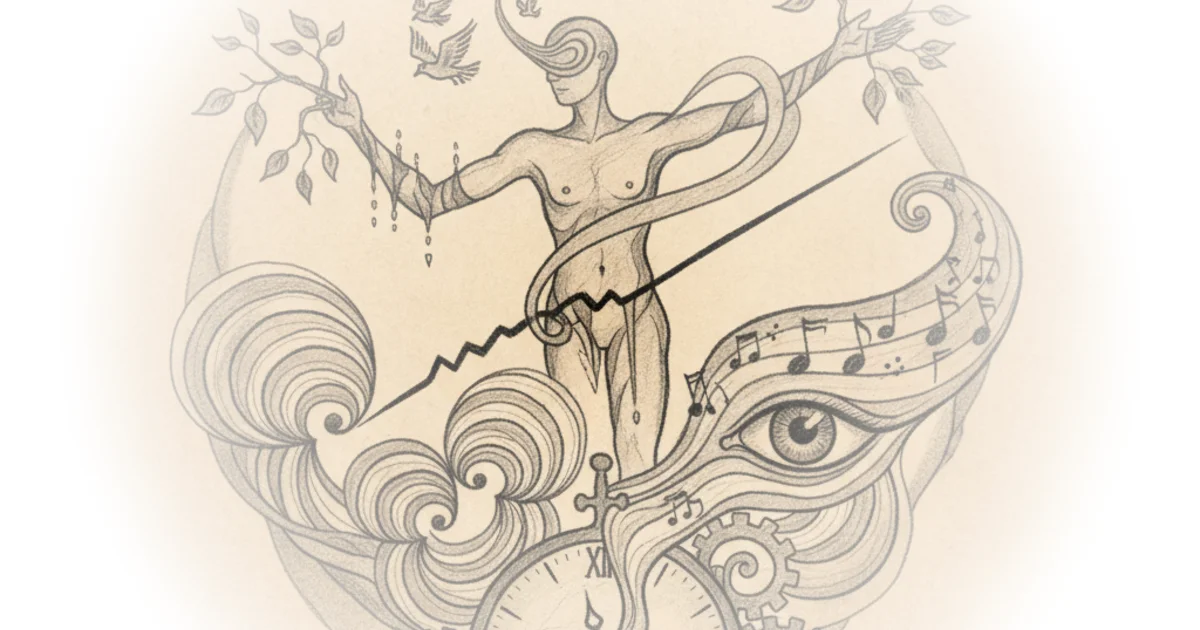
Critics might note that Rubin's reliance on a "fundamentalist" guide like MacLaine, whom he describes as having a rigid belief system, creates a tension with his own skeptical stance. He admits to feeling awkward during the sessions, comparing the second day to a bad second date, yet he returns to the philosophy because it works as a metaphor. This tension between belief and utility is where the piece finds its most honest ground.
The Universalizing Power of Art
The conversation shifts from the metaphysical to the aesthetic as Rubin discusses how art serves a similar function to his regression therapy: it allows us to transcend our specific selves. He draws a parallel between the emotional resonance of a Ken Burns documentary about the American Revolution and the feeling of "vibing into" a past life. In both cases, the boundary between the observer and the subject dissolves.
"I am just like I am there like I am also and like this sense of like the universality of experience and that you can transcend time, you can transcend the self."
Rubin's background as a storyteller is evident here. He explains that whether he is watching a film or listening to a play, he is looking for that moment of connection where the specific details of another person's life become his own. He recalls his childhood, where he would reenact disaster movies like The Poseidon Adventure in his backyard or obsessively listen to the cast recording of Who's Afraid of Virginia Woolf?. For Rubin, these weren't just pastimes; they were early lessons in how words and sound could transport a listener.
"It's like an incantation or like you're like it's like yeah there's something about putting words together."
This section reveals the origin of his artistic philosophy. Raised in a religious household where his father analyzed films through a theological lens, Rubin learned early on that stories are vehicles for ethics and values. He also credits his second-grade teacher, the mother of playwright Sam Shepard, with sparking his interest in the written word. He describes a childhood fascination with the physical shape of words, counting letters and treating language as a musical score.
"Some people are really into music or like math. You have numbers."
Rubin's admission that he no longer watches much film as an adult is a striking counterpoint to his childhood consumption. He describes the experience of watching movies now as often "claustrophobic," feeling trapped inside other people's narratives. He prefers the act of creating, suggesting that the passive consumption of art has lost its utility for him. This is a bold stance for a man whose career was built on curating and producing the work of others, but it underscores his belief that the creative act is the only way to truly engage with the "universality of experience."
"I just don't want to give it more time than I want to cuz it's just there's so much [ __ ]"
This blunt dismissal of passive consumption highlights a shift in his priorities. While he acknowledges that he once watched films to "learn and steal," he now views time as a finite resource that should be spent on creation rather than observation. This perspective challenges the common assumption that the best way to understand art is to consume more of it. Instead, Rubin suggests that deep, active engagement with one's own creative process is the only path to the kind of transcendence he seeks.
Bottom Line
Rick Rubin's most compelling argument is that the truth of a story matters less than its ability to provide a "satisfying ending" to the chaos of life. By treating past-life regression as a narrative device rather than a literal fact, he offers a pragmatic approach to grief and aging that resonates with anyone struggling to make sense of loss. The piece's greatest vulnerability is its reliance on the subjective, unverified nature of these experiences, yet Rubin's self-aware skepticism prevents it from veering into mysticism. For the reader, the takeaway is clear: whether through art, memory, or metaphor, we are all constantly rewriting our stories to find a soft landing.