In an era where film lists often devolve into algorithmic popularity contests or nostalgic name-dropping, Tom van der Linden offers a radical alternative: a curated journey not through rankings, but through the architecture of human meaning. He rejects the arbitrary hierarchy of "best" in favor of a taxonomy designed to mirror the specific ways cinema intervenes in our lives, arguing that the true power of film lies not in its technical perfection, but in its capacity to "enlarge us" and "civilize us." This is not a guide for casual viewing; it is a philosophical map for the busy mind seeking to reconnect with the fundamental questions of existence.
The Architecture of Meaning
Van der Linden's central thesis challenges the conventional wisdom of the "greatest hits" list. He posits that movies are transformative agents, capable of altering our worldview and beliefs. "The great movies enlarge us they civilize us they make us more decent people," he writes, channeling the spirit of Roger Ebert to set a high bar for the collection. Instead of a linear countdown from fifty to one, which he rightly identifies as "arbitrary," he organizes fifty life-changing films into ten thematic categories. This structural choice is the piece's most distinctive feature, forcing the reader to engage with the function of a film rather than its prestige.
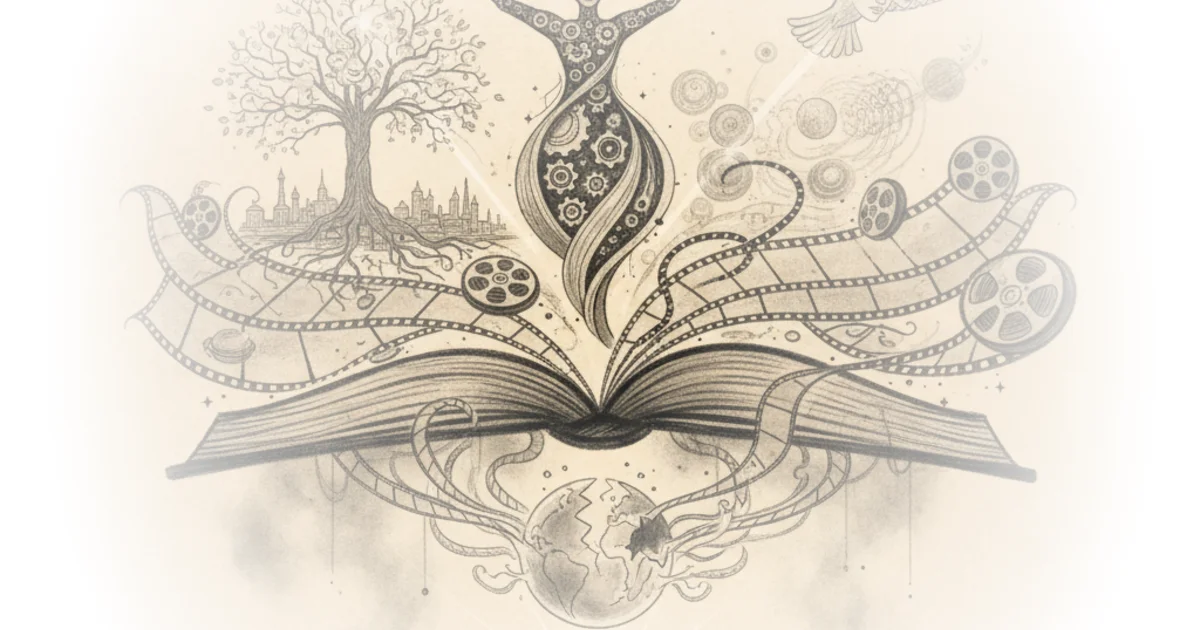
The author admits that this approach will yield "surprising additions and exclusions," a necessary trade-off for a list that aims to be "unique" and "specific." By grouping films by the area of life they impact, van der Linden shifts the focus from critical consensus to personal resonance. This reframing is effective because it acknowledges that a film's value is often subjective and situational, depending on where the viewer is in their own life journey.
Confronting the Cosmic and the Mortal
The first category tackles the most daunting questions: our origins and our inevitable end. Van der Linden selects Ingmar Bergman's The Seventh Seal not merely as a historical drama, but as a "captivating absurdity" that captures the "pain stemming from that in a void that deep Yearning For answers we know will never receive." He describes the film's protagonist, a knight playing chess with Death, as a figure grappling with the silence of God in a world ravaged by plague. The commentary here is sharp; van der Linden notes that while the setting is medieval, the "impossible problem of our mortality" is a "slightly heightened portrait" of the modern condition.
He then pivots to Stanley Kubrick's 2001: A Space Odyssey, describing it as a "seminal Cinema experience" that frames humanity against the "Grandeur of the universe." The author argues that the film's true genius lies in its "quietly profound suggestion" that humanity is not the end of evolution, but merely a "link in a chain that is still developing." He highlights the film's exploration of technology through the character of HAL 9000, asking whether our future depends on our "transgression of that boundary" between creator and creation or on our "continued humbleness in the face of cosmic Powers."
The movie of course doesn't give us any real answers it barely articulates these questions as explicitly as I'm formulating them here and I guess that's the real and Lasting beauty of 2001 Space Odyssey its cinematic journey is a mostly poetic one.
Critics might argue that such an abstract approach to film criticism risks alienating readers looking for practical recommendations or plot summaries. However, van der Linden's defense is implicit: the goal is not to inform, but to provoke. By refusing to provide easy answers, he mirrors the films themselves, which demand active engagement rather than passive consumption.
The Mirror of the Artificial and the Internal
Moving from the cosmic to the synthetic, the commentary on Ridley Scott's Blade Runner serves as a pivot point for examining the nature of humanity itself. Van der Linden suggests that science fiction's greatest utility is its ability to "lift us outside of ourselves" and pose fundamental questions as if they were brand new. He notes that the film forces the audience to confront the "ethical implications" of creating beings that "dream fear and desire."
The author's analysis of the replicants is particularly insightful. He argues that the film transforms the question "do replicants have a soul" into the more unsettling inquiry: "what does it mean to have a soul anyways?" As the boundaries between human and machine blur, the veteran Blade Runner, Deckard, is left questioning his own nature. Van der Linden writes, "it's hard not to wonder if there is some truth about ourselves to be found out there or if the essence of our being is ultimately but a product of and limited to the eye of the beholder."
This line of reasoning is extended to Terrence Malick's The Tree of Life, which the author describes as a "direct dialogue with the cosmos." Van der Linden captures the film's emotional core by noting how it frames an intimate family tragedy against the "birth of the universe to the End of Time." He observes that Malick presents these questions not as "scholarly luxuries" but as "deeply urgent and transformative matters." The commentary emphasizes the film's refusal to offer "shortcuts to give ourselves definitive resolution," instead offering a perspective that invites us to "shake ourselves out of the apathy of our everyday existence."
The Beauty of the Unresolved
Throughout the piece, van der Linden consistently champions films that resist closure. Whether it is the "hauntingly beautiful images" of The Turin Horse or the open-ended nature of Blade Runner, the author values the ambiguity that forces the viewer to continue the work of meaning-making after the credits roll. He argues that these films do not just entertain; they "profoundly impacted my world view" by challenging the viewer to "reckon with both" the beauty and the horror of existence.
What are we to you a woman asks while simultaneously posing the fundamental question at the heart of our being the fundamental question from which all others flow why do we exist why do we suffer how do we navigate this world that seems torn between conflicting Cosmic forces.
A counterargument worth considering is that such a heavy reliance on existential dread and cosmic scale might overlook the transformative power of lighter, more grounded narratives. Not every life-changing moment requires a confrontation with death or the infinite. Yet, van der Linden's curation suggests that for the specific purpose of this list, the weight of the "big questions" is the necessary lens through which to view the medium's highest potential.
Bottom Line
Tom van der Linden's list succeeds because it prioritizes the effect of cinema over its status, offering a framework that encourages deep reflection rather than simple consumption. While the exclusion of more accessible or genre-diverse films may limit its appeal to casual viewers, the argument that great art must challenge our understanding of existence is compelling and rigorously supported. For the busy professional seeking to reclaim a sense of wonder in a cynical world, this commentary provides a vital reminder that the screen can be a portal to the profound, not just a distraction from the mundane.