Jeffrey Kaplan transforms an ancient Greek courtroom drama into a razor-sharp probe of modern moral intuition, arguing that the foundation of ethics cannot simply be "divine approval." In a landscape often cluttered with theological certainty, Kaplan's analysis of Plato's Euthyphro forces a uncomfortable question: if goodness depends on God's love, is morality just a divine whim? This piece matters now because it dismantles the lazy assumption that "right" and "wrong" are merely commands from above, offering instead a rigorous logical trap that even the most devout must navigate.
The Trap of Divine Command
Kaplan begins by setting the scene with characteristic wit, introducing Euthyphro not as a sage, but as a self-aggrandizing figure. "The best of Euthyphro and that which distinguishes him Socrates from other men is his exact knowledge of all such matters," Kaplan writes, immediately undercutting the character's confidence with the label "what a douche." This framing is crucial; it signals that the dialogue is not a reverent sermon but a collision between arrogance and inquiry. Kaplan explains that Euthyphro is prosecuting his own father for murder, a shocking act in ancient Greece, to illustrate Euthyphro's claim to moral clarity.
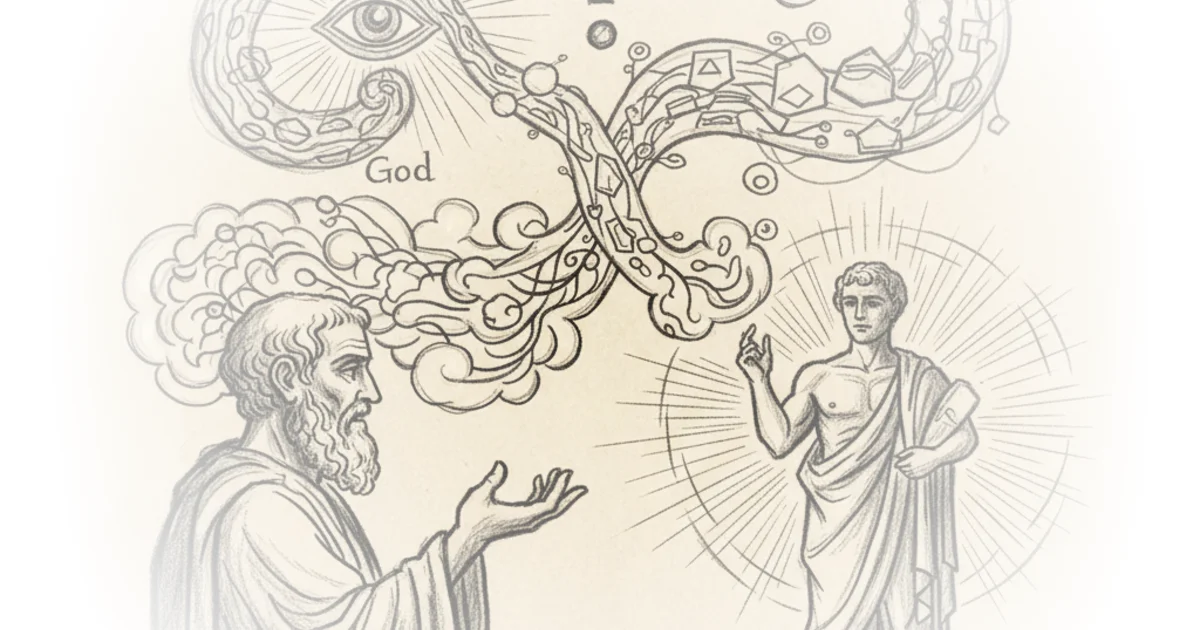
The core of the piece is the Socratic method applied to the definition of piety. Kaplan notes that Euthyphro initially fails to define virtue, offering only examples like "Zeus also killed his own father Cronos." Kaplan rightly identifies this as a category error, comparing it to a child listing skyscrapers when asked what a building is. "We want to know about the nature of building hood itself or in this case we want to know about the nature of virtue itself," Kaplan explains. This distinction is the piece's intellectual engine. It shifts the reader from looking for specific rules to seeking the underlying logic of morality.
"Virtue is that which the gods love or like or love."
This is the pivot point. Kaplan traces how Euthyphro eventually settles on the definition that piety is simply what the gods love. Kaplan then introduces the famous dilemma, reframing it not as a theological crisis but as a question of explanatory priority. He uses a brilliant, accessible analogy involving a sentence and grass. "Is the English sentence grass is green true because grass is green or is grass green because the English sentence grass is green is true?" Kaplan asks. The answer, he argues, is obvious: the grass's color makes the sentence true, not the other way around.
The Logical Dead End
Applying this logic to morality, Kaplan dissects the two horns of the dilemma. If the gods love something because it is good, then goodness exists independently of the gods. If the gods make something good simply by loving it, then morality is arbitrary. Kaplan highlights Socrates' frustration when Euthyphro tries to dodge the issue. "You appear to me Euthyphro when I asked you what is the essence of holiness to offer an attribute only and not the essence," Kaplan quotes, emphasizing that Euthyphro is describing a symptom, not the cause.
The analysis becomes particularly sharp when Kaplan points out the circularity of the "divine love" argument. "If the acts are virtuous independently of whether or not the gods love them and the gods choose to love them because they as it were recognize that virtue... then mentioning the fact that the gods love the virtuous acts doesn't explain their virtuousness," Kaplan writes. This is the piece's strongest moment. It exposes that if morality is just what God loves, then God could love murder and it would become good. If, however, God loves murder only because it is already bad, then there is a standard of goodness higher than God.
Critics might argue that this binary ignores the possibility that God's nature is the standard of goodness, rather than God's arbitrary commands or an external law. Kaplan acknowledges the complexity but maintains that the dialogue forces a choice between two unsatisfying options for the divine command theorist. He notes that even if we switch from Greek polytheism to monotheism, the logical structure remains intact.
The Unresolved Question
Kaplan concludes by leaving the reader with the lingering confusion of Euthyphro, who admits, "I don't know what to say man it seems like every time we talk we just go round and round in circles." This admission is not a failure of the dialogue but its success. Kaplan argues that the value lies in the dismantling of easy answers. "There's something else then that explains why the virtuous acts are virtuous and that's what we want to to know about the whole time," Kaplan asserts. The piece effectively argues that we cannot outsource our moral reasoning to a deity without first understanding the nature of the morality we are outsourcing.
"If the virtuousness explains the gods love then there's got to be something earlier that explains the virtuousness and that's what we want to know about."
Bottom Line
Kaplan's commentary succeeds by stripping away the mystique of ancient philosophy to reveal a timeless logical problem that still haunts ethical debates today. The strongest element is the "grass is green" analogy, which makes a complex metaphysical argument instantly graspable for a busy reader. However, the piece's biggest vulnerability is its brief treatment of the "God is the Good" counter-argument, which many theologians consider a third way that resolves the dilemma. Readers should watch for how this logical tension plays out in modern policy debates where moral authority is often claimed by those who refuse to define the source of their authority.