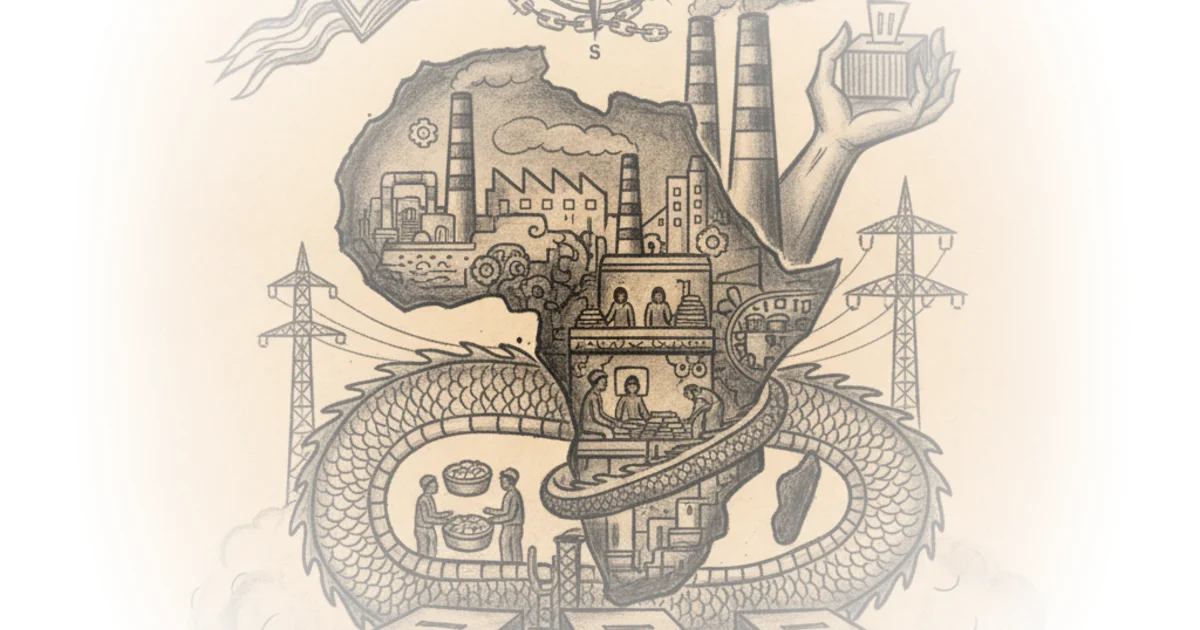
Sam Denby reframes the global power shift not as a geopolitical drama, but as a quiet, economic inevitability where Africa is rapidly becoming the new engine for Chinese growth. The piece's most striking claim is that the West is ignoring a continent that is now the primary source of labor and resources for the world's next manufacturing hub, effectively turning Africa into "China's China." This is not a story about aid; it is a story about a calculated, profitable migration of industry that has already reshaped voting patterns at the United Nations.
The Shift in the Voting Booth
Denby anchors the argument in a stark comparison of two United Nations General Assembly votes separated by 36 years. He highlights how the geopolitical alignment of African nations has flipped from the US sphere to the Chinese one. "Among the 35 countries that voted against the people's republic [in 1971] were much of africa," Denby notes, listing nations like South Africa and Liberia. "But in this vote [2007]... only burundi equatorial guinea eritrea ghana kenya lesotho liberia madagascar malawi mauritania and tanzania voted against china."
This data point is the piece's strongest evidence. It suggests that the change is not merely rhetorical but material. Denby argues that "africa no longer bows to the us" because the economic incentives have fundamentally shifted. The author effectively uses the UN floor as a barometer for real-world influence, showing that political alliances are now dictated by infrastructure investment rather than Cold War ideology.
Critics might note that attributing this shift solely to Chinese benevolence overlooks the agency of African leaders who may simply be leveraging competing superpowers for their own national interests. However, Denby's focus remains on the transactional nature of these new alliances.
"China is getting a lot of influence for in the grand scheme of things not a lot of money."
The Mechanics of Influence
The commentary then dissects the mechanism of this influence: massive infrastructure projects financed by state-controlled loans. Denby details the construction of a "$3.2 billion railway in kenya" and a "$526 million dam in guinea," projects that traditional Western banks deemed too risky. He explains that the Chinese Export-Import Bank operates differently, offering low-interest loans that function as a form of foreign aid because the bank "doesn't care" about the high risk of default, assuming political cooperation.
This framing is crucial. Denby posits that these loans are not acts of charity but strategic investments. "For each of them there's a political goal behind it," he writes. The logic is clear: as China's domestic growth slows and labor costs rise, it needs new markets and resources. "Africa meanwhile is one of the least developed areas of the world and a lack of development actually makes fast growth easy."
The author draws a direct line between financial leverage and political compliance. "It's been found that if an african country recognizes taiwan as a country they receive on average 2.7 fewer chinese infrastructure projects within their borders each year." Conversely, voting with China yields more projects. This empirical link challenges the narrative that Chinese aid is "no strings attached." Denby argues that the strings are simply economic and political rather than ideological or human-rights based.
The Colonial Parallel and the Private Sector
Denby does not shy away from the uncomfortable historical parallel. "The motives behind european powers expanding their territory to less developed nations in the 15th through 20th centuries were remarkably similar to the motivations between china's growing economic influence in the developing world today." He acknowledges that the structure of power—using resources and labor from a less developed region to fuel the metropole—echoes colonialism.
However, the piece introduces a vital nuance that distinguishes this era from the past: the role of the private sector. Denby points out that the Chinese government's direct financial footprint is smaller than often assumed. "In 2015 china loaned just 12 billion dollars to african countries... the country invested a mere three billion dollars into the continent." The real driver, he argues, is private industry. "Private chinese industry is taking hold of the estimated 10 000 chinese businesses in africa... 90 of them are privately owned."
This is a sophisticated argument. It suggests that the phenomenon is now self-sustaining. "Chinese companies in africa are actually making money some substantially so," Denby writes. The government provided the initial push, but now "economic forces are pushing the initiative further forward." This shifts the narrative from a state-led conspiracy to a market-driven reality that the West is ill-equipped to counter because it is profitable.
"China is a victim of its own success... the economic development that its manufacturing industry brought pushed a large segment of its population into the middle class which raised labor costs countrywide."
Bottom Line
Denby's strongest move is reframing the China-Africa relationship as a natural economic migration driven by China's own success, rather than a purely political maneuver. The argument's vulnerability lies in its optimism about the sustainability of this model; it assumes African economies can absorb this influx of labor and capital without significant social friction or debt crises that could derail the partnership. The reader should watch for whether the private sector can maintain these margins as African nations begin to demand more favorable terms, or if the "no strings attached" loans eventually become a lever for deeper political control that even private firms cannot ignore.