The answer lies in a century-old feud between two Russian mathematicians that almost nobody remembers.
In 1905, Russia was in turmoil. Socialist groups rose up against Tsar Nicholas II, demanding political reform or the ruler's resignation. The nation split into two camps: those who wanted to maintain the old order and those pushing for radical change. This division seeped into every corner of Russian society, even mathematics.
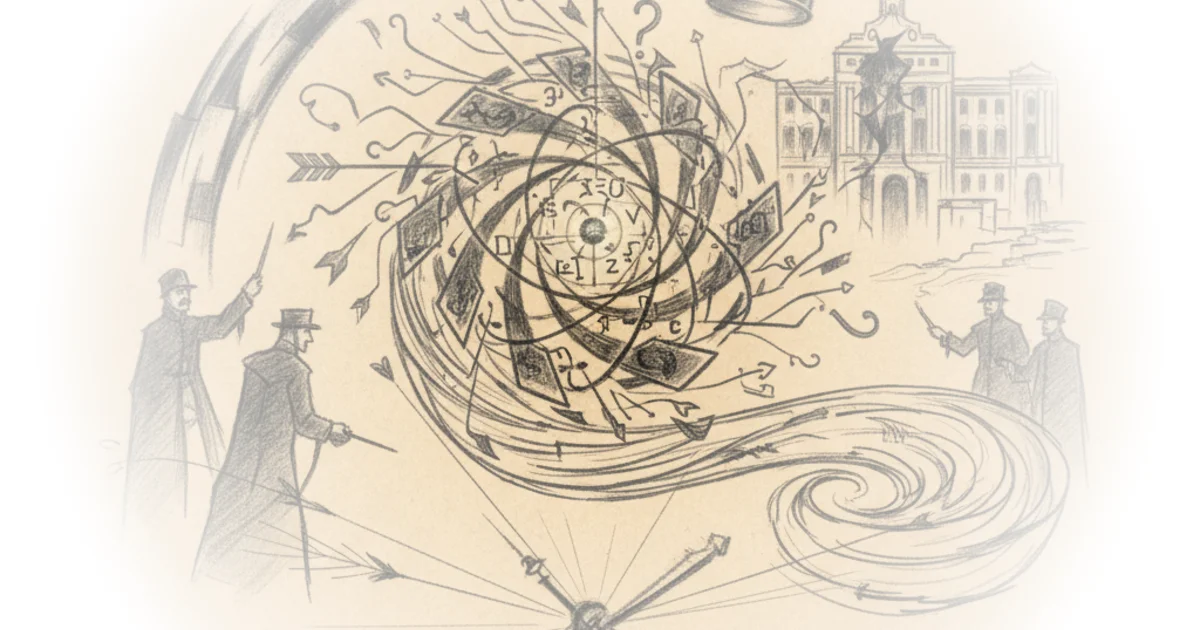
On one side stood a deeply religious man named Pavel Necrosov. He was considered the "Tsar of Probability" — an influential mathematician who argued that probability could prove the existence of free will. His position was simple: if you observe convergence in social statistics like marriage rates or crime rates, those underlying decisions must be independent. And independence meant free will.
His intellectual nemesis on the socialist side was Andrei Markov, known as "Andrei the Furious." An avowed atheist, Markov had no patience for what he considered mystical nonsense. He publicly criticized Necrosov's work, calling it an abuse of mathematics.
Their feud centered on a principle that probability theorists had relied on for two hundred years: the law of large numbers.
The Law of Large Numbers
The concept is intuitive. Flip a coin ten times and you might get six heads and four tails — not the 50/50 split you'd expect. But as you flip more coins, the ratio slowly settles toward the expected outcome. After one hundred flips, you're likely to see something like fifty-one heads and forty-nine tails.
This behavior — where the average outcome gets closer to the expected value as trials increase — is called the law of large numbers. First proven by Jacob Bernoulli in 1713, it became the foundation of probability theory. But there was a catch: it only worked for independent events. A fair coin flip has no influence on subsequent flips.
What if you asked people to shout out their guesses instead of submitting them privately? The first person might think an item is extraordinarily valuable and guess around $2,000. Everyone else hears that number and adjusts their own guesses upward. Now the average doesn't converge to the true value — it clusters around a higher amount.
For two hundred years, probability assumed you needed independence to observe this law. Markov wanted to challenge that assumption.
The Poetry Problem
Markov set out to prove that dependent events could also follow the law of large numbers. He found his example in text: whether your next letter is a vowel or consonant depends heavily on what the current letter is.
He turned to Eugene Onegin, a poem by Alexander Pushkin. Taking the first 20,000 letters and stripping away punctuation, he counted that forty-three percent were vowels and fifty-seven percent were consonants. Then he examined overlapping pairs of letters.
If letters were independent, vowel-vowel pairs should occur about eighteen percent of the time — the probability of a vowel multiplied by itself. But when Markov actually counted the pairs in the poem, vowel-vowel combinations appeared only six percent of the time: far less than if they were independent.
This proved the letters were dependent. Now he needed to show these dependent letters still followed the law of large numbers.
Markov built what amounts to a prediction machine. He created two circles — one representing vowels, one representing consonants — as states in a system. From any state, the next letter could be either vowel or consonant. Using the known frequencies (forty-three percent vowels, six percent vowel-vowel pairs), he calculated transition probabilities: roughly thirteen percent chance of moving from vowel to another vowel, eighty-seven percent chance of moving to a consonant.
When he simulated this system randomly, the ratio of vowels to consonants initially jumped around wildly but slowly converged to forty-three percent vowels and fifty-seven percent consonants — exactly matching what he'd counted by hand.
Markov had built a dependent system. Dependent events following the law of large numbers.
"Thus free will is not necessary to do probability. In fact, independence isn't even necessary."
This should have been revolutionary because almost everything in the real world depends on something else. Weather tomorrow depends on conditions today. How diseases spread depends on who's infected right now. Particle behavior depends on surrounding particles.
Yet Markov seemed indifferent to practical applications. He wrote: "I am concerned only with questions of pure analysis." Little did he know how his method would soon reshape one of the most important developments of the twentieth century.
The Morning After
On July 16, 1945, the United States detonated the world's first nuclear bomb — six kilograms of plutonium creating an explosion equivalent to nearly twenty-five thousand tons of TNT. This was the culmination of the Manhattan Project: a three-year effort involving J. Robert Oppenheimer, John Von Neumann, and a lesser-known mathematician named Stanislav Ulam.
Even after the war ended, Ulam continued studying how neutrons behave inside a nuclear bomb. A uranium-235 nucleus, when struck by a neutron, splits and releases energy along with two or three more neutrons. If those new neutrons go on to hit and split more than one other uranium-235 nucleus, you get a runaway chain reaction.
But uranium-235 was extraordinarily difficult to obtain. One of the key questions was simply: how much of it do you need?
In January 1946, everything stopped. Ulam was struck by encephalitis — an inflammation of the brain that nearly killed him. His recovery was long and slow, spending most of his time in bed.
To pass the time, he played solitaire. But as he played countless games, winning some and losing others, one question kept nagging at him: what are the chances that a randomly shuffled game of solitaire could be won?
The problem was deceivingly difficult. With fifty-two cards, each arrangement creates a unique game. The total number of possible games is fifty-two factorial — roughly ten to the power of sixty-seven. Solving this analytically was hopeless.
But Ulam had a flash of insight: what if he simply played hundreds of games and counted how many could be won? This would give him a statistical approximation without needing an exact calculation.
Back at Los Alamos, scientists grappled with far harder problems than solitaire — like figuring out how neutrons behave inside a nuclear core. In a nuclear core, there are trillions of neutrons interacting with their surroundings. Computing outcomes directly seemed impossible.
When Ulam returned to work, he had a sudden revelation: what if they could simulate these systems by generating lots of random outcomes?
He shared this idea with Von Neumann, who immediately recognized its power but also spotted a key problem. In solitaire, each game is independent — how cards are dealt in one game has no effect on the next. But neutrons aren't like that. A neutron's behavior depends on where it is and what it has done before.
Von Neumann realized they needed a Markov chain: a system where each step influences the next.
The Monte Carlo Method
The simplified version works like this. The starting state is simply a neutron traveling through the core. From there, three things can happen:
First, it can scatter off an atom and keep traveling — an arrow leading back to itself. Second, it can leave the system or get absorbed by non-fissile material, ending its participation in the chain reaction. Third, it can strike another uranium-235 atom, triggering a fission event and releasing two or three more neutrons that start their own chains.
The transition probabilities aren't fixed. They depend on the neutron's position, velocity, energy, and the overall configuration and mass of uranium. A fast-moving neutron might have thirty percent chance to scatter, fifty percent chance to be absorbed or leave, and twenty percent chance to cause fission. A slower moving neutron would have different probabilities.
Von Neumann and Ulam ran this chain on the world's first electronic computer, the ENIAC. The machine randomly generated a neutron's starting conditions and stepped through the chain, keeping track of how many neutrons were produced on average per run — known as the multiplication factor K.
After stepping through the full chain for a specified number of steps, they collected the average K value and recorded it in a histogram. They repeated this process hundreds of times, building a statistical distribution of possible outcomes.
If most cases showed K less than one, the reaction dies down. If it's equal to one, there's a self-sustaining chain reaction that doesn't grow. If K is larger than one, the reaction grows exponentially — and you've got a bomb.
Von Neumann and Ulam had found a way to figure out how many neutrons were produced without doing any exact calculations. They could approximate differential equations too hard to solve analytically.
All they needed was a name.
Ulam's uncle was a gambler, and the random sampling with high stakes reminded him of the Monte Carlo Casino in Monaco. The name stuck.
Bottom Line
The Markov chain — born from a mathematical feud that seemed like pure abstraction — became essential to modeling complex dependent systems we couldn't otherwise understand. It helped predict whether a nuclear reaction would sustain itself or fizzle out. It changed how scientists simulate everything from particle physics to weather patterns.
Markov's insight that independence isn't necessary for probability turned out to be one of the most practically important discoveries of the twentieth century. Sometimes the purest mathematics has the most surprising applications.