Brad DeLong and Patrick Wyman have joined forces to dismantle a comforting historical illusion: that the victims of the Shang Dynasty were merely battlefield casualties executed immediately. Instead, new isotopic evidence reveals a grimmer reality of years of forced labor followed by ritual slaughter, transforming our understanding of early Chinese statecraft from a proto-bureaucracy into a "sacred and sacrificing order" driven by lineage prestige.
The Industrial Scale of Suffering
The piece's most arresting revelation is the sheer magnitude of the violence, which DeLong describes as running on an "extraordinary self-reinforcing engine of war and sacrifice." DeLong highlights Wyman's finding that the term qiang was not an ethnicity but a status—a label applied to anyone the state marked for death, reducing human beings to "Sheep=people." This reframing is crucial; it shifts the narrative from a tribal conflict to a systemic mechanism of domination where the captives were stripped of identity before their deaths.
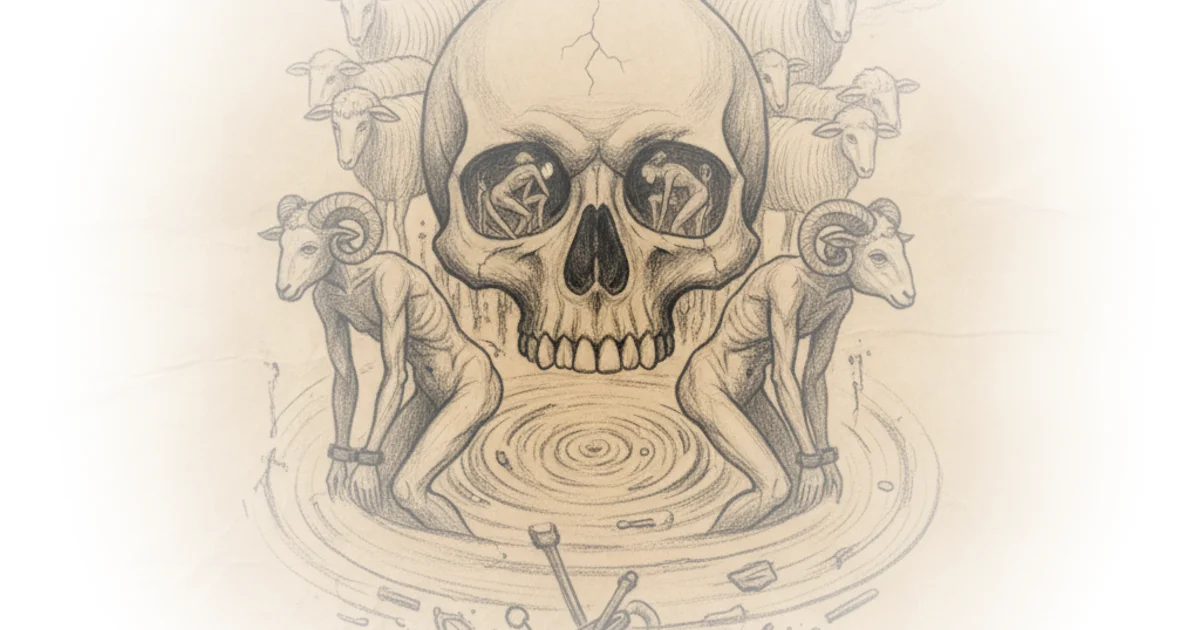
DeLong emphasizes that the Shang Dynasty did not invent ancestor worship or human sacrifice, but it undertook them at an "industrial scale." The evidence is staggering: isotopes in bones show victims endured years of labor before execution, and archaeological pits reveal mass graves containing hundreds of bodies. DeLong notes, "The largest concentration yet recorded involved 339 executions, all deposited in a single act of mass sacrifice." This data forces a confrontation with the reality that the capital city of Anyang, with a population potentially exceeding 100,000, was built and sustained by the systematic destruction of thousands of lives.
"The Shang deliberately and systematically destroyed their lives. The least we can do more than 3,000 years later is return them to the center of the story."
The narrative power of Wyman's work, as curated by DeLong, lies in its refusal to let these victims remain abstract numbers. By weaving in the story of Mei, a village leader captured while weeding fields, the commentary grounds the statistics in human experience. Mei's physical deterioration—"little left on Mei's bones but skin"—serves as a visceral counterpoint to the grandeur of the bronze foundries. Critics might argue that focusing on individual stories risks romanticizing the past, but in this context, it is a necessary corrective to the "mute testimonies of the archaeological record."
The Logic of the Sacrificial Economy
DeLong guides the reader through the terrifying logic that sustained this system. The Shang state was not a modern bureaucracy but a collection of competing lineages where "the scale of the human sacrifice your lineage could undertake was the principal way to gain lineage prestige via spectacle." This distinction is vital for understanding why the violence was so pervasive. It was not merely about resource extraction; it was a spiritual economy where the "currency that paid the spiritual tolls demanded by a baffling array of ancestral spirits" was human life.
The commentary draws a sharp contrast between the Shang and later imperial models. DeLong writes, "Not a proto-bureaucratic empire of the kind we are used to from the Middle East; rather, a sacred and sacrificing order of competing lineages commanding soldiers and slaves." This challenges the assumption that state formation inevitably leads to more efficient, less violent administration. In the Shang era, the "bizarre conglomeration of ancestral spirits" required a constant influx of blood to maintain cosmic order, a belief system that justified the "worst of the many bad societies-of-domination" of the agrarian age.
The inclusion of specific historical details, such as the sixteen individuals sacrificed in the tomb of the queen-general Fu Hao, adds depth without derailing the main argument. While Fu Hao was a powerful military leader, her burial also serves as a grim reminder of the human cost of elite status. The sheer volume of artifacts in her tomb—over 1,000 items—stands in stark contrast to the 16 lives extinguished to accompany her, a ratio that underscores the disparity between the value placed on objects versus people.
"The Shang state appears to have run on an extraordinary self-reinforcing engine of war and sacrifice: the army captured people at the periphery, they were then used as forced labor at the center, after which they were killed."
The Legacy of Domination
DeLong connects this historical analysis to broader theories of state failure and success, referencing Patricia Crone's argument about the incompetence of European elites. He suggests that the Shang's "society-of-domination" represents a path not taken by the modern world, one where the state's primary function was the extraction of life rather than the management of production. This perspective invites readers to consider how the structures of power we take for granted today might also rely on hidden forms of domination.
The piece concludes by stressing that the Shang's legacy is not just in the oracle bones or the bronze vessels, but in the template they set for centralized rule. DeLong notes that the 13th century BC marked the beginning of "an unbroken literacy and an ideal of centralized rule, both of which have endured through the years to the present." However, the human cost of this continuity is the piece's enduring question. The "industrial scale" of sacrifice in Anyang serves as a warning about the potential for state power to dehumanize populations when the spiritual and political interests of the elite are aligned against the living.
Bottom Line
This commentary effectively leverages DeLong's curation and Wyman's narrative to expose the brutal mechanics of the Shang Dynasty, moving beyond dry archaeology to a profound meditation on the human cost of state-building. Its greatest strength is the integration of isotopic science with human storytelling, forcing a reckoning with the reality that the foundations of Chinese civilization were laid on a mountain of bones. The argument's vulnerability lies in its reliance on fragmentary records, yet the sheer scale of the evidence presented leaves little room for doubt about the systematic nature of the violence.