This piece by Heather Cox Richardson does not merely report on a legal filing; it documents a potential constitutional rupture where the executive branch attempts to monetize political violence. The most startling claim is not just the creation of a $1.776 billion fund to settle claims from the January 6 insurrection, but the explicit argument that this fund serves to arm and embolden future attackers against the very officers who defended the Capitol. Richardson frames this not as a policy dispute, but as "the most brazen act of presidential corruption in American history," a charge backed by the specific testimony of those who nearly died stopping the mob.
The Anatomy of a "Slush Fund"
Richardson anchors her argument in the visceral reality of the lawsuit filed by officers Daniel Hodges and Harry Dunn. She writes, "In the most brazen act of presidential corruption this century, President Donald J. Trump has created a $1.776 billion taxpayer-funded slush fund to finance the insurrectionists and paramilitary groups that commit violence in his name." This is not hyperbole in her view; it is a legal assertion that the fund lacks statutory authority and violates the Constitution. The author meticulously details the physical toll of the attack to establish the moral weight of the officers' standing to sue. She recounts how Hodges was "hit from above with a heavy object, kicked in the chest, and driven to the ground," and nearly crushed between metal doors in a tunnel where rioters engaged in "almost medieval style of combat."
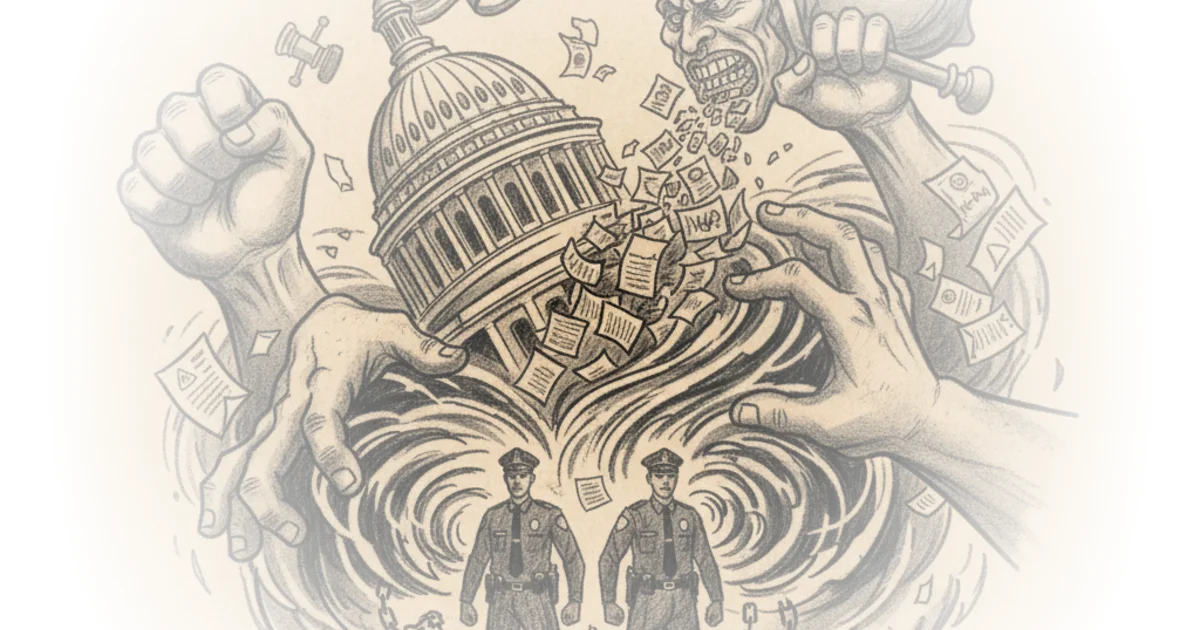
The core of Richardson's analysis is that this fund does more than pay a settlement; it fundamentally alters the incentive structure for political violence. She argues that the plan "will both compensate and empower the very people making those threats," effectively granting "legal imprimatur" to past acts of violence. This framing is powerful because it shifts the narrative from a financial settlement to a security threat. Critics might argue that settling lawsuits is a standard legal procedure to avoid prolonged litigation costs, but Richardson counters that the scale and the specific beneficiaries—those who tried to overthrow the government—make this unprecedented. She notes that the fund "will signal to past and potential future perpetrators of violence against Dunn and Hodges that they need not fear prosecution; to the contrary, they should expect to be rewarded."
The fund will signal to past and potential future perpetrators of violence that they need not fear prosecution; to the contrary, they should expect to be rewarded.
The piece draws a sharp parallel to the historical context of the Hodges v. United States case, reminding readers that the legal system has long grappled with the definition of insurrection and the limits of executive power to shield participants. By invoking the specific date of the attack and the "hand-to-hand combat" that ensued, Richardson forces the reader to confront the human cost of the administration's financial maneuvering. The argument is that the executive branch is using taxpayer money to indemnify those who attempted to stop the counting of electoral votes, a direct challenge to the peaceful transfer of power.
Institutional Erosion and the Purse Strings
Beyond the specific lawsuit, Richardson expands her critique to the broader erosion of institutional norms, particularly the "power of the purse." She highlights Representative Jamie Raskin's introduction of the "No Taxpayer-Funded Settlement Slush Funds Act of 2026," which aims to prohibit federal funds from paying off anyone claiming "weaponization" of the law. Richardson writes, "Congress must reassert the power of the purse and stop this brazen looting of taxpayer funds before this 'pilot program' for massive partisan corruption becomes the permanent operating system of our government." This connects the specific fund to a larger pattern of executive overreach, where the administration bypasses legislative approval to fund its political agenda.
The commentary also touches on the ethical rot within the Department of Justice, specifically regarding Acting Attorney General Todd Blanche. Senators Schiff, Durbin, and Blumenthal questioned whether Blanche was following ethics advice, a promise he made during confirmation. Richardson notes that lawyer George Conway posited that "Blanche never intended to carry out that promise." This suggests a systemic disregard for the rule of law, where legal counsel is ignored to serve the personal interests of the administration. The author points out that the administration's actions raise a chilling question: "what exactly they do intend." The implication is that the intent is self-enrichment and the consolidation of power, rather than the service of the American people.
The Political Fallout and the Demand for Loyalty
The piece pivots to the internal fractures within the Republican party, driven by the administration's demand for absolute loyalty over policy or principle. Richardson details how the administration is using primary challenges to purge dissenters, citing the defeat of Representative Thomas Massie and the endorsement of Ken Paxton over Senator John Cornyn. She writes, "Trump called Paxton 'a true MAGA Warrior' and complained that Cornyn 'was not supportive of me when times were tough.'" This dynamic is framed as a shift from a party of ideas to a vehicle for personal loyalty, where the platform is reduced to "I want absolute loyalty. I want to trade stocks, make hundreds of millions of dollars."
Richardson observes that even traditional Republicans are pushing back, with Senator Lindsey Graham stating, "This is the party of Donald Trump." The author highlights the absurdity of the administration's demands, such as replacing the Senate parliamentarian with a loyalist to bypass procedural rules. The administration's social media posts demand the "kill the Filibuster" to "give us everything," a move Richardson characterizes as a threat to the very existence of the opposition: "If we don't pass at least one of these two provisions quickly, you will never see another Republican President again." This ultimatum reveals a strategy that prioritizes short-term power grabs over long-term institutional stability.
This is the party of Donald Trump.
The author also weaves in the context of the Appropriations bill and the Oath of Office, noting that the administration's actions seem to violate the fundamental duty to "preserve, protect and defend the Constitution." The attempt to fund a ballroom with security measures via a reconciliation bill, and the subsequent demand to change the rules when blocked, illustrates a pattern of ignoring established norms. Richardson points out that the administration is "into building monuments to himself in the nation's capital," framing these projects as vanity endeavors funded by a system that no longer serves the public interest.
Bottom Line
Richardson's strongest argument is her ability to connect the specific legal mechanism of the "slush fund" to the broader existential threat of normalizing political violence. Her framing of the fund as a reward system for insurrectionists is a compelling and necessary intervention in the public discourse. However, the piece's vulnerability lies in its reliance on the assumption that institutional guardrails will hold against an administration that openly seeks to dismantle them. The reader should watch for how the courts rule on the standing of Hodges and Dunn, and whether the "power of the purse" can effectively check an executive branch that has already signaled its intent to ignore legislative constraints.