Brad DeLong does not merely critique a school of thought; he performs a psychological autopsy on its most famous practitioners, arguing that the obscurity of "Continental Philosophy" is not a feature of deep insight but a symptom of the authors' personal pathologies and institutional power games. By tracing a digital rabbit hole from abstract debates about gender to the messy, real-life marriage of Theodor Adorno and Gretel Karplus, DeLong suggests that the true key to understanding these texts lies not in the words themselves, but in the unexamined lives of the men who wrote them.
The Map is Not the Territory, But the Author Is
DeLong begins by recounting his own disillusionment with the field during a senior seminar on "Deconstruction" with Stanley Cavell. He recalls leaving the class convinced that the discipline had devolved into a social power game rather than a pursuit of truth. He describes the typical bad argument as a circular trap: "Viewpoint X is bad because it is a map. The map is not the territory. Therefore we reject viewpoint X. Here is my map: viewpoint Y. My map is good. FULL STOP."
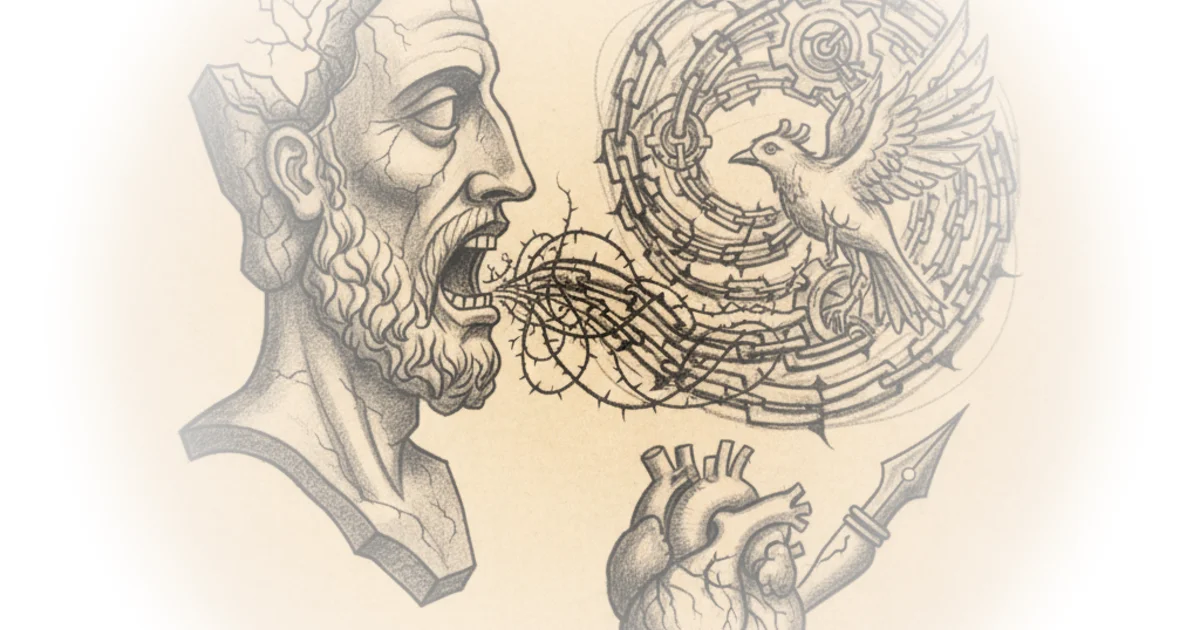
This framing is sharp and effective for a reader tired of academic jargon that obscures more than it reveals. DeLong posits that when philosophers refuse to offer evidence for their claims, they are relying on the prestige of their network rather than the strength of their logic. He cites Matthew Adelstein's critique of Judith Butler, noting how philosophers often assert "A is not B... but instead C" where C is a concept that makes no logical sense, yet is presented as a profound revelation. DeLong writes, "Adelstein is conflating a common rhetorical pattern... with a 'rule of inference,' and suggesting that continental philosophers, rather than he who have confused the two..."
Critics might argue that this dismissal ignores the specific rhetorical goals of problematizing established norms, a technique intended to disrupt comfortable assumptions rather than build linear arguments. However, DeLong's counter is that without a logical bridge, these assertions are merely "purposeful obfuscation" designed to keep the author from being pinned down.
The rhetorical moves of bad Continental Philosophy are best understood not as intellectual arguments but rather as deployments of social-network power and as products of human psychology.
The Personal is the Philosophical
The piece takes a dramatic turn when DeLong applies this skepticism to Theodor Adorno, specifically his scathing depiction of marriage in Minima Moralia. DeLong rejects the defense that Adorno is simply "problematizing" the institution. Instead, he reads Adorno's text as a declaration of personal bitterness. He quotes Adorno's claim that marriage is an "abject parody" where "two conspirators deflect outward responsibility for their respective ill-doing to the other while in reality existing together in a murky swamp."
DeLong finds this view unintelligible as a universal truth but highly intelligible as a reflection of Adorno's own life. He pivots to the historical record of Adorno's marriage to Gretel Karplus, a brilliant chemist who earned her doctorate at 23 and managed a factory with 200 employees. DeLong highlights the stark contrast between Adorno's text and the reality of their partnership, noting that Karplus was not a victim of a "murky swamp" but a powerful, independent woman who supported Adorno's career for decades. She translated his works, edited Dialectic of Enlightenment, and maintained financial independence even while navigating the strain of long-distance courtship and Adorno's infidelities.
DeLong argues that Adorno's description of marriage as an "enforced community of economic interests" that leads to "degradation" is a projection of his own "patriarchal misogynistic self-oblivious delusion." He points out that Adorno's mother and wife were both formidable figures who likely overshadowed his ego, leading to a resentment that he masked as high theory. DeLong writes, "The picture I get from this is of both Maria Calvelli-Adorno della Piana and Gretel Karplus as strong, powerful, confident, strongly feminist women for their day... It seems that Theodore Adorno, somehow, has a pearl of great price indeed."
This biographical turn is the article's most provocative move. It challenges the reader to consider whether the "continental" style of philosophy is a deliberate intellectual choice or a defense mechanism for men unable to process their own emotional realities. The reference to Walter Benjamin, who confided in Karplus about the emotional strain of her separation from Adorno, adds a layer of historical depth that grounds the philosophical critique in human suffering.
The Cost of Intellectual Ego
DeLong concludes that the only way to understand these texts is to look "very much outside the text at the psychological life-experiences and socio-cultural-institutional settings of the bad 'Continental Philosophers'." He draws a chilling parallel to Louis Althusser, whose descent into madness and murder of his wife followed his own theoretical critiques, suggesting a pattern where intellectual arrogance masks a crumbling psyche.
He asks a devastating question: "What happens when I take the black marks on the pages of the codexes of Minima Moralia... and then ask SubTuringAdorno why his map is to be preferred?" The answer, DeLong suggests, is silence or further obfuscation. The argument holds that when a philosopher's life contradicts their theory so blatantly, the theory loses its claim to truth.
Looking inside the texts of the bad 'Continental Philosophers' is the very worst place to seek for any valid insights.
A counterargument worth considering is that great art and theory often emerge from personal dysfunction, and that the validity of a philosophical claim should stand or fall on its own merits, regardless of the author's marriage. However, DeLong's point is not that dysfunction invalidates all thought, but that it often drives the specific, obscure, and unconvincing rhetorical styles that dominate the field.
Bottom Line
DeLong's most compelling contribution is the insistence that we stop treating these texts as oracles and start reading them as symptoms of their authors' lives. While his psychological diagnosis of Adorno may be reductive, his broader critique of an academic culture that rewards obscurity over clarity is a necessary intervention. The reader should watch for how this biographical lens might be applied to other figures in the canon, potentially reshaping our understanding of 20th-century thought.
The picture I get from this is of both Maria Calvelli-Adorno della Piana and Gretel Karplus as strong, powerful, confident, strongly feminist women for their day... and then going on to warn that callow men do not see this and so: forget [women's] true nature.