Jordan Schneider's latest deep dive with former Chicago Mayor and U.S. Ambassador to Japan, Rahm Emanuel, delivers a scathing indictment of the current administration's foreign policy, arguing that American unpredictability is actively validating Beijing's narrative of U.S. decline. While the conversation touches on domestic corruption, its most urgent contribution is the dismantling of the popular myth that allies are increasing defense spending out of admiration for American strength; instead, Emanuel posits they are buying insurance against an American exit. For a busy reader tracking the shifting tides of the Indo-Pacific, this distinction is critical: it suggests the U.S. is not leading a coalition but frantically trying to hold together a structure it is actively dismantling.
The Insurance Policy Against Withdrawal
The piece's most striking reframing concerns the defense budgets of Japan and South Korea. Schneider notes that while the administration claims these nations are ramping up military capabilities because of American resolve, Emanuel insists the opposite is true. "Their willingness to go above 2% of GDP in defense spending is probably more out of fear of Donald Trump's failure to show up than it is because of prodding by the Trump administration," Emanuel states. This argument flips the standard political script, suggesting that the "Fear Factor" in Asia is driven by the threat of U.S. abandonment rather than the threat of Chinese aggression alone.
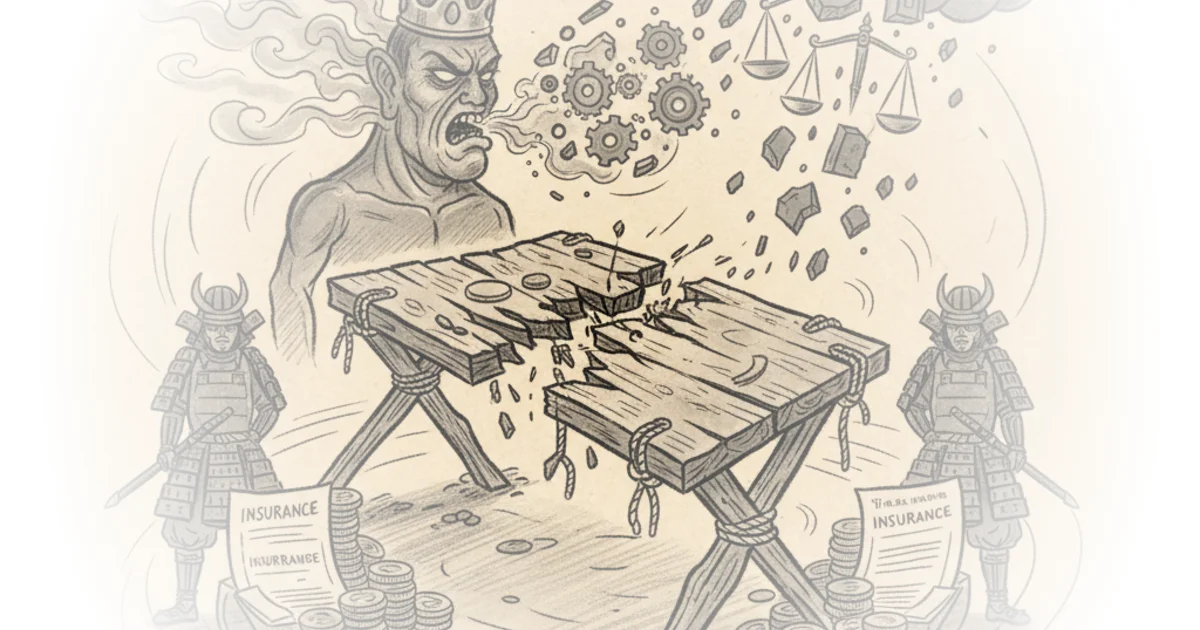
Schneider highlights how this dynamic undermines decades of diplomatic architecture. The article references the Camp David summit, a pivotal moment where the U.S., Japan, and South Korea forged an unprecedented trilateral security pact. Emanuel argues that the current executive branch has effectively "taken it off the page," replacing a strategy of containment with one of isolation. This is not merely a policy shift; it is a strategic blunder that allows China to execute its long-held strategy of dividing the region. As Emanuel bluntly puts it, "Everything President Trump's doing is underscoring China's message with a bunch of exclamation points because of the way we're behaving."
The commentary is particularly sharp when it addresses the Quadrilateral Security Dialogue (the Quad). The article reminds readers that bringing India into the American orbit was a 35-year bipartisan project, a strategic necessity to counterbalance China in the Himalayas. Yet, the current administration appears to have derailed this progress. Emanuel alleges this reversal was driven by personal financial entanglements, noting, "It looks like it was done for Pakistan's economic gifts to the Trump family... Specifically to the Trump boys." While critics might argue that foreign policy is always subject to the whims of the executive branch, the sheer scale of abandoning a strategic rival to China for what Emanuel calls "Pakistan's vanity" represents a profound departure from institutional continuity.
A superpower doesn't pick geographies, which is what they're trying to do. They failed with Canada, they failed with Panama, they failed with Greenland.
The Erosion of Institutional Integrity
Beyond geopolitics, the conversation turns to the corrosive effect of blending personal business interests with statecraft. Emanuel draws a stark contrast between his own tenure in public service and the current administration's approach to ethics. "When I got to Congress, I set up a blind trust... Meanwhile, you got a bunch of people who just left prison and are now investors," he observes. The article points to specific instances where government contracts appear to be funneled to startups linked to the President's family, citing a $700 million Pentagon contract awarded to a startup associated with one of the President's sons.
This section of the dialogue moves beyond standard political criticism to a structural analysis of corruption. Emanuel invokes the "Broken Windows" theory, suggesting that small, unenforced ethical violations create the conditions for systemic decay. "They have not only corrupted in the sense of the money they're making in public policy, but they've corrupted the process of doing it," he argues. The implication is that when the rules of the game are rewritten to benefit the players' families, the credibility of the entire state apparatus crumbles. This is a dangerous precedent for a superpower that relies on its reputation for reliability to maintain alliances.
The discussion also touches on the Supreme Court's role in enabling this behavior. Emanuel expresses deep frustration with the judiciary's recent rulings, stating, "The Supreme Court — John Roberts and the rest of those hacks — gave him a carte blanche to go steal." While this is a highly charged political assessment, it underscores the broader concern that institutional checks and balances are being dismantled, leaving no mechanism to prevent the conflation of national interest with private gain. A counterargument worth considering is that the administration views these actions as a necessary disruption of a bloated bureaucracy, but Emanuel's evidence of specific financial conflicts suggests a more self-serving motive.
Education as the True National Security
In a pivot to domestic policy, Emanuel challenges the administration's reliance on tariffs as a primary tool against China. He argues that these economic measures are a distraction from the real battle: workforce development. "Tariffs are a distraction and the only real way to beat China is a massive domestic push for workforce training," he asserts. This aligns with a growing consensus among economists that long-term competitiveness depends on human capital, not trade barriers. The article draws a parallel to the Solyndra era, noting that while past administrations made mistakes in green energy investment, the current approach of simply taxing imports fails to address the underlying productivity gap.
Emanuel also addresses the rise of artificial intelligence, warning that while AI boosts productivity, it poses a significant political risk by widening inequality. "A technology that boosts productivity but widens inequality is a political and social risk," he warns. This is a crucial insight for a reader concerned with the long-term stability of the American economy. If the benefits of AI are concentrated while the costs are distributed broadly, the social contract could fracture, leaving the U.S. ill-equipped to compete globally. The piece suggests that without a robust domestic strategy for education and retraining, the U.S. will lose the technological race regardless of how many tariffs are imposed.
The only envy Donald Trump has of Putin is that that is their business model, and he would like it to be America's model.
Bottom Line
The strongest element of this commentary is its unflinching diagnosis of how American unpredictability is fueling the very adversaries it seeks to contain. Emanuel's argument that allies are fortifying themselves against the U.S. rather than with it is a sobering reality check that demands attention. However, the piece's heavy reliance on allegations of personal corruption, while compelling, risks overshadowing the deeper structural issues of institutional decay that would persist even without the specific individuals in power. The reader should watch for whether the administration can pivot from transactional, family-centric deals to a coherent, long-term strategy for the Indo-Pacific before the window for alliance-building closes permanently.