The Dean of Strategy on Wars That Almost Were Not
Lawrence Freedman has spent a career studying how nations stumble into conflicts and occasionally manage to avoid them. In this wide-ranging ChinaTalk interview, Freedman draws on his decades of work on the Falklands War, nuclear strategy, and great-power decision-making to illuminate the uncomfortable truth that strategic outcomes rarely hinge on a single brilliant decision. They emerge from accumulations of hesitation, miscalculation, and domestic political pressure.
The conversation covers an enormous arc, from the South Atlantic in 1982 to a possible Taiwan crisis, from the origins of nuclear arms control to the hype surrounding artificial intelligence. What holds it together is Freedman's insistence that strategy is not a science but a craft practiced by flawed individuals under immense stress.
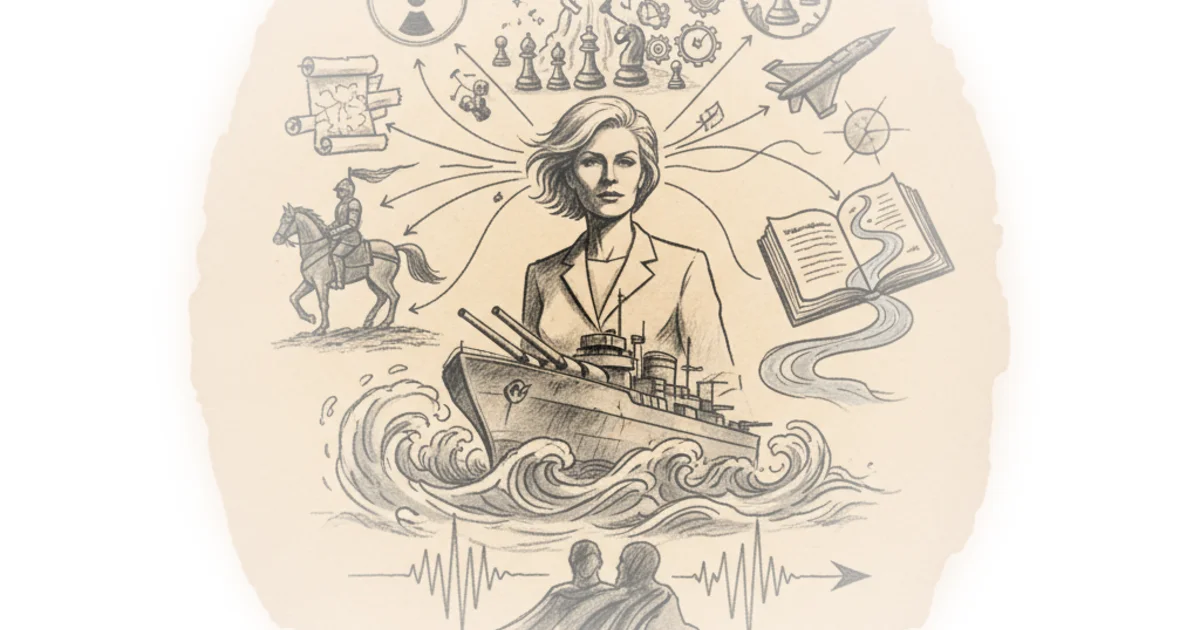
The Falklands as a Template for Surprise
Freedman opens with the Falklands War, which he covered in real time and later documented in the official history. The core lesson is about the failure of imagination. British intelligence assessed that invading the Falklands would be so foolish that Argentina would never attempt it. Even as evidence mounted, analysts clung to that view.
The intelligence community had a view that this would be such a foolish thing to do that the Argentinians would do it despite the evidence that maybe they might. Even when they were doing it, they were reluctant to get off that position.
Freedman draws a direct parallel to Russia's 2022 invasion of Ukraine, where Western analysts made the same error with Putin. The pattern is clear enough to be called a law: when an adversary's action seems irrational by your own standards, do not assume they share your standards.
The timing dimension is equally striking. Freedman notes that Argentina acted impetuously. Had the junta waited even a few months, Britain's carrier capability would have been scrapped, and no task force could have been sent.
The idea was to sell HMS Invincible to Australia, and the HMS Hermes was due to be scrapped. If that were the case, then the UK would not have been able to take air power with the task force. It would have been hopeless.
Impatience, in other words, saved British sovereignty over the Falklands. That is not a reassuring lesson for anyone counting on deterrence to hold indefinitely.
Taiwan and the Limits of Analogy
The conversation pivots naturally to Taiwan, though Freedman is careful about the analogy. The Falklands involved British territory and British citizens who wanted to remain British. Taiwan involves a client-state relationship mediated by deliberate ambiguity.
The status quo is tenable with Taiwan as long as both sides can live with the fiction that one way or the other, they're still part of the same country.
Freedman argues there is no inherent dynamic pushing the Taiwan situation toward conflict, unlike the Falklands where Argentine patience was visibly eroding. The danger lies in disruption of the fiction, whether by a Taiwanese government declaring independence or an American president signaling disengagement.
Where interviewer Jordan Schneider sees the post-Xi era as the most dangerous period, Freedman offers a more nuanced view. China's party institutions remain intact in ways Russia's do not. Succession after Xi should, in principle, be less chaotic than succession after Putin. But Freedman adds a sharp qualifier: the longer Xi remains, the more those institutional advantages erode.
One area where the analysis could be stronger is on China's lack of recent combat experience. Freedman acknowledges the Chinese military's concern about untested commanders, but the conversation does not fully grapple with how this inexperience might cut both directions. A military that has never fought a modern war might be either more cautious or dangerously overconfident about its own capabilities. The 1979 Sino-Vietnamese War, China's last major engagement, was hardly a showcase of operational excellence.
Why Nuclear War Has Not Happened
Freedman's explanation for the absence of nuclear war is elegant in its simplicity: nuclear weapons made the consequences of war so vivid that leaders on both sides recoiled.
Nobody could think of a way to win a nuclear war. We still can't think of a way to win it.
This stands in sharp contrast to the pre-1914 world, where leaders harbored optimistic delusions about quick victories. Nuclear weapons, Freedman argues, provided a kind of forced clarity. The "crystal ball effect" meant that unlike the Kaiser or the Tsar, Cold War leaders could see clearly what awaited them.
He is candid, however, that this stability is not guaranteed. Ukraine, India-Pakistan tensions, or North Korean unpredictability could all shatter the taboo. The long peace is not a law of nature. It is a streak of good judgment that could end at any time.
Arms Control as Theater
Some of the sharpest commentary comes in Freedman's assessment of the SALT process, which he has revisited fifty years on. His verdict is quietly devastating. The treaties were built on a theory of "perceivable symmetry" that Freedman considers largely contrived.
Serious people expended intellectual effort trying to explain why it mattered, if one side had a superiority in one measure even, if not in all measures, when both could blow each other up. It was just a bad theory.
The real reason the arms race stabilized, Freedman contends, was the demonstrated supremacy of offense over defense. Anti-ballistic missile systems could be overwhelmed. Both sides figured this out independently. SALT merely confirmed what the physics already dictated.
Actually, one would be hard put soberly to say the strategic arms control actually calmed the situation.
This is a provocative claim, and it deserves at least mild pushback. Even if SALT did not fundamentally alter the strategic balance, the diplomatic channels and verification regimes it created had value beyond the specific warhead counts. The process of negotiation itself built familiarity and reduced the risk of miscalculation, something Freedman himself acknowledges when he notes the two sides "learned quite a lot about each other."
Leaders Under Pressure
The most compelling thread running through the interview is Freedman's portrait of individual leaders confronting decisions they are not fully equipped to make. Thatcher, who had no military experience, was "shocked by the event, fearful of the consequences, and not very knowledgeable about military affairs." Yet she showed nerve at every critical juncture and transformed her political fortunes as a result.
She was not particularly popular in her own government in the cabinet. There was a risk if she wasn't careful that everything would just turn against her, because she was doing what a patriotic nationalist leader should not do, which is lose territory.
Kennedy, by contrast, had enough combat experience to distrust military advice and enough confidence to override it. Freedman describes him as "the most dovish member of his own administration" on Vietnam in 1961. Johnson, inheriting Kennedy's advisers but lacking Kennedy's self-assurance, could not push back effectively even when he doubted the counsel he was receiving.
Freedman treasures a moment he witnessed firsthand: Thatcher being briefed by genuine Soviet experts before meeting Gorbachev in December 1984. The academics impressed upon her the weakness of the Soviet economy, and Freedman watched her "lapping this up." That openness to challenge produced some of Thatcher's best foreign policy. But when the Soviet bloc began to collapse, her prejudices about German reunification reasserted themselves. The window for changing a leader's mind, Freedman suggests, is narrow and unpredictable.
What's interesting to me there was to be at a moment when you could see a prejudice being challenged successfully. Now, as often as not, that just doesn't happen, because the people surrounding especially well-established leaders tend to be, if not out and out sycophants, at least wary about challenging the leader's thoughts directly.
AI and the Misplaced Nuclear Analogy
On artificial intelligence, Freedman is characteristically measured. He resists the fashionable comparison between AI governance and nuclear arms control, noting that artificial intelligence is not a single weapon system but a vast collection of capabilities layered on top of existing technologies.
The difficulty of conversations about AI is that AI is so many different things. A lot of the hype either way is overblown. It's important, but the point is that it's layered — that is, that AI comes on the top of all the other things that are already there.
This brevity is both the section's strength and its weakness. Freedman is right that the nuclear analogy is strained, but the conversation moves on before exploring what a better framework for AI governance might look like. For someone who has spent decades thinking about how states manage dangerous technologies, a more developed view would have been welcome.
Bottom Line
Lawrence Freedman's central message is that strategy is not a discipline of grand plans executed with precision. It is the art of muddling through under uncertainty, where the decisive factors are often domestic politics, the psychology of individual leaders, and the sheer contingency of timing. The Falklands were saved because Argentina was impatient. Nuclear war has been avoided because the weapons are too terrifying to use. Arms control treaties ratified conclusions that physics had already reached.
None of this is comfortable. Freedman offers no formula for preventing the next catastrophic miscalculation. What he offers instead is a way of thinking that takes human fallibility as its starting point rather than its exception. In a world where strategists on all sides are prone to assuming their adversaries think as they do, that humility may be the most valuable strategic asset of all.