Dan Williams challenges the comforting narrative that America's current chaos is a recent invention caused by a single demagogue or a sudden collapse of truth. Instead, he argues we are living through a decades-long fracture where two distinct tribes have constructed entirely separate, self-reinforcing realities, a condition that makes democratic compromise mathematically impossible. This is not just a story about bad actors; it is a structural diagnosis of how modern societies process information when trust in institutions evaporates.
The Illusion of a Shared Reality
Williams opens by dismantling the idea that one side is sane and the other is delusional. He notes that both political tribes believe the other has lost its mind, but they diagnose the illness differently. The "blue tribe" sees a Republican ecosystem poisoned by disinformation, hoping to fix it with technocratic tools like fact-checking and moderation. Conversely, the "red tribe" views the establishment as a "sinister fifth column" infected by wokeism, believing only a radical overhaul can restore reality.
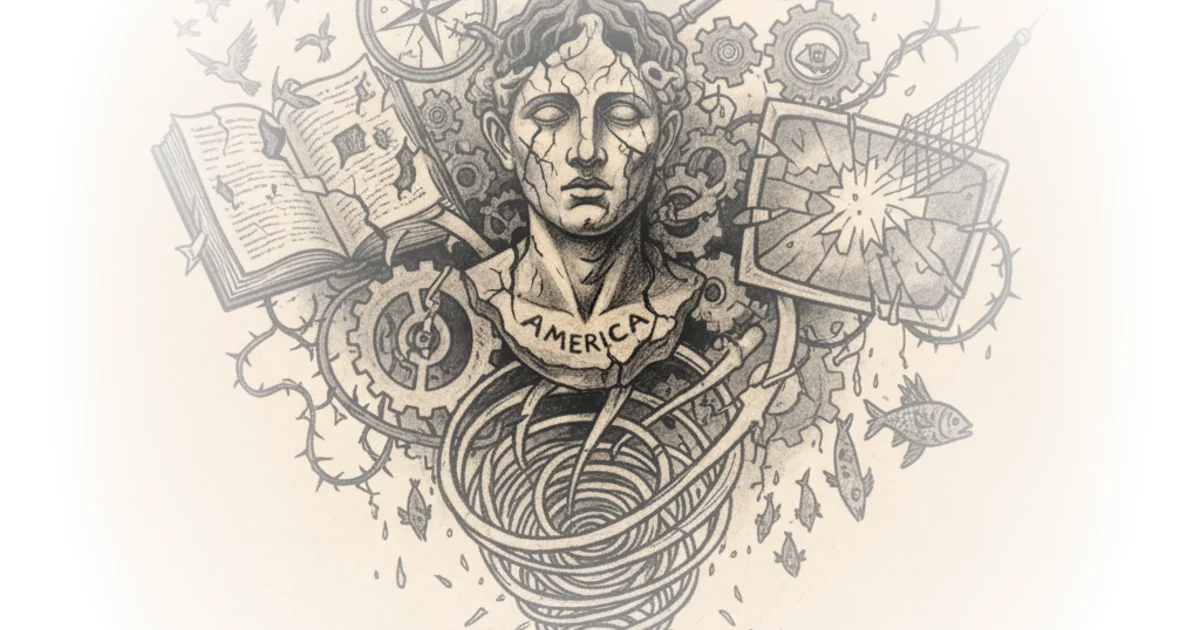
As Dan Williams puts it, "Many liberals and conservatives seem to inhabit distinct realities. And within these realities, they have constructed narratives to explain why their ideological enemies are afflicted with ignorance, lies, and delusion." This framing is crucial because it shifts the blame from individual malice to systemic isolation. It suggests that the problem isn't that people are lying, but that they are operating in incompatible pseudo-environments.
"If we do not have the capacity to distinguish what's true from what's false, then by definition the marketplace of ideas doesn't work. And by definition our democracy doesn't work. We are entering into an epistemological crisis."
Williams leans heavily on the work of the late philosopher Jeffrey Friedman to explain why this happened. Friedman rejected "naive realism," the belief that we see the world exactly as it is. Instead, Williams explains that our access to reality is "profoundly mediated" by the people and institutions we trust. We don't just see facts; we see facts filtered through "stereotypes"—simplifying systems that turn complex data into manageable narratives.
The Two Types of Naive Realism
The most striking insight Williams offers is Friedman's distinction between how the left and right construct their truths. He argues that conservatives tend to be "first-person naive realists," trusting their own common sense and intuition over institutional expertise. In contrast, liberals often act as "third-person naive realists," treating the consensus of credentialed experts as a new form of common sense.
Dan Williams writes, "Those on the right tend to be first-person naive realists in treating economic and social realities as accessible to the ordinary political participant by simple common sense, while those on the left tend to be third-person naive realists in treating credentialed experts as forming a consensus—a new common sense." This reframes the culture war not as a battle between truth and lies, but as a clash between two different epistemological methods. One side trusts the gut; the other trusts the credential. Both assume their method is the only path to objective reality.
Critics might note that this analysis risks equating the rejection of climate science with the rejection of systemic racism, potentially flattening the moral weight of scientific consensus. However, Williams is careful to point out that both sides suffer from the same cognitive trap: the inability to see that their "truths" are actually just interpretations of a mediated world.
The Myth of the Golden Age
Perhaps the most controversial move in the piece is Williams' rejection of the "post-truth" narrative favored by many liberal intellectuals. The standard story is that there was a golden age of objectivity before the rise of right-wing populism, a time when everyone agreed on facts. Williams, channeling Friedman, calls this a historical fiction.
"Post-truth scholars mistake agreement—agreement among experts, and agreement with experts by nonexperts—as a sign of truth," Williams argues. He contends that the mid-twentieth century wasn't a time of shared reality, but a period of "epistemological complacency" driven by the dominance of establishment liberalism. The consensus wasn't based on universal truth; it was based on the exclusion of dissenting voices from the media and academic ecosystems.
The fracture only widened when the regulatory landscape shifted. Williams points to 1987, when the Federal Communications Commission repealed the Fairness Doctrine, as the catalyst that allowed a separate right-wing media ecosystem to flourish. This paved the way for figures like Rush Limbaugh to declare themselves "liberated from the East Germany of liberal media domination." This historical pivot is essential because it shows that the current polarization wasn't an accident or a sudden moral failure, but the result of structural changes in how information was distributed.
"A truly sophisticated epistemology has to recognize that the mix of truths and errors in which each of us believes forms an interconnected web that, as it grows in breadth and depth over a lifetime, comes to function increasingly like an ideology in the neutral sense of the term: a self-perpetuating worldview."
This concept of the "self-perpetuating worldview" explains why fact-checking often fails. When a piece of information doesn't fit the web of belief, it is rejected not because it is false, but because it is "illegible" to the existing framework. Williams suggests that the solution isn't more facts, but "intellectual charity"—the ability to understand the genuine reasons why rational people arrive at different conclusions based on the information streams they inhabit.
Bottom Line
Williams' strongest contribution is his refusal to treat the current crisis as a temporary glitch that can be fixed by better moderation or more fact-checking. By identifying the deep structural roots of our separate realities, he forces the reader to confront the uncomfortable possibility that our democracy is currently broken not because people are lying, but because we no longer share a common language for truth. The biggest vulnerability in this analysis is its potential fatalism; if everyone is trapped in their own web of belief, it is unclear what mechanism exists to break the cycle other than a generational shift. Readers should watch for how this framework applies to future policy debates, where the inability to agree on basic premises may render traditional compromise obsolete.