Matt Stoller makes a startling claim: the silence of Wall Street during a global energy crisis isn't accidental, but the result of a deliberate strategy by the executive branch to manipulate market psychology as a weapon of war. While analysts usually look for supply and demand fundamentals, Stoller argues that the administration is actively engineering a narrative to prevent a stock market collapse, treating the S&P 500 not as an economic indicator, but as a strategic asset to be defended at all costs.
The Strategy of Market Manipulation
Stoller begins by dismantling the conventional wisdom that markets are ignoring the closure of the Strait of Hormuz. He notes that if the choke point remains shut, "that means $250-$300 price of oil (Brent)," a figure that historically triggers catastrophic market drops. Yet, the S&P has only dipped 7%. Why? Stoller posits that the administration has made the stock market the "most important scorecard" for the White House, driven by the self-interest of wealthy officials and the GOP's reliance on Wall Street capital.
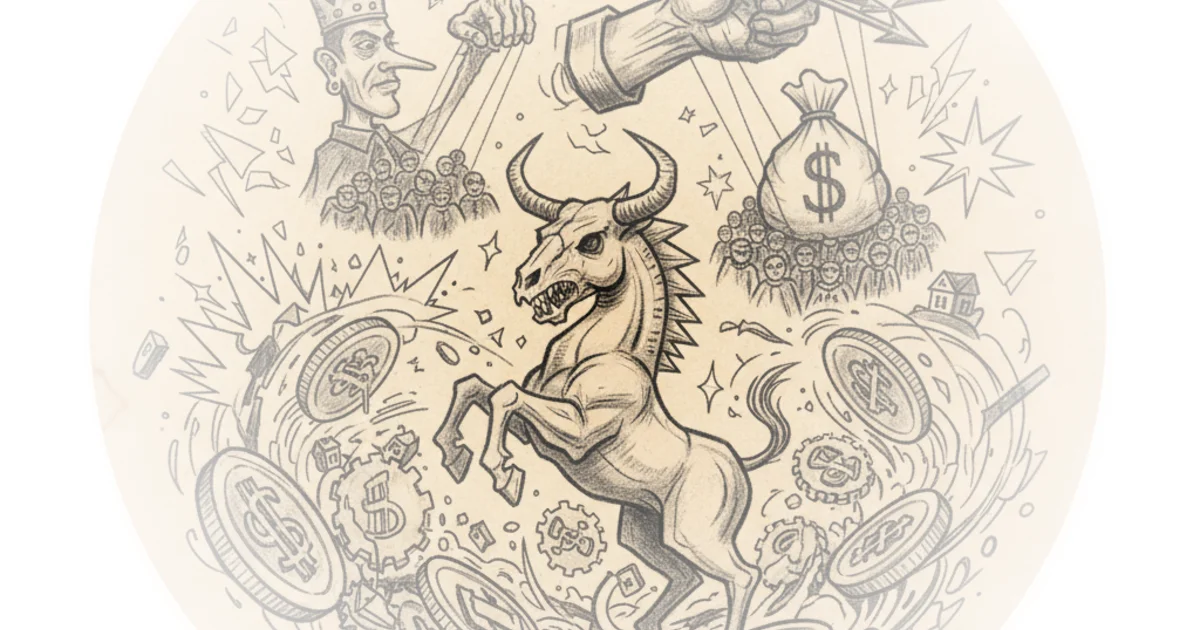
The author suggests that the timing of the conflict itself was calculated to minimize financial panic. "The war began in the early morning of February 28th, a Saturday," Stoller writes, allowing the administration "36 hours of uninterrupted strikes before the Asian markets and U.S. futures opened." This framing is compelling because it shifts the narrative from a military blunder to a coordinated financial operation. By isolating the initial violence from market hours, the executive branch could spin the opening salvo as a "smashing victory" before traders could react.
The American-led hegemonic order really is centered on the U.S. stock market and dollar denominated assets.
Stoller's analysis deepens as he traces a week-by-week pattern of intervention. In the first week, the administration used confident rhetoric to calm speculators despite ongoing counter-attacks. By the second week, as oil prices surged, the President claimed the war was "ahead of schedule," a statement that immediately reversed market losses. Stoller observes that "the comments, including similar remarks earlier in the day, triggered sharp moves in market prices," effectively decoupling asset values from the reality of a closed oil strait.
Critics might argue that attributing market movements solely to presidential tweets ignores broader macroeconomic factors like the existing oil glut or the U.S.'s energy independence. However, Stoller counters this by highlighting the fragility of the current consensus. He points out that even when Treasury Secretary Scott Bessent claimed on "Squawk Box" that "more and more of the fuel ships start to go through," the relief was fleeting, and the market slid again. This suggests the manipulation is a high-wire act with a short half-life.
The Broken Hegemonic Order
The piece takes a darker turn as Stoller argues that this manipulation reveals a fundamental crack in the global order. He contends that the system is not truly American but is "run for a global oligarchy" that expects U.S. soldiers to keep oil flowing while they profit from dollar-denominated assets. When Iran closed the Strait, it didn't just threaten oil; it threatened the "basic deal" of this oligarchy.
Stoller writes, "The U.S. has been revealed as a paper tiger, unable to defend luxury resorts like Dubai where the investors and influencers live." This is a provocative assertion that challenges the perception of American military invincibility. He draws a parallel to the pandemic era, noting that during the crisis, "German, Swiss, and British pharmaceutical giants, and furtive South African elites, blocked" vaccine access for poor countries. This historical context, reminiscent of the "Petrodollar recycling" dynamics discussed in related deep dives, reinforces his point that global elites prioritize their own interests over national stability.
The author suggests that the administration's inability to end the war, despite the pain inflicted on the investor class, is unprecedented. "A war that America started but cannot end even as pain gets inflicted on the investor class, and supply chains everywhere, is something no one has seen in our lifetimes." This lack of control is what he believes investors are slowly beginning to realize. The "half-life of these kinds of comments is shortening," and the market's slow slide indicates that the spin is losing its grip.
There are no analogies to draw upon.
Stoller's argument here is particularly strong because it moves beyond the immediate conflict to the structural implications for the global economy. He notes that refiners in Asia still need Middle Eastern oil, and without it, "hospitals are starting to ration scans because there's little helium to spare, China is restricting exports of plastics, and airlines are cutting flights." These are tangible, downstream consequences that no amount of market manipulation can permanently obscure.
The Illusion of Control
In the final analysis, Stoller argues that the administration's strategy is a gamble that is increasingly failing. While the President has threatened to destroy Iran's power plants to force the Strait open, the market remains flat, and rumors of a ceasefire persist. Stoller notes that "it is not up to America, or any other set of nation-states" to resolve this, as the conflict has been hijacked by the strategic leverage of the Strait itself.
The author's coverage effectively reframes the "Trump administration's" actions not as a coherent foreign policy, but as a desperate attempt to maintain a financial status quo that is already crumbling. He suggests that the "global elites" who usually remain insulated are now facing a reality where "fuel shortages hit everywhere from Sri Lanka to the Slovenia to Thailand." This breakdown of the "Davos-mediated world" is the true story, far more significant than the daily headlines about stock fluctuations.
Bottom Line
Stoller's most powerful insight is the identification of market manipulation as a deliberate war strategy, a perspective that explains the bizarre disconnect between soaring oil prices and a relatively stable stock market. However, the argument's vulnerability lies in its reliance on the assumption that the administration can sustain this deception indefinitely; the evidence suggests the "half-life" of their spin is already expiring. Readers should watch for the moment when the market's patience runs out, as the gap between the administration's narrative and the physical reality of a closed Strait of Hormuz becomes impossible to bridge.