Fred Mills doesn't just report on a construction delay; he exposes the terrifying fragility of Europe's most vital artery. While the headline screams about a $2 billion U-turn, the real story lies in the author's candid admission that even the most sophisticated engineering can be humbled by a 400-meter stretch of fractured rock. This is not a tale of failure, but a masterclass in the unpredictable nature of tunneling, where the line between a 2027 completion and a decade-long disaster is thinner than the rock itself.
The Stakes of the Alpine Corridor
Mills establishes the stakes immediately, framing the Gotthard Road Tunnel not as a mere convenience, but as the linchpin of continental connectivity. He notes that without this 17-kilometer passage, "thousands of drivers would have to find a detour in a place where they are very hard to come by." The author effectively contrasts the modern 15-minute drive with the winding, winter-blocked routes of the 1400s, reminding us that the original tunnel, completed in 1980, was a marvel that cut travel time by an order of magnitude. However, the core of his argument is that the solution to aging infrastructure isn't replacement, but redundancy. As Mills explains, the new tunnel is being built "not because it would boost capacity or replace the existing one entirely," but to allow the original tube to be renovated without halting traffic.
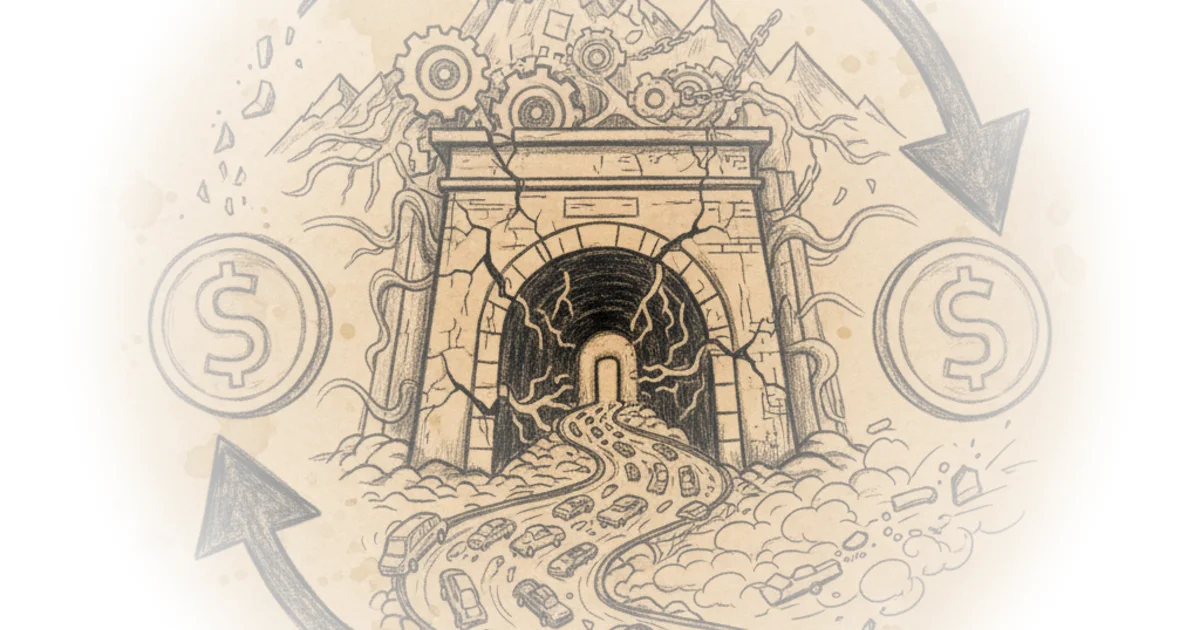
This strategic pivot is crucial. The Swiss government recognized that closing the tunnel for three or four years would be catastrophic. By building a parallel tube, they ensure the corridor remains open while the old one undergoes a complete electromechanical overhaul. It is a bold gamble on logistics, betting that two tunnels operating side-by-side can handle the load while one is essentially a construction site. Critics might argue that doubling the tunnel count without increasing total capacity is an inefficient use of resources, yet Mills correctly identifies that in a region with no viable detours, availability is the only metric that matters.
"Geology is always challenging in tunneling. You think you know everything about it. Uh, there's still surprises."
When Machines Meet the Unexpected
The narrative takes a sharp turn when Mills details the predicament of "Paulina," one of the massive Tunnel Boring Machines (TBMs) tasked with digging from the south. Despite years of geological surveys, the machine encountered a "highly fractured loose rock and cavities" that caused the tunnel face to collapse. The author describes the scene with visceral clarity: the cutter head is blocked, the torque is insufficient, and the machine is effectively stuck. "The situation is that the cutter head is blocked," a project official tells Mills, noting the need to dig an access tunnel just to free the machine.
This section highlights a critical tension in modern engineering: the reliance on TBMs for speed versus the need for flexibility in unstable ground. The project team had planned to switch to the conventional drill-and-blast method for known shear zones, a technique reminiscent of the New Austrian Tunneling Method used in the original 1970s construction. However, the unexpected nature of this specific fault zone forced an unplanned deviation. Mills points out that while the geology was predicted, the exact location and severity were not. "The big fault zone it was easy to situate but there are some small fault zone... it's not easy to understand where are these fault zone," he quotes, underscoring the limits of predictive modeling.
The cost of this error is staggering—$25 million added to the bill and months of delays. Yet, the response is pragmatic. The team is now working three shifts, seven days a week, and switching to drill-and-blast for the problematic 500-meter section. This adaptability is the project's saving grace. While a rigid adherence to the TBM schedule might have led to a total collapse, the willingness to revert to older, slower methods saved the project from a far worse outcome.
Beyond the Tunnel: A Legacy of Waste and Power
Mills also shines a light on the often-overlooked aspects of mega-projects: what happens to the waste, and how the infrastructure serves the wider grid. The excavation will produce 7.5 million tons of rock. Rather than dumping it, the plan is to reuse a quarter for concrete, a quarter for road surfaces, and send the remaining half to Lake Lucerne to create new shallow water habitats. This circular approach to waste management is a refreshing counterpoint to the usual environmental toll of such projects.
Furthermore, the new tunnel will house high-voltage power lines in a dedicated service duct, a first for Europe. This clever integration means the ugly pylons currently cluttering the Gotthard Pass can finally be removed. It transforms the tunnel from a simple road into a multi-functional utility corridor. As Mills puts it, the tunnel is designed to handle "ventilation" above and "utilities" below, maximizing the utility of every cubic meter of excavated space.
"We need all also the logistic for material management for concrete production. We have very very small surface and that's why part of the installation will be done underground."
Bottom Line
Fred Mills delivers a compelling narrative that balances the awe of engineering with the humility required to face nature's unpredictability. The piece's greatest strength is its refusal to sugarcoat the setbacks, presenting the TBM entrapment not as a scandal, but as an inevitable lesson in geology. The argument is slightly weakened by a lack of deep technical detail on the specific rock mechanics, but for a general audience, the balance of human drama and logistical strategy is perfect. The ultimate takeaway is clear: in the Alps, the only constant is the need for flexibility, and the cost of rigidity is measured in billions.