The Illusion Only Some People Can See
A Window Into How We See Everything
Derek Muller makes a claim that feels like it should be obvious but carries real weight: the Ames Window illusion isn't just a party trick — it's a mirror for how we perceive all of reality. The piece's central argument is that our brains constantly interpret ambiguous visual data as rectangles, and when that assumption fails, perception breaks down entirely.
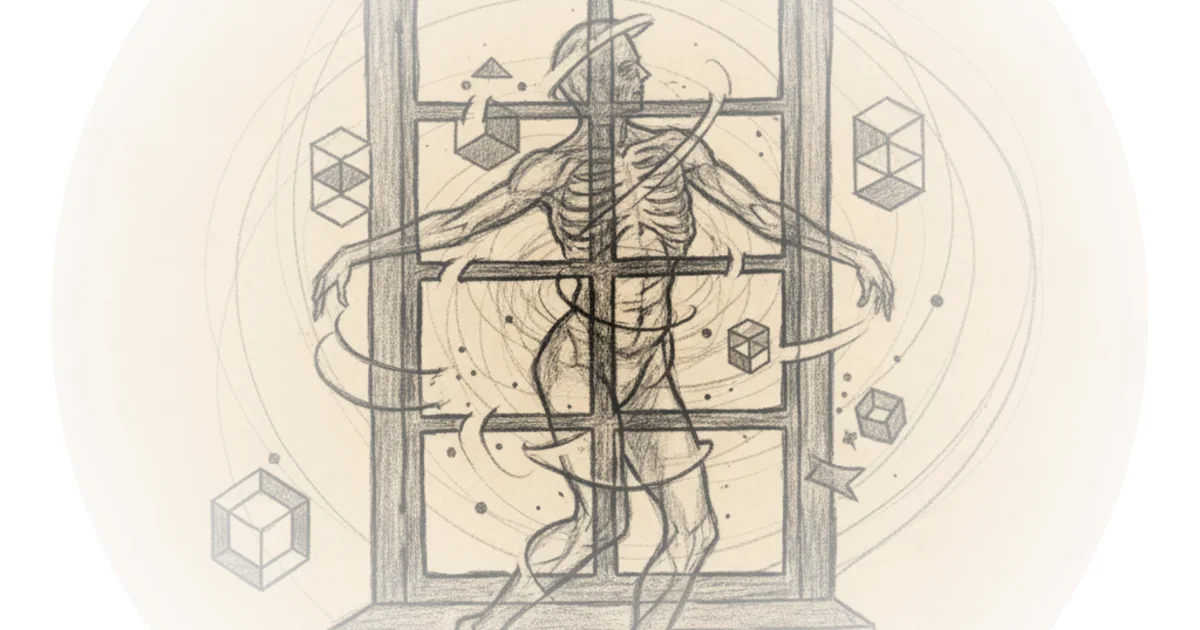
Muller walks viewers through the mechanics with impressive clarity. "You're looking at this window and it looks like it's turning around except here it stops now," he says — then immediately corrects himself: "i was gonna say i'm good i'm not good okay." The self-aware humor signals that this isn't a lecture; it's an exploration he's still figuring out.
The core of the illusion is elegantly simple. A trapezoidal window rotates continuously, but our brains assume it should be rectangular. "Our brains use these strange shapes to infer depth information which in our rectilinear world is almost always correct," Muller explains, "but not in the case of a trapezoidal window that our brains assume to be rectangular hence the illusion." This lands because it names something fundamental — our perceptual system runs on assumptions we don't consciously make.
The piece gains real traction when Muller tests the carpentered environment hypothesis. Harvard psychologists in 1957 ran the experiment in South Africa with 80 children aged 10 to 14. Forty lived in Durban, full of rectangular buildings, doors and windows. The other forty came from rural communities where they lived in round huts with few prominent 90-degree angles. When seated 10 feet away with both eyes open, "60 percent of the urban group reported seeing the window oscillating but in the rural group only 17.5 percent saw the same thing." This is striking — actual data showing that experience shapes susceptibility to optical illusion. The results were consistent with the hypothesis: kids with less exposure to rectangles were less likely to fall for it.
But Muller doesn't let the story end there. When seated 20 feet away and with one eye closed, "now 90 percent of all participants saw the window oscillating and there was no significant difference between urban and rural groups." The illusion became universal. This twist is crucial — something else is happening beyond just rectangle experience. The piece acknowledges this but doesn't fully explain what that something else is.
Muller then widens the lens to art and history. He shows how anamorphosis works — distorted images that only make sense from particular vantage points. "This is a painting from 1533 called the ambassadors by hans holbein the younger," he explains, describing how a distorted shape over the floor becomes a human skull when viewed from the correct position. The connection feels forced at first but lands when Muller notes that "anamorphosis involves making a distorted projection of an object so to see its proper proportions you need to look at the work from a particular position or with a particular device often a mirror."
The piece's most ambitious claim comes late: "our perceptions far from transparently representing external reality are constantly faced with ambiguity and our brains below the level of consciousness have to decide which of the infinite possibilities we're actually looking at." This is the argument that deserves more development. Muller connects it to science directly — using examples about whether the sun goes around the earth or the earth rotates on its axis, and quantum measurement questions. "The data do not discriminate between those theories," he argues, suggesting the Ames illusion is a metaphor for how we form all conclusions.
Something as simple as a little rotating picture can fool our brains in fairly spectacular ways so we should approach the world and our conclusions about it with a little more humility and a little less certainty.
This line is the piece's thesis statement, and it's well-earned after 15 minutes of visual evidence. The argument works because Muller has just spent an entire video showing how certainty fails — even when you're looking directly at something rotating.
Critics might note that the scientific analogy feels more aspirational than rigorous. Linking perceptual illusions to quantum mechanics or heliocentric models requires more connective tissue than Muller provides. The piece also doesn't fully explain why one eye closed reverses the illusion's effectiveness — it simply notes the finding without diving into what this reveals about depth perception mechanisms.
Bottom Line
Muller's strongest move is showing that the Ames Window isn't a novelty — it's a window into how all perception works. His biggest vulnerability is the leap from visual illusion to broader epistemological humility; the metaphor is compelling but underdeveloped. The piece succeeds most when it stays empirical — testing hypotheses with South African children, building giant trapezoidal windows in his studio, attaching rulers through the center to track motion. The moment it drifts toward philosophy, it loses the satisfying specificity that makes the illusion so convincing. For viewers who finish watching, the takeaway should be clear: what you see is not what's there.