Noah Smith reframes a routine legislative fight over pork prices as a profound moral crisis, arguing that the proposed federal rollback of state animal welfare laws represents not just policy failure, but active moral degeneration. While most coverage focuses on the economic friction between California and Midwestern agribusiness, Smith forces the reader to confront the visceral reality of "concentrated animal feeding operations" and asks whether a society can claim moral superiority while legally mandating the torture of sentient beings.
The Architecture of Suffering
Smith anchors his argument in the stark physical reality of gestation crates, describing them not merely as inefficient housing but as instruments of psychological destruction. He writes, "In a gestation crate or a farrowing crate, sows don't have enough room to turn around — all they can do is either stand or lie down in a pile of their own feces." This description serves as the essay's emotional core, stripping away the euphemisms often used by industry lobbyists. The comparison to an airline seat where one cannot unbuckle highlights the absolute confinement, a condition that contradicts the biological nature of pigs as social creatures capable of "emotional contagion."
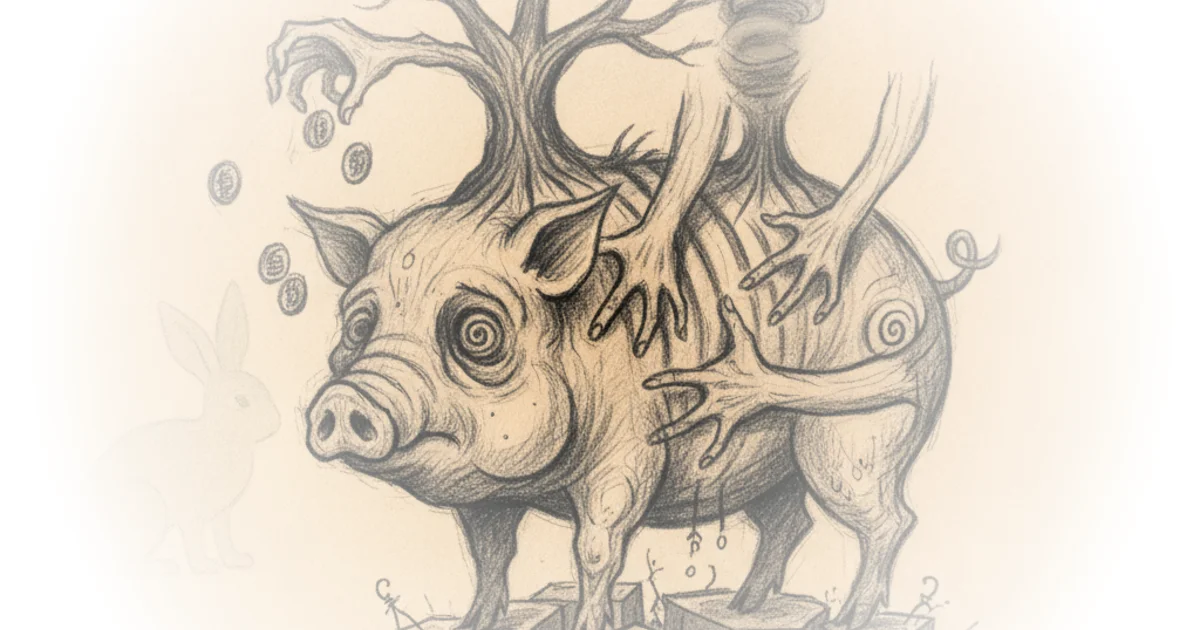
The author argues that the individual act of abstaining from meat is insufficient because it fails to dismantle the system itself. He notes, "Suppose that our society farmed human beings for food. Would simply refusing to eat human flesh be enough to absolve me of culpability? I don't think so. I would still have a responsibility to try to abolish the evil system." This rhetorical pivot is effective; it moves the debate from consumer choice to civic duty, suggesting that complicity in a brutal system requires active opposition rather than passive avoidance. Critics might argue that this analogy stretches moral equivalence too far between livestock and humans, potentially alienating readers who view animal welfare as distinct from human rights. However, Smith uses the comparison strictly to illustrate the limits of individual ethics against systemic evil.
"I have no other word for this except 'sin'. This is a sin."
The Political Battle: Prop 12 vs. The Farm Bill
The commentary shifts to the immediate political threat: the inclusion of the "Save Our Bacon Act" within the broader federal Farm Bill. Smith details how this legislation, which would prevent states from regulating meat based on production methods in other states, effectively nullifies voter-approved measures like California's Proposition 12. He points out that this law was enacted by voters in 2018 with a nearly two-to-one margin, establishing a precedent that has been upheld by courts. Yet, the executive branch and congressional allies of the farming lobby are now attempting to override these state mandates through federal preemption.
Smith identifies the dynamic as a classic case where "a concentrated interest group — the pig farming lobby" is pitted against "a diffuse interest (voters with a conscience)." He cites polling data showing that two-thirds of Americans, including regular pork buyers, find gestation crates unacceptable. Despite this, the industry has successfully lobbied to bury the anti-welfare language inside the massive Farm Bill, making it harder for voters to isolate and reject the specific provision. As Smith puts it, "It's 'really a Save Our Crate Act,' Brent Hershey, a hog farmer who opposes it, told me. 'A vote for the farm bill,' he said, 'is a vote to cage an animal that can't walk or turn around.'"
The argument gains depth when considering the historical context of tail docking. Smith notes that piglets have their tails chopped off without anesthesia specifically because the stress of confinement causes them to bite each other's tails in anguish. This practice, often hidden from consumers, underscores his point that the cruelty is systemic and intentional. The proposed federal law would not only protect these practices but prevent future state-level innovations in animal welfare, effectively freezing progress at the lowest common denominator.
The Meta-Golden Rule and Moral Regression
Perhaps the most distinctive part of Smith's analysis is his invocation of AI and the "Meta-Golden Rule" to frame the issue as a test of humanity's future fitness. He suggests that the rapid rise of artificial intelligence should force humans to reconsider their position at the top of the hierarchy. Quoting Vernor Vinge, Smith paraphrases the rule: "Treat your inferiors as you would be treated by your superiors." He argues that maintaining a system where the strong inflict unimaginable cruelty on the weak is a dangerous precedent for a species that may soon face entities far more intelligent than itself.
Smith posits that the drive to preserve these farming practices stems from a psychological need for power among those who feel disempowered by cultural shifts. "The line 'The cruelty is the point' probably applies here," he writes, suggesting that the defense of factory farms is less about economics and more about asserting dominance over beings with no voice. This framing elevates the debate from agricultural policy to a question of character. He warns that by passing such laws, America risks "slipping a little bit back down toward developing-country status" in terms of moral development.
"The people who wrote the Save Our Bacon Act don't believe in this Meta-Golden Rule. Instead, they believe that all of the moral value and weight in the Universe lies with them... and that they should have the right to inflict unimaginable cruelty on any being that doesn't possess the power to stop them."
Bottom Line
Smith's strongest move is his refusal to treat factory farming as a mere economic dispute, instead framing it as a fundamental failure of moral imagination that threatens our collective character. The piece's vulnerability lies in its reliance on a specific theological and philosophical framework regarding AI and "sin," which may not resonate with secular or purely pragmatic readers who view the issue through cost-benefit analysis alone. However, the urgency of his call to strip the anti-welfare provisions from the Farm Bill remains undeniable: if this legislation passes, it will codify cruelty as federal policy for a generation.