Cyril Hédoin dismantles a persistent economic stereotype not by denying the data, but by reframing the very definition of the problem. He argues that what looks like national sloth is actually a rational, albeit complex, response to a specific mix of tax policy, social identity, and a self-fulfilling prophecy of low growth. For busy leaders watching global productivity trends, this piece offers a crucial distinction: the French aren't working less because they are broken; they are working less because the incentives and expectations have been engineered that way.
Beyond the Stereotype
Hédoin begins by stripping away the moral judgment often attached to the French work ethic. He notes that while the data shows a significant gap in annual hours worked between France and the United States, the narrative of inherent laziness fails to hold up under scrutiny. "I will rather talk about 'low willingness to exert effort' (LWTE)," Hédoin writes, deliberately choosing a neutral term to replace the pejorative "laziness." This semantic shift is the essay's first and most important move, forcing the reader to consider structural causes rather than cultural defects.
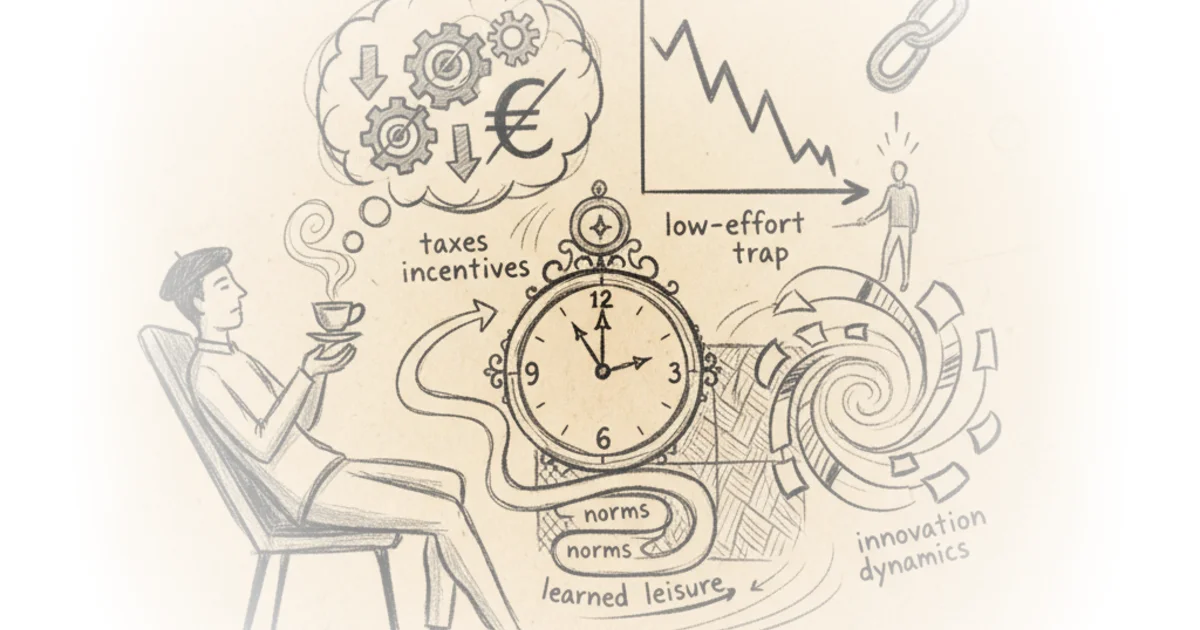
The evidence presented is stark: French employment rates sit at 69 percent compared to 75 percent in the US, yet French labor productivity per hour remains relatively high. Hédoin argues that this discrepancy suggests a deliberate trade-off rather than incompetence. He posits that the standard microeconomic explanation—preferences versus incentives—must be applied rigorously. "So, stylized facts indeed suggest that the French exhibit LWTE and, though this is partially compensated by relatively high labor productivity, this can be viewed as a significant socioeconomic and political issue," he observes. The author effectively separates the symptom (fewer hours) from the disease (the underlying economic logic).
Critics might argue that high productivity per hour is a poor metric if it masks a lack of innovation in new sectors, but Hédoin anticipates this by diving deeper into why those hours are not being worked.
The Architecture of Leisure
The essay moves beyond simple tax arguments to explore how preferences are formed. Hédoin invokes the work of Gary Becker to suggest that leisure is not just a choice but a habit that compounds over time. "The basic idea behind this Beckerian-type explanation is that individuals' choices create a 'capital' that affects the returns of future choices," he explains. In this view, the French have accumulated a "personal leisure capital" where the utility of relaxing has increased because they have practiced it for generations.
This is a sophisticated take on the "European lifestyle" argument, but Hédoin pushes further by integrating social identity. He cites the work of George Akerlof and Rachel Kranton to show that working less is often a way to signal conformity to national norms. The legal 35-hour workweek in France is not just a regulation; it is a cultural prescription. "In some cases, people may even 'proudly' limit their work hours as it reinforces their French identity as people who 'know how to enjoy life,'" Hédoin writes. This framing is powerful because it suggests that changing the hours worked requires changing the national identity, not just the tax code.
Laziness is not the problem for France and Europe, but gloomy expectations definitely are a part of it.
The Low-Effort Trap
Perhaps the most compelling section of the commentary is Hédoin's analysis of the "low-effort trap." He argues that even if productivity is high today, the expectation of future stagnation can depress current effort. This is where the piece connects to broader global dynamics, particularly the dominance of US and Chinese innovation in fields like artificial intelligence. Hédoin suggests that if European workers believe they cannot compete with the technological giants, they rationally choose to opt out of the race.
"Even if French workers' productivity is not low today, if they expect that the returns of their future efforts will decrease whatever they do now, this disincentivizes present effort," he argues. This creates a vicious cycle where pessimism becomes a self-fulfilling prophecy. The author draws a parallel to the concept of increasing returns, noting that "America's economic performance is conducive to an (impure) public good," allowing Europe to free-ride on US innovation without contributing to the effort. This is a sobering take on the "free-rider" problem in the global economy.
The argument here is that the administration's or the executive branch's inability to foster a competitive innovation ecosystem in Europe has inadvertently created a psychological barrier to growth. The fear is not that workers are lazy, but that they have lost faith in the marginal utility of their labor.
Bottom Line
Cyril Hédoin's strongest contribution is his refusal to accept cultural laziness as an explanation, replacing it with a rigorous analysis of incentives, identity, and expectations. The piece's greatest vulnerability lies in its reliance on the assumption that workers are perfectly rational actors who can accurately assess the long-term returns of their labor in a rapidly shifting global market. However, the verdict is clear: the solution to Europe's productivity gap is not to shame workers into working harder, but to dismantle the structural and psychological traps that make working less the most rational choice.