Steve Vladeck delivers a scathing indictment of the federal government's litigation conduct, arguing that the executive branch has moved beyond mere political maneuvering into a dangerous zone of procedural chaos that threatens the very foundation of judicial trust. This isn't just about policy disputes; it is a forensic dissection of how the Department of Justice is actively dismantling the "presumption of regularity"—the legal principle that courts should assume government officials act lawfully—through a combination of deliberate deception and staggering incompetence. For busy professionals tracking the rule of law, the stakes here are existential: when the government stops "turning square corners," the courts lose their ability to function as neutral arbiters.
The Erosion of Institutional Credibility
Vladeck opens by contrasting the current administration's conduct with the previous one, noting that while the past was defined by "malevolence tempered by incompetence," the current era is characterized by "malevolence exacerbated by incompetence." This distinction is crucial. It suggests that the damage being done is not accidental but compounded by a lack of basic legal competence that makes the government's actions even more unpredictable and dangerous. The author warns that this behavior has "deep, perhaps irreparable damage its behavior would do to public faith in the integrity (or even the minimal competence) of the Department of Justice."
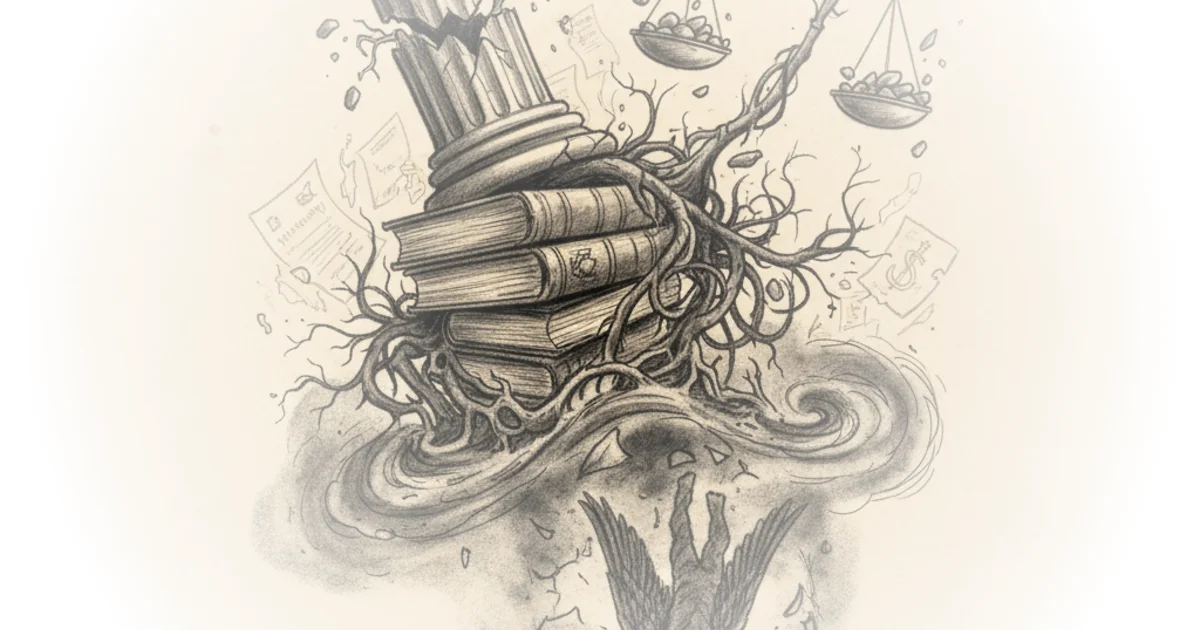
The core of Vladeck's argument rests on the idea that the government is no longer just losing cases; it is losing the ability to make a credible argument. He points out that the administration's actions are so erratic that they risk duping the Supreme Court itself. "At some point soon, one suspects that the Supreme Court itself may well have to grapple with its consequences—or risk being duped," he writes. This is a profound concern for any student of the judiciary, as the Court's authority relies heavily on the assumption that the parties before it are acting in good faith. When that assumption evaporates, the Court is forced to spend its energy policing the government's basic honesty rather than interpreting the law.
Whereas the first Trump administration was often characterized as "malevolence tempered by incompetence," this is worse: it's malevolence exacerbated by incompetence.
Critics might argue that the administration is simply facing a hostile judiciary that is predisposed to find fault, but Vladeck's evidence of procedural failures—such as hiding evidence or filing defective indictments—suggests the problem is internal to the government's own legal apparatus. The sheer volume of independent errors across different cases makes a coordinated "hostile court" narrative difficult to sustain.
Case Studies in Procedural Collapse
Vladeck anchors his broader thesis in three specific, high-stakes legal battles from the last week, each revealing a different facet of the government's unraveling credibility. First, he examines the criminal prosecution of former FBI Director James Comey. The case has devolved into a "Keystone Kops-like" spectacle where prosecutors appear to be using an indictment that was never actually presented to a grand jury. Vladeck highlights the absurdity of the situation: "The issue isn't the charges; it's the bizarre bait-and-switch that Halligan and her colleagues for some reason pulled to use a document that reflects only the counts on which the grand jury voted an indictment—and not the original document that included one count on which the grand jury declined to return a true bill."
This is not a minor technicality; it strikes at the heart of due process. The author notes that the case is now beset by "errors that remotely competent law students wouldn't make," suggesting that the drive to prosecute has overridden any commitment to legal rigor. The implication is that political pressure has created a legal environment where competence is secondary to the desire for a specific outcome, a dangerous precedent for any administration.
Second, Vladeck turns to the case of Kilmar Abrego Garcia, an individual the government attempted to remove from the country. The administration's actions here reveal a mix of bureaucratic failure and bad faith. Vladeck points out that "there may never have been an actual removal order against Abrego Garcia—which should have been the predicate to any of the immigration-related actions the government has taken against him over the past eight-plus months." The government's dismissal of this as a mere "technicality" ignores the fact that without a valid order, the entire legal basis for the detention and removal attempts collapses. Furthermore, the administration's refusal to send Garcia to Costa Rica, despite that country's willingness to accept him, underscores a "malevolence" that prioritizes obstruction over humanitarian resolution.
The absence of such an order could therefore clear the way not only for a more aggressive judicial role, but also for claims by Abrego Garcia that might otherwise be foreclosed.
Finally, the commentary addresses the "Midway Blitz" in Chicago, where federal law enforcement officers were deployed. Judge Sara Ellis's 233-page opinion found that a Border Patrol commander engaged in "outright lying" about the circumstances on the ground. Vladeck emphasizes the gravity of this finding: "While Defendants may argue that the Court identifies only minor inconsistencies, every minor inconsistency adds up, and at some point, it becomes difficult, if not impossible, to believe almost anything that Defendants represent." This finding is particularly damaging because the Department of Justice has relied on these same false claims to justify deploying federal troops in other contexts, including to the Supreme Court.
The Supreme Court's Dilemma
The ripple effects of this government misconduct are already reaching the Supreme Court. Vladeck notes that the Court has taken up the asylum case Noem v. Al Otro Lado, which dates back to the Obama and first Trump administrations, despite the specific policy at issue no longer being in effect. He views this as "almost certainly an ominous sign for the plaintiffs," suggesting the Court is eager to resolve the legal question even as the government's conduct in lower courts becomes increasingly erratic. Additionally, the Court's use of "administrative stays" to block lower court rulings in the Texas redistricting case, even when no immediate harm is evident, signals a Court that may be preparing to rubber-stamp the administration's most aggressive moves.
The author also touches on the broader context of the Court's original jurisdiction, noting that the Court has long interpreted this power as discretionary. By calling for the views of the Solicitor General in water rights disputes, the Court is effectively asking the Department of Justice to help decide whether the Court should even hear the case. This dynamic places immense pressure on the government to maintain credibility, a standard it is currently failing to meet. As Vladeck observes, the Court is "risk being duped" if it continues to defer to an executive branch that has lost its way.
It's an entirely depressing sign of the times that Texas's application proudly boasts that the goals of the redistricting were to protect Republican incumbents and create five new Republican seats.
Vladeck's analysis of the Texas redistricting case highlights a disturbing trend where the government's legal filings are becoming more transparent about their partisan motivations, yet the courts seem poised to accommodate them. This suggests a shift in the judicial landscape where the traditional checks and balances are being tested by an administration that is willing to flaunt norms and rely on procedural shortcuts to achieve its goals.
Bottom Line
Steve Vladeck's most compelling argument is that the government's loss of credibility is not a side effect of political polarization but a direct result of a systemic failure to adhere to basic legal standards. The strongest part of his case is the accumulation of evidence from disparate cases—Comey, Abrego Garcia, and the Chicago Blitz—which collectively paint a picture of an executive branch that is both deceitful and incompetent. The biggest vulnerability in the current legal landscape is the possibility that the Supreme Court, overwhelmed by the volume of emergency applications and the pressure to resolve national issues, may choose to overlook these procedural failures rather than confront them. Readers should watch for how the Court handles the upcoming birthright citizenship cases, as a ruling that ignores the government's pattern of misconduct could signal a permanent shift in the balance of power between the branches.