GWAS Stories delivers a rare glimpse into the frontier of genetic medicine: a mutation that doesn't break a gene, but invents a new one. The piece argues that this discovery upends the conventional wisdom that disease-causing variants must disrupt existing biological machinery, revealing instead that a tiny sequence change can build a new regulatory switch from scratch. For busy professionals tracking the future of drug development, this isn't just academic; it suggests a hidden universe of therapeutic targets previously invisible to standard screening.
The Limits of Coding Variants
The article begins by dismantling the field's historical reliance on coding variants—those changes that directly alter protein structure. "So far, the field has been mainly relying on coding variants to do this," the piece notes, highlighting a critical blind spot. The editors explain that most coding variants simply reduce gene function, creating a deficit that is present everywhere in the body from conception to death. This omnipresence makes it difficult to target specific tissues without causing systemic side effects.
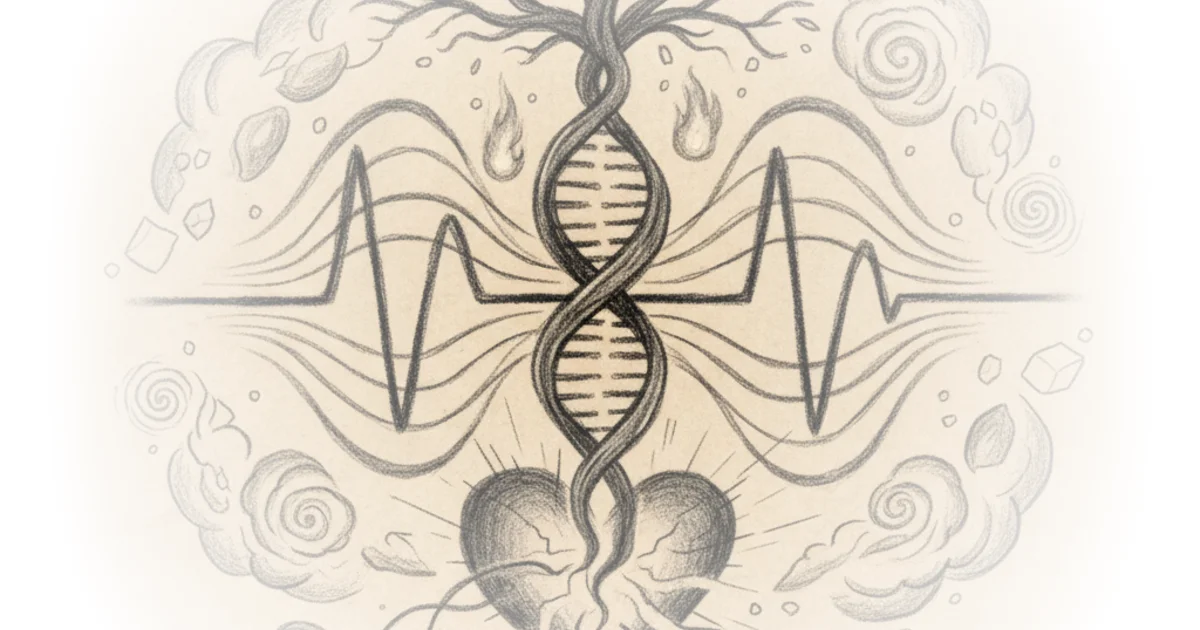
The commentary here is sharp and necessary. By focusing only on broken proteins, researchers have ignored the complex instruction manual that tells genes when and where to work. "Noncoding variants are expected to address many of the limitations of coding variants," the article asserts, pointing to the regulatory elements scattered across the genome that control this spatial and temporal precision. Critics might note that studying noncoding regions is significantly harder due to the lack of clear functional markers, but the piece correctly identifies this difficulty as a barrier to be broken, not a reason to ignore it.
"Solving this mystery not only will bring genetic diagnoses for hundreds of rare diseases but I believe it will also bring breakthroughs in drug development."
A New Mechanism of Disease
The core of the coverage centers on a specific, newly identified cardiac syndrome called ST depression syndrome. The narrative traces a patient followed for over 30 years, who remained asymptomatic until developing fatal arrhythmias later in life. The genetic investigation revealed a "complex deletion-insertion variant" that the authors call "delinsTCCC." What makes this finding extraordinary is not the disease itself, but the mechanism: "the authors report a new mechanism through which noncoding variant causes a gain of function effect: de novo creation of a cardiomyocyte-specific enhancer."
GWAS Stories details how the mutation created a new enhancer where none existed before. In a stunning twist, this new element did not directly contact the target gene's promoter. Instead, it acted as a "super enhancer" that amplified the interaction between a nearby, existing enhancer and the gene. "The physical interaction between E-139 element and KCNB1 promoter became amplified in the presence of delinsTC," the piece reports. This finding challenges the standard model of gene regulation, suggesting that mutations can rewire entire networks rather than just breaking a single link.
The editors use this case to illustrate a broader principle: "disease-variants not only can disrupt already existing regulatory elements but it can also introduce an entirely new regulatory element." This is a profound shift in perspective. It means that a gene normally silent in the heart could be forced to express itself there, causing disease not because the protein is broken, but because it is in the wrong place at the wrong time.
Rethinking Diagnostic Priorities
The final section of the piece serves as a warning to the medical community. The standard practice of excluding genes that aren't expressed in the relevant tissue is now shown to be flawed. "The study reminds us that disease-variants not only can affect genes that are specifically expressed in disease-relevant tissues but it can also affect genes that are specifically not expressed in disease-relevant tissues," the editors argue. This insight is crucial for clinicians and researchers who might otherwise dismiss a gene as irrelevant simply because it doesn't show up in a standard heart tissue screen.
The authors conclude with a forward-looking statement: "we believe this is the first description of an entirely de novo cryptic enhancer causing a Mendelian disorder." They suggest that as whole genome sequencing becomes more common, similar mechanisms will likely be uncovered, fundamentally changing how we diagnose and treat rare diseases. A counterargument worth considering is whether these "super enhancer" effects are rare anomalies or a common feature of complex diseases that we have simply lacked the tools to detect until now.
"This study is one of the many examples to remind us that we should reconsider our notions about disease-causing variants."
Bottom Line
The strongest part of this argument is its demonstration that genetic disease can arise from the creation of biological function, not just its destruction. The piece's biggest vulnerability lies in the sheer complexity of validating these mechanisms, which requires expensive, multi-step experimental validation that may not be scalable for all rare diseases. However, the implication is clear: the next frontier of precision medicine lies in the noncoding genome, and ignoring it is no longer an option.