Paul Cooper doesn't just recount the fall of an empire; he reconstructs the geological and biological stage upon which that drama played out, arguing that the Aztec story is inextricably linked to a 66-million-year-old cosmic accident. By weaving together the discovery of a single stone disc in modern Mexico City with the extinction of the dinosaurs, Cooper reframes the collapse of Tenochtitlan not as a sudden historical event, but as the final chapter in a deep-time narrative of isolation and convergence. This approach offers busy listeners a rare perspective: the realization that the clash of worlds was made possible by the very shape of the continents and the timing of the last ice age.
The Stone Beneath the Asphalt
Cooper anchors his narrative in a tangible, modern moment before leaping back into deep time. He describes how, on a February night in 1978, electric company workmen in Mexico City struck an "enormous piece of stone" while digging for cables. This discovery, a three-meter disc depicting the decapitated goddess Coyolxauhqui, sparked a massive excavation that revealed the buried heart of Tenochtitlan. Cooper writes, "The excavations in Mexico City would go on for another 4 years and every day its people would come and watch as the ruins of a buried civilization rose out of the familiar streets."
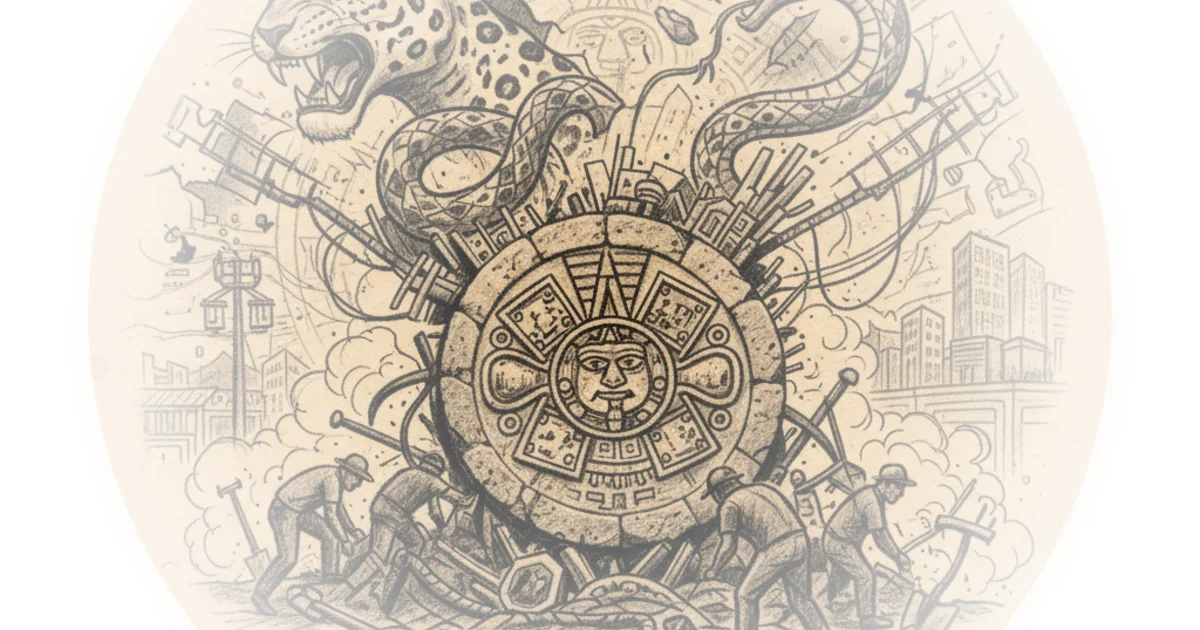
This framing is effective because it grounds the abstract concept of a "fallen civilization" in the concrete reality of urban life. It forces the listener to confront the idea that history is not just in books, but literally underfoot. Cooper uses this moment to pivot to the fundamental question of the episode: "How could such a large and advanced Society simply disappear beneath the Earth?" The answer, he suggests, requires looking far beyond the 16th century.
The discovery of this Stone sparked an outburst of interest in what else might lie beneath the surface of Mexico City.
The Deep Time Stage
To explain why the Americas were so isolated, Cooper takes a radical step back, describing the world before the asteroid impact that wiped out the dinosaurs. He paints a vivid picture of a prehistoric North America, noting that "in those days its surface was home to enormous reptiles known today as dinosaurs." He details the catastrophic impact 66 million years ago, describing how an asteroid "measuring 11 km across" released energy equivalent to "the entire world's nuclear Arsenal being detonated all at once about 15,000 times over."
This geological context is crucial to Cooper's thesis. He argues that the separation of the continents by the Atlantic Ocean created a distinct evolutionary path for the Americas. While Afro-Eurasia developed certain megafauna and human cultures, the Americas were cut off. Cooper explains that "the human populations of the two sides of the world were now separated," a separation that would only end when sea levels dropped during the last ice age, allowing humans to cross a land bridge. The core of his argument is that the Aztec civilization was a product of this specific, isolated evolutionary timeline.
Critics might note that spending significant time on dinosaur extinction risks overshadowing the actual human history, but Cooper uses it to emphasize the fragility of life and the sheer improbability of the civilizations that eventually rose. He posits that the "small rat-sized mammals from which every person you know today is ultimately descended" survived only to eventually populate a continent that had been reset by cosmic violence.
The Rise of the Mexica
As Cooper moves from deep time to the specific rise of the Aztec Empire, he clarifies a common misconception: the people we call Aztecs called themselves the Mexica. He highlights the importance of the sources used to tell this story, particularly the work of the Spanish churchman Bernardino de Sahagún. Cooper writes, "One of the main sources for these years was the work of the Spanish Churchman Bernardo Des sahagun who some have called the first Anthropologist."
Cooper details how Sahagún spent 50 years learning Nahuatl and recording the memories of indigenous elders decades after the conquest. The result was the Florentine Codex, a massive manuscript containing "over 2,500 illustrations drawn by native" artists. This section is vital because it addresses the reliability of the narrative. Cooper acknowledges the challenge: "one problem for historians is that these eyewitness accounts were all written after contact and most several decades after the events."
By foregrounding the Florentine Codex, Cooper validates the indigenous voice within a colonial framework. He notes that the Toltecs, who preceded the Mexica, were so renowned for their craftsmanship that the word "Toltec" came to mean "artist" in Nahuatl. This cultural lineage helps explain the sophistication of the Mexica, who built upon the ruins of earlier giants like Teotihuacan. Cooper writes, "Teotihuacan played a similar role in Mexico as the ancient Greeks did for Europeans; they inspired new cultures and left a mark on their religion society and art."
The most famous section of the Historia General is known as the Florentine codex; it's a manuscript consisting of 2,400 Pages organized into 12 books and containing over 2,500 illustrations drawn by native.
Bottom Line
Paul Cooper's greatest strength is his ability to scale the narrative from the cosmic to the cultural, showing how the fall of the Aztecs was the culmination of millions of years of geological and biological drift. While the deep-time prologue is ambitious, it successfully contextualizes the isolation that defined the New World. The piece's vulnerability lies in its heavy reliance on post-conquest sources, though Cooper is transparent about this limitation. For the listener, the takeaway is clear: the clash of worlds was not just a meeting of two armies, but a collision of two entirely separate evolutionary histories.