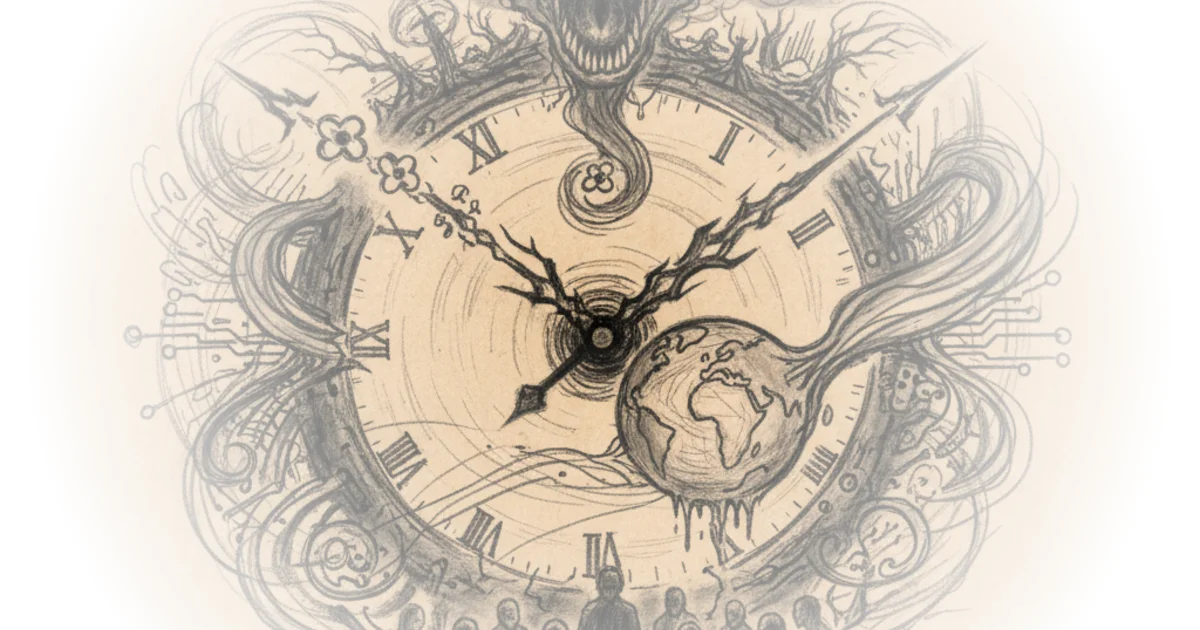
John Campbell doesn't just read the news; he reads the end of the world, and his latest assessment suggests the clock has stopped ticking and started sprinting. By anchoring his analysis in the Bulletin of the Atomic Scientists' 2026 update, Campbell argues that humanity is now merely 85 seconds from midnight, a threshold he claims represents the closest we have ever come to total civilizational collapse. This is not a standard geopolitical recap; it is a visceral warning that blends hard data on nuclear modernization with a provocative critique of global governance and a literal interpretation of biblical prophecy.
The Ticking Clock and the Human Element
Campbell opens by establishing the stakes with a stark timeline. He notes that the Doomsday Clock, originally set in 1947 by Manhattan Project scientists, has fluctuated 27 times but has never been this close to catastrophe. "Midnight is a civilization ending disaster," he states, framing the clock not as a metaphor but as a countdown to a "new dark age" where humanity reverts to hunter-gatherer survival. The author's strength lies in his ability to connect historical flashpoints, like the 1962 Cuban Missile Crisis, to current anxieties, reminding listeners that the fear of total annihilation is not new, but the tools have become more precise and the margin for error thinner.
He argues that the primary driver remains nuclear risk, exacerbated by the modernization of arsenals and the expansion of nuclear-capable nations. "We think of the Cuban missile crisis in 1962... This was the climate of fear justifiably so," Campbell recalls, drawing on personal memory to illustrate the immediacy of the threat. He suggests that accidents, miscalculations, or even the "possible madness" of leaders could trigger a conflagration that renders our advanced technology useless. Critics might note that the Bulletin of the Atomic Scientists includes a broad range of experts who weigh climate and AI alongside nuclear threats, whereas Campbell tends to prioritize the nuclear angle as the singular "top of the list" existential threat, potentially oversimplifying the complex interplay of global risks.
"We are being the instruments of our own potential destruction."
The Arrogance of Technology and Governance
Moving beyond the bomb, Campbell turns his attention to what he views as a dangerous hubris in human innovation. He is particularly scathing regarding geoengineering and the manipulation of the climate, questioning the wisdom of "spraying chemicals into the ozone layer" without understanding the "knock-on butterfly effects." He frames this not just as a scientific risk, but as a moral failing of arrogance. "How can people be so complacent and so arrogant as to think they can manipulate climate like that?" he asks, challenging the assumption that technology can always fix the problems it creates.
This skepticism extends to the rise of artificial intelligence and the erosion of the nation-state. Campbell cites a 2017 prediction by Vladimir Putin regarding AI dominance to highlight the geopolitical stakes of the technology race. He warns that "deep fakes" could soon be used to trigger nuclear war by impersonating world leaders, creating a scenario where "you don't know who is saying something." Furthermore, he argues that international bodies are actively disempowering national governments, leading to a loss of patriotism and a rise in "malfeance" or deliberate harm by global elites. He points to the prioritization of the World Economic Forum over national parliaments as evidence of this shift, claiming, "I would have thought that makes him a traitor."
"The one who becomes the leader in this sphere will be the ruler of the world."
The Four Horsemen and the Path Forward
In a distinctive pivot, Campbell concludes by mapping modern threats onto the biblical Four Horsemen of the Apocalypse from Revelation chapter 6. He interprets the white horse's bow as modern weaponry, potentially augmented by biological pestilence, and the red horse's sword as the capacity for mass death through thermonuclear or chemical means. "He was given power to take peace from the earth and to make people kill each other," Campbell writes, drawing a direct line between ancient prophecy and current military capabilities.
Despite this grim outlook, he offers a path to push the clock back, though he remains deeply pessimistic about its feasibility. He calls for "humility" in the face of nature, the localization of food production, and the removal of current world leaders who resist change. "Science and evidence-based policym change most national and world leaders," he asserts, adding the blunt caveat that "we need to get rid of most of the world leaders that we have now." While his call for transparency in biological research and keeping "humans in the loop" for AI decisions is reasonable, his solution of replacing global leadership is politically vague and relies on a level of consensus that the very fragmentation he describes makes impossible.
"We can reduce risk of nuclear war if only we work together. But of course, we don't, so maybe we can't."
Bottom Line
Campbell's commentary is a powerful, if alarmist, synthesis of nuclear anxiety, technological distrust, and religious metaphor that successfully conveys the urgency of the current geopolitical moment. Its greatest strength is the emotional resonance of connecting historical fears with future technologies, but its credibility is strained by a tendency to conflate legitimate scientific risks with conspiratorial narratives about global elites and a reliance on biblical literalism that may alienate secular readers. The piece serves as a stark reminder that the margin for error is gone, even if the proposed solutions remain out of reach.