The Architecture of Modern Authoritarianism
Brad DeLong's crosspost of Josh Marshall's analysis cuts through the noise to identify something larger than any single politician: a transnational network of wealth, power, and anti-democratic ambition that has congealed into a self-aware movement.
The Authoritarian International
DeLong draws on Marshall's framing of what they call the "Authoritarian International"—a coalition that extends far beyond American politics. Brad DeLong writes, "I'm talking about the global authoritarian movement, which includes and is even perhaps led by Trump. But it exists quite apart from him and has roots in some of the wealthiest and most powerful people and governments around the world."
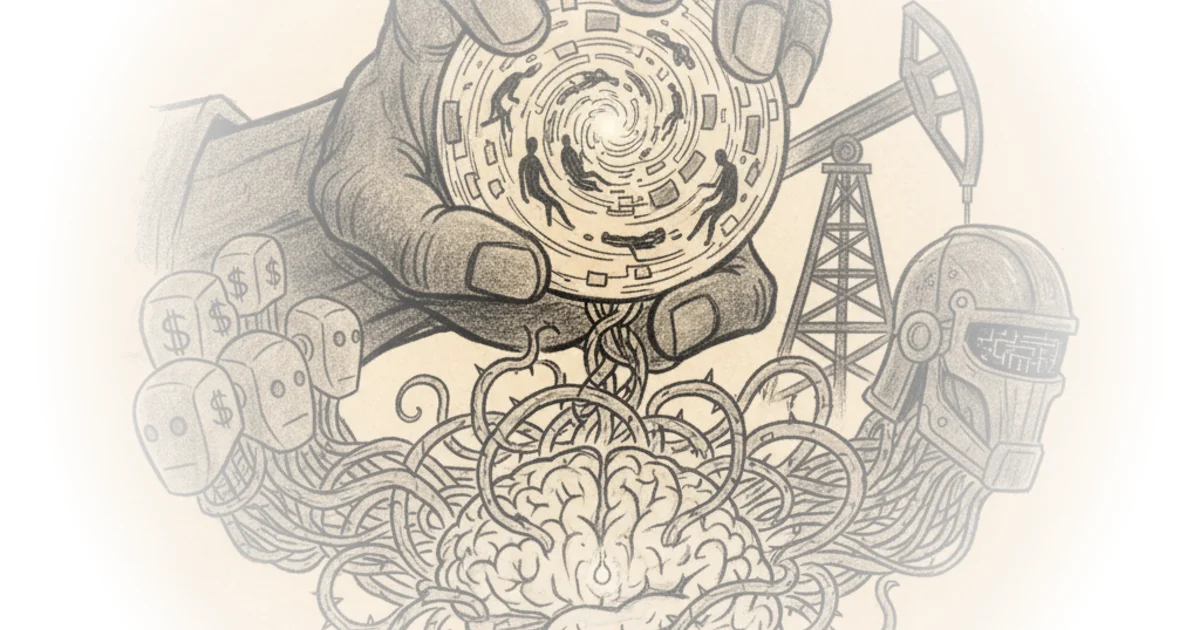
The network includes Gulf monarchies, post-Soviet oligarchs, elements of Silicon Valley's rightward shift, and a billionaire class that has increasingly aligned itself with primitive economy petro-states. As Brad DeLong puts it, "Trump is their avatar, but they exist and are now joined together in a way that will outlive him personally and electorally."
This is not merely an anti-democratic project but something more fundamental: an anti-civic world built on private deals, mutual secrecy, and soft extortion. Brad DeLong observes, "It's a world of private, one-off deals, mutual pledges of secrecy, often enforced by soft, mutual extortion, and above all, a rejection of democratic accountability."
"They command vast economic resources; they run the governments in many countries where the government never changes; they have deep tentacles into the U.S. political system and many of its key players are from the U.S."
The Parasocial Trap
DeLong then pivots to examine the infrastructure that enables this movement: our current attention-based information ecosystem. He describes how human social cognition—evolved for villages of 150 people—now operates in a billion-person feed curated by authoritarian-curious plutocrats.
Brad DeLong writes, "Now the same wetware is deployed into a mediasphere where the 'village' is a billion-person feed, and the people who most reliably trigger our attention systems are those who broadcast strong signals—charisma, outrage, fear, desire—without any of the feedback that would normally tame them."
The result is a profound skew in how we allocate moral and emotional energy. Most modern relationships are primarily parasocial—we spend more hours with curated information sources than with neighbors or colleagues. As Brad DeLong puts it, "In terms of sheer hours of exposure and emotional arousal, even most of our real relationships these days are primarily parasocial."
Marshall's Counter-Model
Against this backdrop, DeLong presents Josh Marshall's Talking Points Memo as evidence that another path exists. Marshall built a membership-funded enterprise that treats subscribers as co-owners rather than eyeballs to monetize.
Brad DeLong notes, "Where others took venture money and pursued scale for its own sake, Marshall slowly built a membership-funded enterprise that treats subscribers less as eyeballs to be monetized than as co-owners of a long-running civic project."
This business choice is normative as well as financial—it aligns incentives with sustaining a reality-based public sphere rather than optimizing for outrage and virality. Brad DeLong writes, "He showed that a small, stubborn, historically literate operation, in loyal conversation with its readers, can do real journalism, shape real outcomes, and keep alive the idea that being extremely online need not mean being permanently diminished."
Critics might note that Marshall's model depends on a narrow slice of politically engaged readers willing to pay—a luxury that most news consumers cannot afford. The membership approach may preserve quality but sacrifices the democratic ideal of universal access. Others might argue that DeLong's diagnosis of parasocial overload overlooks how traditional media also cultivated parasocial bonds—radio audiences felt they knew FDR, moviegoers felt they knew Garbo. The infrastructure has changed, but the psychological dynamic is older than the internet.
Bottom Line
DeLong's piece identifies a structural threat that transcends electoral cycles: a global network of wealth and power that has organized itself against civic democracy, operating through the attention-hacking tools of our current information ecosystem. Marshall's TPM demonstrates that reality-based journalism can survive—but survival requires readers who treat news as a civic investment rather than free content. The verdict: this analysis matters because it names the architecture of the problem, not just its symptoms.