This piece from Works in Progress delivers a jarring, data-driven reality check: the poverty of the developing world is not just a lack of buildings, but a catastrophic failure to leave room for movement. While most urban analysis fixates on housing density or slum upgrading, the editors argue that the true bottleneck for economic growth in the Global South is the systematic erosion of public space. They posit that without deliberate, often painful, intervention to carve out wide streets and transit corridors, rapid urbanization will merely create sprawling, disconnected settlements rather than engines of prosperity.
The Historical Imperative
The article's central thesis rests on the concept of agglomeration—the economic boost that comes from human proximity. Works in Progress reports, "Cities enable cooperation. They allow people to specialize, to hire and be hired, to learn from one another, to build things together that none could build alone." However, the editors quickly pivot to the physical prerequisite for this cooperation: access. "Buildings without transport are as useless as transport without buildings," they note, establishing that density without connectivity is a trap, not an opportunity.
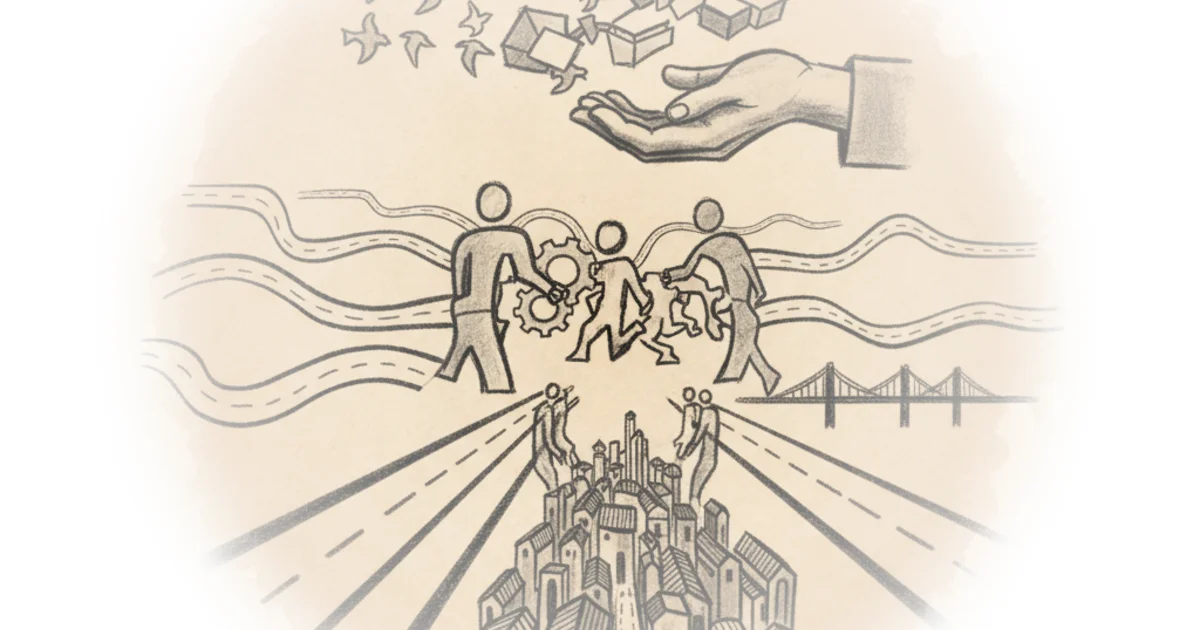
The piece contrasts the chaotic, incremental growth of modern developing cities with the deliberate, often violent, restructuring of nineteenth-century Europe. In the past, authorities understood that private claims to land would inevitably crowd out the shared spaces necessary for a city to function. The editors write, "In nineteenth-century Europe and America, this tension between private use and public need prompted a historic rebalancing." This was not a gentle process. The article highlights how "railway lines were driven almost to cities' cores, huge termini were built, and vast fleets of trams rattled up and down wide new public roads built by destroying existing city fabric."
To illustrate the scale of this ambition, the editors point to Baron Haussmann's renovation of Paris, where "close to 20,000 buildings" were demolished to create the boulevards that still define the city today. Similarly, London saw the creation of major arteries like Shaftesbury Avenue and Regent Street by cutting through existing neighborhoods. The argument is clear: these investments were not mere luxuries or aesthetic choices. As the piece argues, "These investments were not just luxuries: they were what made industrial-era agglomeration possible." Without these wide arteries, the productivity gains of the industrial age would have been impossible to realize.
"Buildings without transport are as useless as transport without buildings: the benefits of agglomeration depend on access, on the ability of people and goods to move efficiently across urban space."
Critics might argue that this historical parallel ignores the immense human cost of such projects, particularly the displacement of poorer tenants who were often left without adequate substitutes after eviction. The editors acknowledge this, noting that "poorer tenants were often left without adequate substitutes after they were evicted from their homes," yet they maintain that the long-term economic dividends for the city as a whole justified the short-term disruption. This utilitarian calculus remains a contentious point in modern urban planning, where the rights of the individual often clash with the needs of the collective.
The Cost of Crowded Streets
The editors turn their attention to the developing world, where the opposite dynamic is playing out. Instead of reserving land for public use, rapid urbanization is consuming it. The data presented is stark: while Manhattan and London dedicate roughly 24 to 27 percent of their land to roads, the average city in Africa, Asia, or Latin America reserves only 16 percent. In cities like Dhaka, Kolkata, and Nairobi, the figure drops to between 10 and 14 percent.
"Lax building rules have allowed homes and workplaces to take over public spaces," the article observes, leading to a paralysis of movement. The economic consequences are immediate and severe. The piece cites IMF estimates showing that average road speeds in countries like India and Nigeria are less than half of US speeds. In Delhi, journeys during rush hour are "75 percent longer" than at other times. The human toll of this inefficiency is quantified in the cost of a commute: "The direct costs of one-way motorized travel to Lower Parel in Mumbai's economic center are seven times the hourly wage of the average Mumbaikar."
This congestion creates a vicious cycle where the poor are effectively locked out of the labor market. The editors note that "poorer residents instead make most of their trips on foot, and are thus shut off from the larger labor market entirely." Even for those with access to vehicles, the unpredictability of travel times forces workers to arrive early, sacrificing hours of potential productivity. A study in Bardoli, India, found that to avoid being late once a week, commuters had to account for travel times that were 40 percent longer than the average.
The argument here is that the lack of infrastructure is not a passive condition but an active barrier to growth. "Without deliberate efforts to reserve and protect rights of way," the piece warns, "they risk becoming collections of poorly connected settlements rather than integrated economic wholes." The contrast with the nineteenth-century European model is sharp: then, governments used their power to carve out space for the future; now, the absence of such intervention is condemning cities to stagnation.
The Dividend of Infrastructure
Despite the grim diagnosis, the article offers a compelling case for intervention, backed by empirical evidence. The editors cite studies showing that road density is a primary driver of population growth and productivity. One study of Sub-Saharan African cities found that "every single kilometer of road per square kilometer of area in the center of a city leads to a city population that is between 1.5 and 7 percent larger 15 years later." Another analysis of American cities revealed that those with high highway density saw a 4 percent increase in output per worker when their population doubled, while those with low density saw no such gain.
The piece highlights the transformative power of even modest infrastructure investments. In Mexico, a randomized program to pave roads in slums resulted in a 2 percent return on investment through increased property values alone. Households in these areas increased their vehicle ownership by half and gained access to a wider range of economic opportunities. "By giving land over to public uses, especially infrastructure, including roads, developing countries can improve economic growth, largely through enhancing agglomeration," the editors conclude.
The argument is reinforced by the example of China, where the construction of 98,000 kilometers of motorway between 1990 and 2012 generated an annual return of 11 percent due to productivity gains. The message is unambiguous: the path to prosperity is paved, literally. The editors urge that "if they are to deliver on the promises of urbanization, they must make room for the roads, railways, and shared infrastructure that turns density into opportunity."
"Cities bring us closer to one another, with all the potential benefits that offers. But how much they do this depends on how good intra-city transport is."
A counterargument worth considering is the political feasibility of such large-scale land acquisition in modern democracies or fragile states. The nineteenth-century model relied on strong, often authoritarian, central governments willing to expropriate land and displace populations. Replicating this in today's complex political landscape, where property rights are more entrenched and civil society is more vocal, presents a significant hurdle. The article touches on this but does not fully explore the political mechanics of how such reforms could be implemented without sparking social unrest.
Bottom Line
The strongest part of this argument is its refusal to treat urban congestion as an inevitable byproduct of growth, instead framing it as a policy failure with measurable economic costs. The editors effectively use historical precedent to demonstrate that the wide streets of the modern world were not natural occurrences but deliberate, hard-won achievements. The biggest vulnerability lies in the political roadmap; while the economic case for wider streets is irrefutable, the article offers less clarity on how to navigate the fierce resistance to land expropriation in the twenty-first century. For policymakers, the takeaway is clear: the next great leap in global development will not come from building more houses, but from carving out the space to move between them.