David Smith cuts through the noise of a volatile week to reveal a disturbing pattern: Moldova is no longer just a bystander to the war next door, but an active target of hybrid warfare where the battlefield has shifted from the front lines to the air above Chisinau and the disinformation feeds of local politicians. This isn't just a report on stray drones; it is a forensic examination of how a small nation's sovereignty is being eroded by a coordinated mix of physical incursions and psychological operations designed to paralyze its government.
The Sky Over Chisinau
Smith opens by documenting a disturbing escalation in aerial violations, moving from a single, low-altitude incursion to a coordinated swarm. He notes that on the night of November 24-25, Moldovan surveillance detected six drones entering the country's airspace, a stark contrast to the single, unarmed unit seen days prior. "A much larger incursion took place on the night of November 24-25, where the Moldovan army's airspace surveillance systems detected 6 drones entering the country's airspace," Smith writes, highlighting the shift from anomaly to tactic.
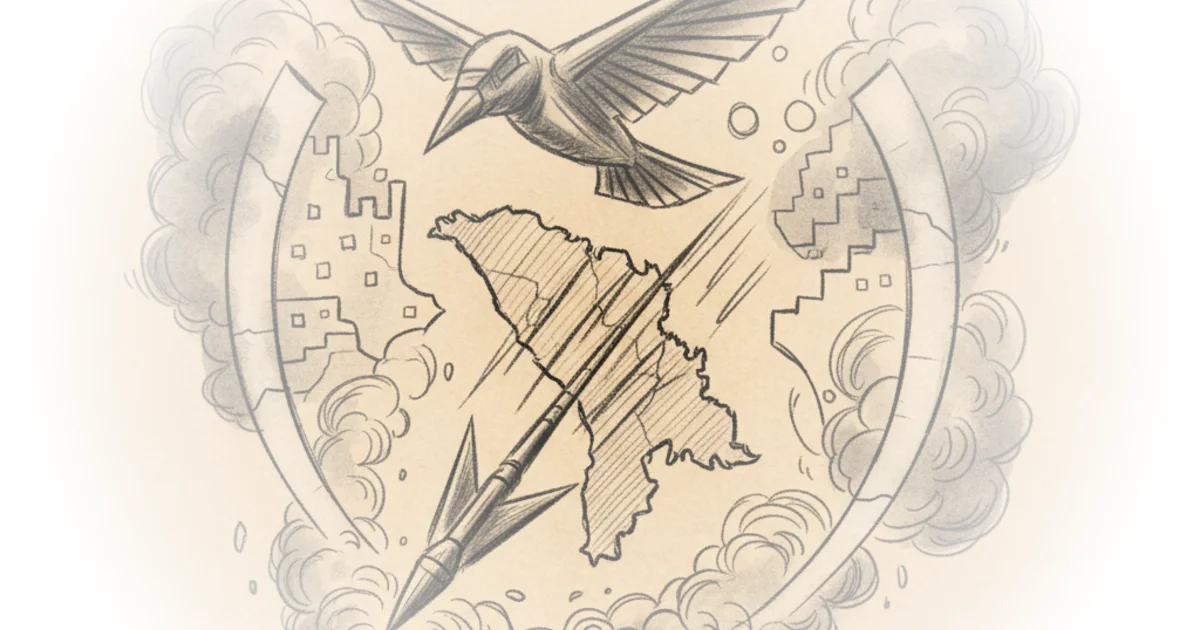
The author provides crucial context on the hardware involved, identifying one crash-landed drone as a Russian Gerbera. While often dismissed as mere decoys, Smith points out their dual utility: "Gerbera drones can carry around 5-10 kg of TNT and they also have surveillance capabilities." This detail is vital; it suggests that even "decoys" are not harmless, serving as eyes to map Ukrainian air defenses while carrying enough explosive force to threaten civilian infrastructure. The proximity of these flights to the Vulcănești power station—a critical node for the new high-voltage line to Chisinau—underscores the strategic intent behind the chaos.
"We live on the border with the bloodiest war on the continent in the last 80 years."
Smith uses this quote from former Economy Minister Dumitru Alaiba to anchor the human and national stakes, contrasting the gravity of the situation with the absurdity of the political response. The author argues that the immediate reaction from pro-Russian factions was not concern for safety, but a rapid pivot to conspiracy. "Some do so out of ignorance (not to say stupidity). Others do so because they follow and promote the agenda of Russian propaganda, which will continue to try to convince us that war is not war and that Russia is not the aggressor," Smith paraphrases Alaiba's frustration. This framing is effective because it exposes the mechanism of the attack: the physical drone is secondary to the narrative weaponization of its crash.
Critics might argue that Smith is too quick to dismiss the "false flag" theories raised by opposition figures like Igor Dodon, who claimed the government staged the crash to cover up scandals. However, Smith's evidence regarding the drone's flight path and the specific radar signatures makes the "staged" theory logistically improbable, suggesting that the conspiracy narratives are themselves a tool of the hybrid war.
The Border Breach and the Weaponized Narrative
The piece shifts to a ground-level incident that quickly spiraled into a geopolitical scandal. On November 20, a truck flagged by Moldovan customs at the Leușeni-Albița crossing was found carrying a cache of Soviet-era weaponry, including anti-tank missiles and a surface-to-air launcher. Smith meticulously details the contents: "18 items of 'ammunition components', 8 items of 'complete ammunition', a surface to air launcher, [and] a Geran 2 drone."
What makes this section particularly sharp is Smith's dissection of the disinformation campaign that followed. He notes that the story was weaponized before the facts were even clear. "Immediately a flurry of mis- and dis-information exploded across the internet," he observes, pointing out how opposition figures seized on the fact that Romanian scanners, not Moldovan ones, found the weapons. The narrative twisted into a claim of Moldovan incompetence or corruption, with Renato Usatii even falsely claiming the presence of a US-made Stinger missile.
Smith identifies the true target of this information operation: "The Internal Narrative - The Moldovan government is corrupt and complicit in selling drugs and arms trafficking. The External Narrative - Ukraine is corrupt and is selling American weapons." This analysis is the core of the article's value. It reveals that the smuggled weapons were likely a "convenient message for the Kremlin," designed to destabilize Moldova's political landscape and erode trust in its institutions. The fact that the truck was ostensibly bound for Israel, a destination with no logical need for such a specific cache of Soviet hardware, further supports the theory of a setup.
"All the hallmarks of a false flag operation."
Smith cites the watchdog group Watchdog, which suggests the entire event was a pre-planned information operation. The author's choice to highlight the lack of a "logical reason" for smuggling these specific weapons to Israel is a powerful rhetorical move, stripping away the cover story and exposing the operation's true purpose: fear-mongering.
The Diplomatic Void
The commentary concludes by contextualizing these events within the broader geopolitical shift, specifically the absence of the United States. Smith attended the Moldova Security Forum and noted a glaring omission: "At the Moldova Security Forum that absence of any US government representatives on panels was notable and impossible to imagine if this was held even 1 year ago."
This observation ties the local security threats to the global political vacuum. Smith references the chaotic "peace plan" discussions emanating from the White House, noting that European podcasts are increasingly arguing that "all evidence points to the [US] administration actively supporting the Russian position." President Sandu's plea for support—"The democratic world must work with us to propose solutions. We can participate in discussions, but we cannot accomplish this alone"—takes on a darker tone when viewed against this backdrop of American retrenchment.
Smith's argument here is that Moldova is being forced to stand alone against a sophisticated hybrid war, with its own population divided by foreign-funded disinformation. The "peace plan" chaos is not just diplomatic noise; it is a signal that the security guarantees Moldova relies on are fracturing.
Bottom Line
David Smith's most compelling argument is that the drone incursions and the weapons smuggling scandal are not isolated security failures, but synchronized components of a Russian strategy to paralyze Moldova through fear and internal division. While the piece effectively dismantles the "false flag" conspiracy theories with hard evidence, its greatest vulnerability lies in the uncertainty of the investigation's outcome; if the smugglers are indeed "disposable agents" acting without high-level direction, the Kremlin's direct culpability remains technically unproven. Readers should watch for the next phase of the investigation into the "unknown persons" in Ukraine who supplied the weapons, as this will determine whether this was a rogue operation or a state-directed campaign.