Jack Clark's latest dispatch from Import AI cuts through the usual hype to reveal a startling reality: the tools we use to build AI are now being used to write mathematical proofs and automate cyberattacks at a speed that outpaces human oversight. This isn't just about faster code; it is about a fundamental shift in how intelligence is generated, verified, and weaponized, suggesting that the bottleneck for the future of technology is no longer human ingenuity but computational throughput. For the busy professional, the takeaway is urgent: the era of waiting for AI to mature is over; the era of AI acting as a primary economic and security actor has arrived.
The End of Specialized Math
Clark highlights a breakthrough that upends the assumption that AI needs custom-built architectures to handle complex logic. He points to a new system, Numina-Lean-Agent, which leverages standard, general-purpose foundation models to solve high-level mathematical problems. "In the past few years, large-scale AI models have become good at coding and have also begun to generalize into other useful disciplines, especially those in math and science," Clark observes. The system didn't just mimic human mathematicians; it collaborated with them to formalize the Brascamp-Lieb theorem, a task that required generating over 8,000 lines of formal code and introducing 70 new definitions in less than two weeks.
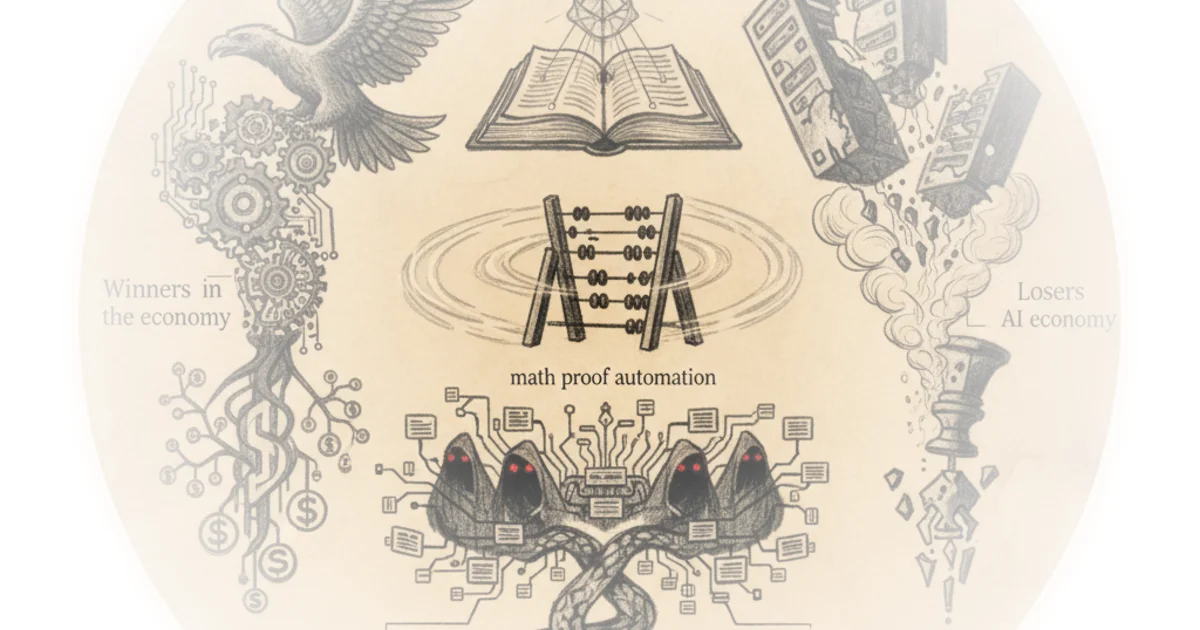
The architecture of this system is particularly revealing. It doesn't rely on a single monolithic brain but rather a "Discussion Partner" tool that allows the primary model to "proactively initiate discussions with other LLMs" when it hits a logical wall. This mimics human collaboration, where experts consult one another to resolve dilemmas. Clark notes that this approach demonstrates a crucial trend: "the AI ecology writ large is composed of many distinct frontier models and it seems like getting these models to interact with one another can lead to some richness." This suggests that the future of AI development lies not in building bigger, single models, but in orchestrating ecosystems of specialized agents that can critique and refine each other's work.
Critics might argue that solving math problems in a controlled environment like the Putnam competition doesn't equate to handling the messy, unstructured reality of real-world scientific discovery. However, the speed at which the agent generated new lemmas suggests that the gap between simulation and reality is closing faster than many anticipate.
The era of math proof automation has arrived, and it shows that AI systems are far more capable than people think when given the right tools to elicit their capabilities.
The Industrialization of Cyber Warfare
The tone shifts dramatically when Clark turns to cybersecurity, where the implications are less about academic curiosity and more about immediate existential threat. He cites independent researcher Sean Heelan, who tested advanced models on generating exploits for a zero-day vulnerability. The results were sobering: the models performed so well that Heelan predicts a future where the limiting factor for attackers is not the number of hackers they employ, but their "token throughput over time."
Clark explains that we are moving toward a world where "vulnerability discovery and exploit development you can trade tokens for real results." This is the industrialization of cyber espionage. Just as the Industrial Revolution replaced manual labor with machines, the AI revolution is replacing the manual labor of hacking with automated agents. The speed of this transition is the critical variable. Clark posits that "most parts of cyberoffense and cyberdefense are going to move to running at 'machine speed', where humans get taken out of most of the critical loops."
This creates a dangerous asymmetry. While defense requires patching every single vulnerability, offense only needs to find one. Clark's assessment is grim: "my guess is we're heading for an era of offense-dominance as it'll take a while for defenses to get deployed." The White House and other government bodies are already grappling with this, with OpenAI's CEO noting that models are approaching a "Cybersecurity High" level where they can automate end-to-end operations against hardened targets. The risk is that the very tools designed to secure networks will be used to dismantle them faster than humans can react.
The Economic Tsunami and the Cost of Safety
Beyond code and code-breaking, Clark explores the macroeconomic implications through the lens of Stanford economist Charles "Chad" Jones. Jones argues that AI will likely be the most significant technological invention in human history, surpassing even electricity and semiconductors. The core of his argument rests on the potential for AI to automate all cognitive labor, which could raise GDP by 50 percent. "If this occurred over the course of a decade, it would raise growth rates by something like 5 percent per year, which would be huge," Clark writes, summarizing Jones's projection.
However, Jones also confronts the dark side of this abundance: the risk of catastrophic failure. He draws a parallel to the global response to the pandemic, where society spent the equivalent of 4 percent of GDP to mitigate a 0.3 percent mortality risk. If the risk of AI-induced extinction is even 1 percent, Jones argues that the economic logic dictates we should be willing to spend "more than 100% of GDP" to mitigate it. He proposes a radical solution: a tax on compute hardware like GPUs and TPUs to fund safety research and slow the race. "In addition to slowing the race, this revenue could be used to fund safety research," he writes, suggesting a global mechanism to manage the pace of innovation.
This economic framing forces a difficult question: are we prepared to pay the price for safety, or will the competitive pressure to deploy AI faster override caution? A counterargument worth considering is that taxing compute might simply drive development to jurisdictions with laxer regulations, accelerating the very risks the tax aims to prevent. Yet, the sheer scale of the potential upside and downside makes the debate unavoidable.
Winners and Losers in the Transition
Finally, Clark examines who will survive the transition. A study from the Centre for the Governance of AI suggests a nuanced picture of job displacement. Contrary to the fear that AI will wipe out vast swathes of the workforce immediately, the data shows that "AI exposure and adaptive capacity are positively correlated." Many workers in high-exposure roles, such as managers and technical specialists, have the resources and skills to pivot. However, a specific group remains vulnerable: "6.1 million workers... work in occupations that are both highly exposed and where workers have low expected adaptive capacity," primarily concentrated in clerical and administrative roles.
The study identifies key factors like net liquid wealth, skill transferability, and geographic density as buffers against displacement. Older workers, for instance, face greater challenges due to "reduced flexibility in retraining, relocation, and occupational switching." This data provides a stark map of the coming inequality. While the economy may grow, the distribution of those gains will depend heavily on one's ability to adapt. Clark notes that the "speed of AI diffusion" is the missing variable; if the technology rolls out slowly, adaptive capacity matters less. If it arrives overnight, the gap between the adaptable and the vulnerable could become unbridgeable.
We are already at a point where with vulnerability discovery and exploit development you can trade tokens for real results.
Bottom Line
Jack Clark's analysis delivers a sobering verdict: the AI revolution is no longer a theoretical future but a present-day accelerator of both mathematical discovery and cyber conflict. The strongest part of his argument is the demonstration that general-purpose models, when paired with the right tools, can outperform specialized systems in complex domains, signaling a shift toward agentic ecosystems. The biggest vulnerability, however, lies in the assumption that defense can keep pace with offense in a machine-speed environment. Readers must watch for how the administration and global regulators respond to the proposed compute taxes and whether the "industrialization" of hacking forces a fundamental restructuring of digital security before the next major breach occurs.