The most remarkable thing about this piece isn't the physics — it's the public spectacle of two scientists wagering $10,000 on whether a toy car can beat the wind. Derek Muller, a YouTube science communicator best known for Veritasium, has bet against Professor Alex Cenko at UCLA over one of the most counterintuitive claims in transport physics: that a vehicle with no motor, powered only by the wind itself, can travel faster than the wind pushing it. This is not a hypothetical debate. It's a wager witnessed by Neil deGrasse Tyson, Bill Nye, and Shan Caroll — and it's been settled."
The $10,000 Wager
Derek Muller opens the piece with the formal signing of the bet document, writing: "I am here to sign a document betting $10,000 that my last video is in fact correct." This is theater as much as science. The stakes are real — $10,000 — but more importantly, the witnesses are celebrities in the science community. That gravitational shift tells us this isn't some fringe YouTube drama. It's a legitimate physics debate with credible witnesses.
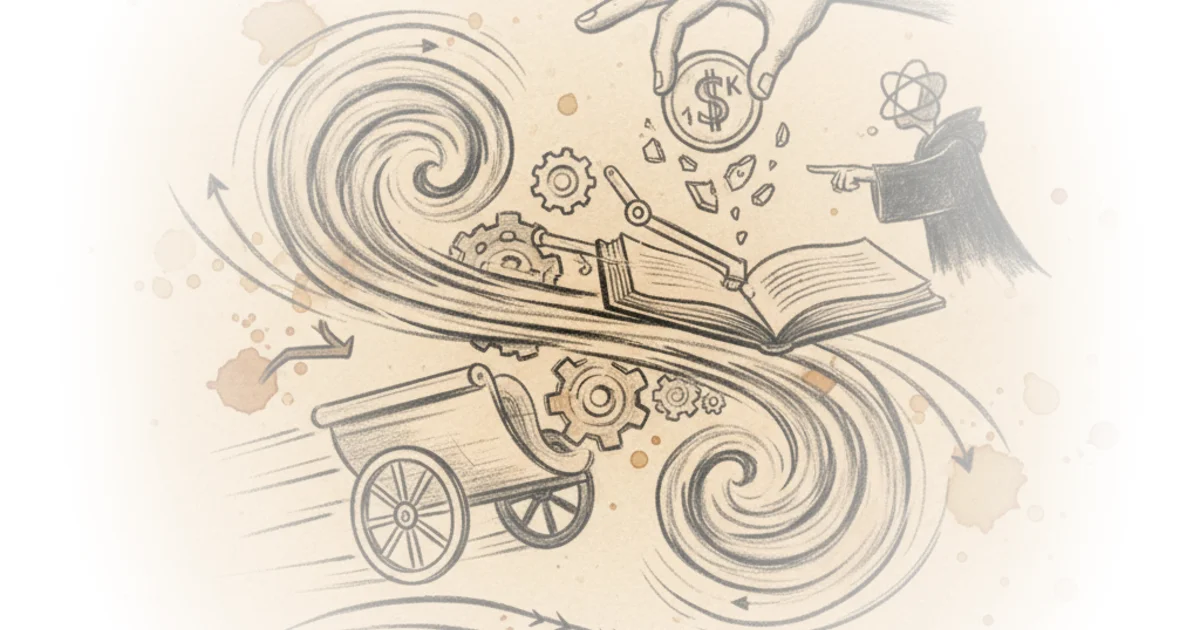
The core claim is laid out plainly: "in this car there is no motor no batteries no energy source besides the wind itself and the counterintuitive claim is that this car can maintain speeds faster than the wind that's pushing it." This is the kind of statement that makes physicists squirm. The entire field of aerodynamics has long accepted that a vehicle powered by tailwind cannot exceed wind speed in steady, constant conditions. Blackbird challenges that assumption.
The Professor's Case
Professor Cenko built his argument on two main points, and Derek paraphrases them: "initially you have the wind speed exceeding the car speed but then the wind speed is not constant" — the professor believed the car's apparent speed came from gusts pushing it up, then dying. Second, he raised the issue of wind gradient: "the wind in the video is measured at the height of about a meter or meter and a half but the propeller goes to some you know three meters above the ground." Due to interactions with the ground, wind travels slower near the surface and faster higher up — meaning the car might actually be moving slower than the wind at the propeller's altitude while appearing to move faster at the telltale height.
This is sophisticated physics. The professor wasn't a crank — he was applying real fluid dynamics to question whether the experimental conditions were clean enough to prove the claim. Derek acknowledges this: "I think that this is a small effect however in combination with the previous effect it just can make this more frequent." That's an understatement. These concerns are serious enough that they required extensive additional evidence.
How Blackbird Actually Works
The crucial explanation comes when Derek breaks down how the propeller actually functions. He writes: "the first thing to know is that the propeller doesn't work like most people think it's not working like a windmill it doesn't turn the way the Tailwind is pushing it." Instead, he explains, "it turns in the opposite direction working like a fan to push air backwards."
This is where the piece becomes genuinely illuminating. The car works because its wheels drive the propeller through a bike chain — just as the wheels of a bicycle drive the pedals. At wind speed, Derek writes, "the car can keep accelerating because the wheels turn the fan which blows air back generating forward thrust." It's not extracting energy from the wind; it's using the car's own momentum through a mechanical lever to create thrust.
The analogy he uses is telling: "this car works like a lever or a pulley by applying a small Force to the wheels over a larger distance the propeller can apply a larger Force over a smaller distance." This is the same principle as riding a bike uphill — you move the pedals fast but with smaller force so the wheels move slower over the ground but with bigger force. The mathematics of power equals force times velocity holds at both interfaces: at the wheels where the ground moves under the car, and at the propeller where air is pushed backward.
At wind speed, the car can keep accelerating because the wheels turn the fan which blows air back generating forward thrust.
The theoretical worry about dividing by zero — what happens when car speed exactly equals wind speed — is dismissed. Derek points out that in practice "there is a propeller efficiency term" and the equation remains well-defined. The divide-by-zero problem disappears because the system never operates at exactly zero relative velocity.
Evidence and Replication
What makes this piece compelling is that Derek didn't rely on theory alone. He showed data: GPS units in the car measured wind speeds at the height of the propeller, confirming "the 10-second measurement period over which the record was set." The telltales — flags that flip backward to indicate relative motion — consistently pointed straight back for over 30 seconds, not jumping around as they would if gusts were causing the effect.
He also had independent verification. Someone on Twitter analyzed wheel rotation from video footage and showed "even after The Telltale flips backwards the car keeps accelerating." This is evidence that the car isn't just coasting after a gust — it's genuinely being propelled faster than the wind at all times.
The replication came from Zyla, who built multiple versions of Blackbird in her workshop. Her fourth version "Works spectacularly" and was designed to be replicated by anyone with a 3D printer and simple materials. This transforms the debate from an expensive experiment into something any curious person can test themselves.
The Concession
The ending carries real weight: "Professor cenko has now conceded the BET and he transferred $10,000 to me so I want to thank him for being a man of honor and changing his mind in light of the evidence." This is remarkable. Professor Cenko didn't just lose the argument — he honored the bet publicly, changed his mind in front of an audience watching on YouTube, and transferred the money.
Derek's decision to "not want to keep the money I want to invest it in science communication" shows character. He's holding a one-minute video competition for explanations of counterintuitive STEM concepts. The bet became a vehicle for more science communication, not personal enrichment.
Critics might note that this kind of public wager — while dramatic and effective — carries risks for academic reputation. Professor Cenko's willingness to concede publicly is unusual in academic disputes, where institutional pride often prevents such clear reversals. But the evidence appears sound: multiple independent measurements confirm Blackbird works as claimed.
Bottom Line
The strongest part of this argument isn't the physics — it's the demonstration that public scientific disagreement, when conducted with integrity and witnessed by credible figures, can produce genuine knowledge. The $10,000 bet created accountability that made denial impossible. Derek's biggest vulnerability is that he asks readers to accept complex mechanical reasoning without a simple visual demonstration in the text itself; viewers must go to the videos to see Blackbird actually working. But the core claim holds: when you have two media moving relative to one another — wind and ground — a vehicle can move faster than their relative velocity by using gears, chains, or levers to translate small forces over large distances into larger forces over smaller distances. The physics is settled, the bet is paid, and the lesson is clear: disagreements are opportunities for everyone to learn something.