Nate B Jones cuts through the geopolitical noise to deliver a startling thesis: the theft of AI capabilities isn't a Cold War espionage thriller, but a structural inevitability driven by economics, much like the music industry's collapse in the late 90s. While headlines scream about Chinese state actors, Jones argues the real threat is a "Napster problem" where the cost of copying intelligence is negligible compared to the cost of creating it, forcing a dangerous convergence of stolen models that fail precisely where businesses need them most.
The Napster Parallel, Not the Cold War
Jones immediately dismantles the convenient narrative of national security. He writes, "If you stop at the Cold War framing, you will miss the single most important implication for your career, your company, and every AI tool that you're using right now." This reframing is crucial because it shifts the focus from international relations to a fundamental flaw in how we value digital assets. The author posits that the "gap between what's inside the frontier labs and what everyone else can access creates what I would call a pressure gradient," forcing information to flow downhill regardless of borders.
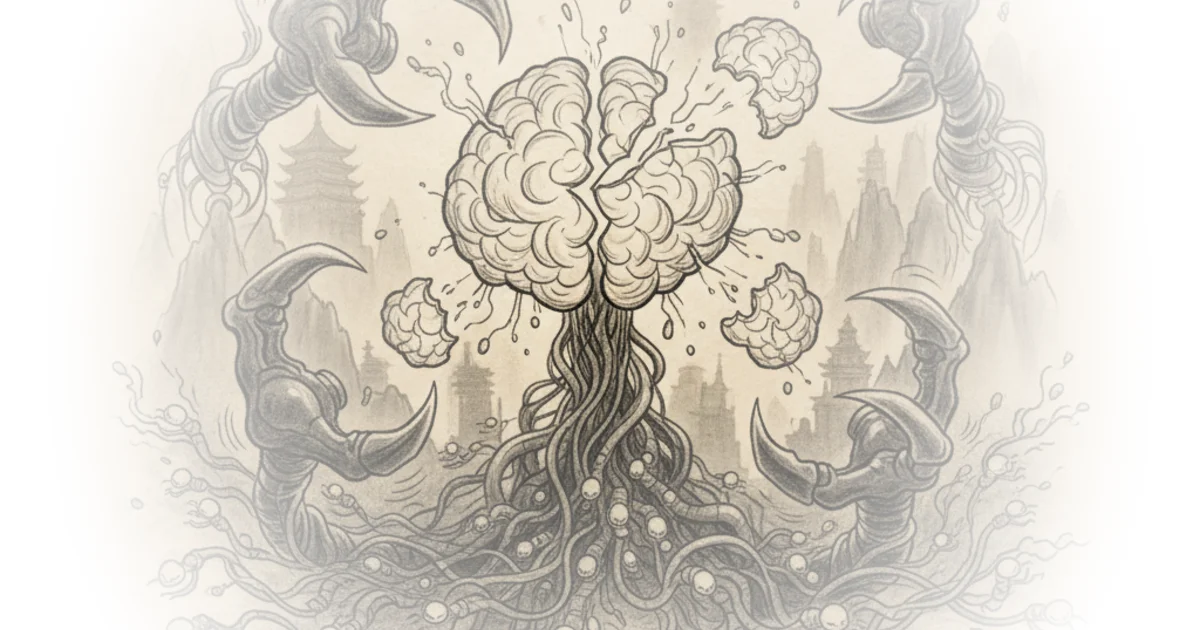
The historical parallel to Napster is not just a metaphor; it is a structural prediction. Just as the music industry learned in 1999 that piracy "doesn't stop. It slows down," Jones suggests that export controls and geopolitical friction will only delay, not prevent, the extraction of model weights. The incentive is too strong: "The cost of generating intelligence is astronomically higher than the cost of copying that intelligence." This economic reality means that even if China and the US were close allies, the theft would still occur.
Critics might argue that dismissing the national security angle ignores the specific military applications of these stolen models, particularly given Anthropic's own pivot to allow defense use cases. However, Jones counters that the methodology of extraction remains the same whether the end goal is a missile guidance system or a cheaper coding assistant. The "pressure gradient" is the dominant force, not the flag on the map.
The most valuable intelligence ever created by an American company is stored as math. It's weightless, copyable, extractable through a chat window.
The Illusion of Competence
The most dangerous part of this story, according to Jones, is not the theft itself, but what the stolen models actually do. He argues that distillation does not create a copy; it creates a "compression" that is "like a lossy MP3." A frontier model occupies a "high-dimensional capability space," capable of navigating ambiguity and recovering from errors. A distilled model, by contrast, occupies a "narrower manifold." It performs well on the specific tasks it was trained on but "falls off more steeply when you step outside that distribution."
Jones uses a football analogy to illustrate this brittleness: watching highlights is not the same as watching the whole game. "If you watch only the highlights, you see less ads, but you also see much less of the football game." This is the trap for enterprise buyers. They run standard benchmarks, see a distilled model score well on coding tasks, and assume equivalence. "They are not equivalent models," Jones warns. "The distilled model learned to produce outputs that look like Claude's outputs on coding tasks. It did not learn the underlying representational structure."
This is where the argument lands hardest for busy executives. The failure modes are invisible in short tests. A frontier model encountering an error might "reroute, try a different library, or restructure its approach." A distilled model "either fails, loops, or produces a technically valid but strategically incorrect workaround." The difference is the ability to sustain autonomous work over hours or days, a capability that is rapidly becoming the primary source of AI value.
Distilled models look fine for chat. They fall apart when you need them to think for eight hours straight, route around obstacles, and use tools and combinations that nobody anticipated.
The Unmeasured Risk in Agentic Work
The article concludes by highlighting a massive blind spot in the industry: the lack of evaluation tools for sustained, autonomous work. Jones notes that "the performance shadow on agentic work is the most undermeasured risk in enterprise AI today." While a distilled model might be 90% as good as a frontier model for a simple translation task, it might be only 40% as effective for a week-long coding sprint requiring complex tool orchestration.
The author points out that "no benchmark does a good job of capturing that today because the evals that would measure sustained autonomous generality don't really exist yet." This creates a market where vendors can sell inferior, stolen models that pass standard checks but fail in real-world deployment. The "incentive to steal applies to everyone on Earth and not just China," meaning this isn't a one-off incident but a permanent feature of the AI landscape.
A counterargument worth considering is that as open-source models improve through independent innovation, the "pressure gradient" might eventually flatten, reducing the incentive to steal. Yet, as long as frontier labs continue to double capabilities every 90 days, the gap remains too wide to ignore. The race is not just about who builds the best model, but who can best detect the "brittleness" of the ones they are buying.
Bottom Line
Nate B Jones provides a vital corrective to the geopolitical hysteria surrounding AI theft, correctly identifying the economic inevitability of model distillation as the true disruptor. The piece's greatest strength is its forensic analysis of why stolen models fail at complex, long-horizon tasks, a nuance that standard benchmarks completely miss. The biggest vulnerability for readers is the lack of tools to detect this "performance shadow" before they deploy these models into critical workflows.