Charles Derber delivers a jarring diagnosis of modern American foreign policy, arguing that the current administration isn't breaking the rules of the international order, but finally revealing the brutal rules that have always existed beneath the surface. While mainstream critics lament the erosion of diplomatic norms, Derber insists the real story is the convergence of domestic authoritarianism and overseas resource extraction, a fusion he terms "American fascism." This is not a standard critique of a specific leader's temperament; it is a structural indictment of a system where war abroad and policing at home are two sides of the same coin.
The Illusion of Rules
Derber's central thesis challenges the comforting narrative that the post-World War II era was defined by a "rules-based international order." He contends that this concept was merely a "veneer" masking a reality of US dominance driven by corporate profit. "The alleged rules in place provided the veneer of secure international order, while masking the reality of a US-dominated world order," Derber writes. This framing forces the reader to confront the uncomfortable history of interventions in Vietnam, Chile, and Iraq, which were never constrained by international law but rather by the strategic interests of the executive branch.
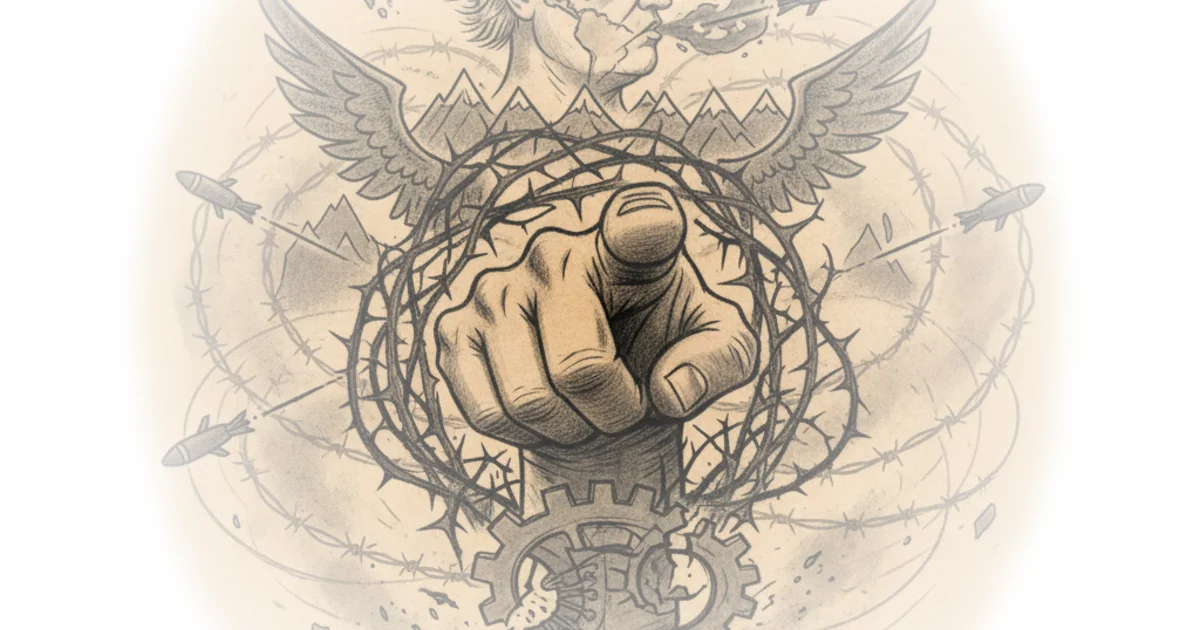
The author suggests that the avoidance of direct conflict between superpowers was not a triumph of diplomacy, but a matter of chance. "The avoidance of Great Power war was more a result of luck than any rules of the system," he argues. This perspective strips away the moral superiority often claimed by US foreign policy. It recalls the terrifying proximity of nuclear annihilation during the 1962 Cuban Missile Crisis, a moment where luck, not rules, prevented global catastrophe. Derber posits that the current administration's blunt rhetoric about seizing oil and minerals is simply an honest admission of what previous administrations did under the guise of "deterrence" and "democracy protection."
The US engaged in endless interventions in Central and Latin America, the Middle East and Southwest Asia, all in the name of deterrence and democracy protection against the Soviet Union or Islamic terrorism. But no international rules governed or curbed these interventions.
Critics might argue that this view is overly cynical, dismissing the genuine diplomatic efforts and alliances that have prevented larger conflicts for decades. However, Derber's point is that the underlying motivation has consistently been economic hegemony, a fact that becomes undeniable when the diplomatic language is stripped away.
The Twin Wars: Home and Abroad
The piece's most provocative section connects the militarization of foreign policy with the militarization of domestic policing. Derber defines fascism not just as a foreign policy tool, but as a domestic strategy to unite elites and workers against a manufactured enemy. "Fascism is a politics of uniting war abroad with war at home," he states. This linkage explains why the rhetoric against "narco-terrorists" in Venezuela is inextricably tied to the crackdown on immigrants and activists in cities like Chicago and Minneapolis.
The author traces this trajectory back through recent history, noting that the expansion of presidential war powers and the abuse of agencies like Immigration and Customs Enforcement (ICE) began long before the current administration. "Bush and Cheney used 9/11 to begin the move from covert toward overt American authoritarianism," Derber writes. He points out that under the Obama administration, nearly three million people were involuntarily deported, and the Border Patrol was described by the American Civil Liberties Union as "Monstrous." This historical context is crucial; it suggests that the current escalation is not an anomaly, but an intensification of a long-standing trend.
Trump's role has been to make the system overt, stripping away major elements of the democratic veneer by his unmasking rhetoric and practices.
Derber draws a stark parallel between the current administration's "Donroe" policy—a play on the Monroe Doctrine—and Hitler's concept of Lebensraum. Just as the Nazi regime sought to expand territory and resources while purging internal "enemies," the current strategy seeks to dominate the Americas and its resources while targeting brown populations both abroad and domestically. This comparison is heavy and requires careful handling, yet it underscores the author's argument that the logic of conquest is being applied to the Western Hemisphere.
The Corporate Engine
Beneath the rhetoric of nationalism, Derber identifies the driving force: a pact between the executive branch and corporate oligarchs. The wars are not about security; they are about securing markets and resources for the wealthiest elites. "The wars are at the heart of an openly corrupt political governing alliance between Trump and corporate elites," he asserts. The author highlights how figures like Elon Musk and Jeff Bezos are heavily invested in the military-industrial complex, from space satellites to high-tech armaments.
This economic angle explains the administration's aggressive stance on Greenland, Cuba, and Venezuela. The push to control Greenland is framed not as a geopolitical necessity, but as a grab for vital minerals as climate change makes the terrain accessible. "Venezuela is part of the payback; it exposes Trump's naked embrace of Chevron and all his corporate oligarchs," Derber notes. This reframing shifts the focus from the personality of the leader to the material interests of the ruling class.
Critics might suggest that this analysis ignores the genuine security concerns regarding drug cartels or regional instability. Yet, Derber's evidence suggests that these security narratives are often constructed to justify economic predation, a pattern visible in the history of US interventions from the early 20th century to the present.
The resistance needs to join the rest of the world—especially in Latin America and the Global South—in moving toward a rejection of US militarism and imperialism.
The Path Forward
Derber concludes by calling for a "positive populism" that rejects the bipartisan consensus on militarism. He argues that the Democratic Party's failure to embrace a class-based politics has left a vacuum filled by authoritarianism. "When the Democrats abandoned the New Deal, and began under Clinton to prioritize siloed identity politics over class politics, they laid the foundation for their failure to deliver a resounding populist anti-war critique," he writes. The author sees hope in progressive movements that link domestic democracy with foreign policy, citing the work of figures like Bernie Sanders and Alexandria Ocasio-Cortez.
The argument is that true resistance requires understanding that democracy at home is indivisible from democracy abroad. The current moment, according to Derber, offers a unique opportunity to expose the "lie of a rules-based order" and build a movement that challenges the corporate oligarchy directly.
If the resistance can seize this moment to unite Americans against the corporate oligarchy militarily controlling people abroad as well as at home, it will not only help progressive Democrats win elections but truly change the course of history.
Bottom Line
Charles Derber's strongest contribution is his unflinching linkage of domestic policing and foreign intervention as a single, coherent strategy of elite control, forcing readers to see the human cost of "national security" in both the streets of Minneapolis and the villages of Venezuela. However, the piece's reliance on the term "fascism" risks alienating moderate readers who may view the comparison as hyperbolic, potentially obscuring the very real structural critiques it offers. The most vital takeaway is the urgent need to move beyond the debate over "rules" and confront the economic imperatives driving American militarism.