Rafael Holmberg delivers a startling twist on political theory: he argues that the philosopher Immanuel Kant, long dismissed as too abstract for the rough-and-tumble of statecraft, might actually hold the key to imagining a political future beyond the current crisis of global capitalism. While most analysts are busy dissecting the latest policy shifts or personality clashes in Washington, Holmberg digs into the archives of German Idealism to ask a question no one else is asking: if the current system is broken beyond repair, can we use Kant's concept of the "unthinkable" to build a new one?
The Shadow of Hegel in Modern Politics
Holmberg begins by dismantling the idea that philosophy is separate from power. He traces how Georg Wilhelm Friedrich Hegel's ideas have been stretched and twisted to justify everything from Italian fascism to modern neoliberalism. The author points out that Giovanni Gentile, a key architect of Mussolini's regime, used a distorted version of Hegel to argue that the individual must submit to the state. Holmberg writes, "The individual is by definition particular, and thus by definition inferior to the universal (the Fatherland) to which the individual is submitted in the name of tradition." This is a chilling reminder that high-minded philosophy can be weaponized to demand total obedience.
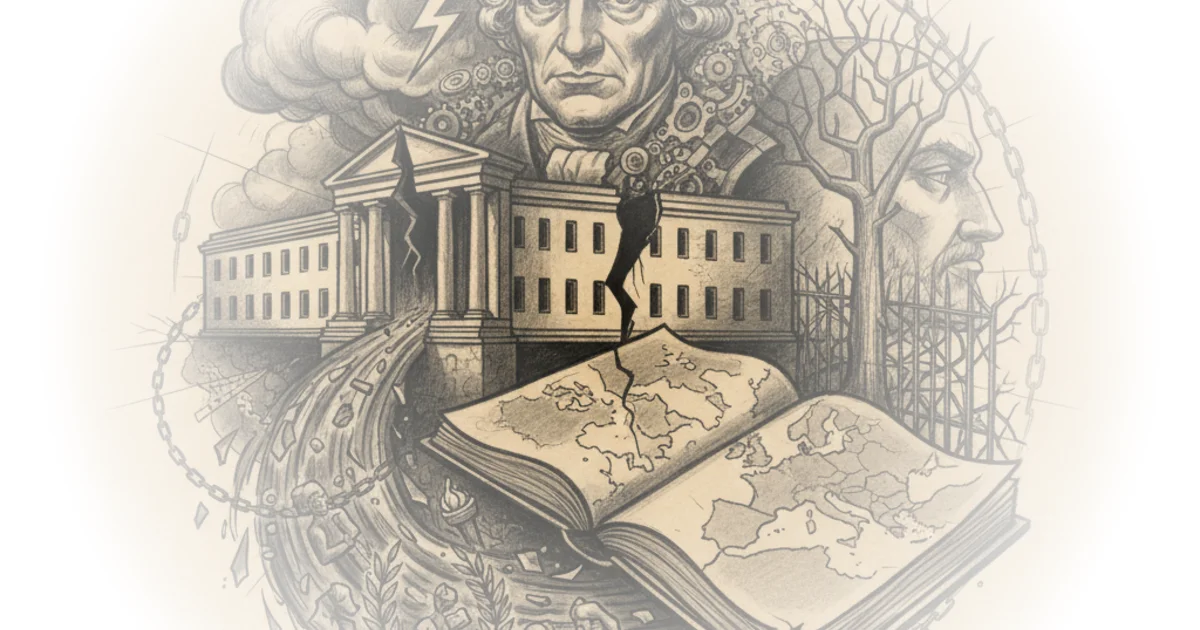
But the story doesn't end with fascism. Holmberg shows how the same philosophical lineage fueled the creation of the European Common Market and even shapes the worldview of current leaders like Emmanuel Macron. He notes that Macron, a self-proclaimed Hegelian, recently told Der Spiegel that history is larger than any single leader. Holmberg observes, "Macron seems to indulge in a piece of critical reconsideration of the meaning of 'Weltgeist zu Pferde' ('World Spirit on horseback'), the words Hegel used to describe Napoleon, as inevitably acting in opposition to Napoleon's individuality." The author suggests that while Macron tries to position himself as a steward of history, his politics remain trapped within the very system he claims to transcend.
Hegel is a directly political thinker - he is internally politicised, as is evident by his appropriation from figures like Gentile (fascism) to Macron (neoliberalism).
This analysis is compelling because it strips away the veneer of neutrality from political ideology. It forces the reader to see that the "common sense" of today's global order is actually a specific, contested philosophical project. However, a counterargument worth considering is whether Holmberg overstates the direct line from 19th-century texts to 21st-century policy. While the intellectual echoes are undeniable, reducing complex geopolitical strategies solely to philosophical misinterpretations might overlook the material economic pressures that drive these decisions.
The Failure of the Current Order
The piece takes a sharp turn when it addresses the current rupture in the global system. Holmberg argues that the rise of right-wing protectionism and the instability of the neoliberal order are not anomalies but symptoms of a deeper failure. He writes, "Trump appears to be shaking the basic coordinates of the neoliberal Empire. But Trump is in fact not a direct negation of the regime of globalised capital, but rather a symptom of its failure to account for or contain the aggressive wealth and power concentrations that inevitable arise from its own economic logic." This is a crucial distinction: the current political chaos isn't a rejection of the system, but a distorted continuation of it.
The author contends that simply returning to traditional liberalism or European centrism is not a solution. "Any serious democratic or egalitarian project is therefore forced not only to reject Trump but to reject his false opposition in Democratic liberalism or European neoliberalism," Holmberg asserts. The stakes are high. If the only options are the status quo or a chaotic reaction to it, the future looks bleak. Holmberg suggests that we are facing a moment where the "political solution" has become impossible to conceive within the existing framework.
Critics might argue that this diagnosis is too pessimistic, ignoring the resilience of democratic institutions or the potential for reform from within. Yet, the author's insistence that the current binary of "us versus them" is a trap feels increasingly urgent as global alliances fracture.
Kant and the Politics of the Unthinkable
Here is where Holmberg makes his most radical move. If Hegel represents a system that can be co-opted by any ideology, Holmberg turns to Immanuel Kant for a way out. He argues that Kant's Critique of Judgement offers a unique tool for political imagination: the ability to judge what cannot be fully known. Holmberg explains that while Kant's earlier works seem too rigid for politics, his third critique introduces a paradox where "subjective universal judgements" allow us to construct a universal from a particular experience without having a pre-existing rulebook.
He writes, "The empirical presentation of an artistic object which we judge as beautiful forces us to construct the very universal to which we in turn apply it." In other words, instead of waiting for a perfect theory to guide us, we must act on the basis of a shared, subjective feeling that demands to be universal. This is the "unthinkable" space where new politics can emerge. Holmberg posits that this aesthetic judgment is the only way to bridge the gap between what we can know and what we need to create.
Beauty confronts us with an impossible universal. The judgement of something as beautiful therefore comprises a paradoxical operation. It implies a radical gap between what can be known and what can be judged.
This is a dense but vital argument. It suggests that the next great political movement won't come from a new economic model or a charismatic leader, but from a collective shift in how we perceive and judge the world. It's a call to embrace uncertainty as a political virtue. While some may find this approach too abstract for the gritty reality of policy-making, it offers a necessary counterweight to the rigid ideologies that have dominated the last century.
Bottom Line
Holmberg's strongest move is reframing Kant not as a dry epistemologist, but as the only philosopher capable of helping us navigate a world where old political coordinates have collapsed. The argument's biggest vulnerability is its reliance on aesthetic theory to solve material crises, which may feel distant to those facing immediate economic hardship. However, the piece succeeds in proving that if we want to imagine a future beyond the current cycle of crisis and reaction, we must first learn to think the unthinkable.