In an era where political discourse feels uniquely fractured, this Reason editorial delivers a sobering historical reality check: the architects of American democracy were often consumed by despair over its trajectory. The piece's most striking claim is that disillusionment was not an anomaly among the Founders but the rule, with even their greatest triumphs failing to shield them from the corrosive effects of factionalism and the very democratic forces they unleashed.
The Myth of Unified Glory
The article dismantles the romanticized image of a seamless transition from revolution to republic. Instead, it paints a picture of a generation that watched their creation unravel almost immediately. Reason reports that while history remembers Jefferson and John Adams dying on the same day in 1826, "Less remembered is that the two otherwise ideologically and dispositionally opposed torchbearers for the flame of '76 had each soured on the fruits of their precious Revolution." This reframing forces a confrontation with the uncomfortable truth that the Founders saw their own work as a failure in many respects.
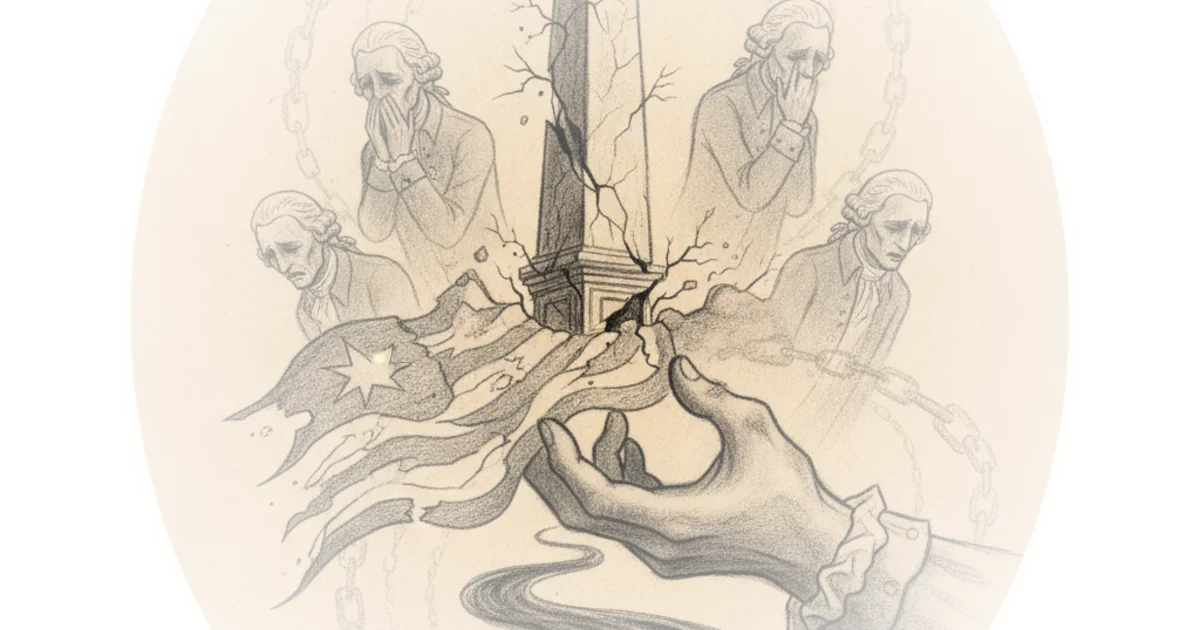
The piece leans heavily on historian Gordon Wood to establish that this anxiety was widespread. "Those of them who lived on into the early decades of the nineteenth century expressed anxiety over what they had wrought," the editors note, quoting Wood's observation that they were "bewildered, uneasy, and in many cases deeply disillusioned." This evidence is compelling because it moves beyond the standard narrative of heroic consensus to reveal a group of men who felt their experiment was collapsing under the weight of human nature.
The existence of history creates the illusion of inevitability... But that's not at all how the Founders experienced the 1790s.
The argument gains further depth by connecting these historical anxieties to specific, visceral events. The editors highlight Thomas Jefferson's revulsion toward Andrew Jackson, quoting his warning that Jackson was "one of the most unfit men I know of for such a place" and a "dangerous man." This detail is crucial; it shows that the Founders feared the rise of populist demagogues long before they became a modern political phenomenon. Critics might argue that focusing on Jefferson's elitism overlooks the genuine democratic aspirations of the era, but the piece effectively uses his fear to illustrate the tension between republican virtue and popular will.
The Trap of Faction
A central pillar of the commentary is George Washington's prescient warning about political parties. The article argues that Washington saw faction not just as a nuisance, but as an existential threat. "The alternate domination of one faction over another... is itself a frightful despotism," Reason quotes from his farewell address. This framing is powerful because it suggests that the current polarization is not a deviation from the American norm, but rather a fulfillment of Washington's worst-case scenario.
However, the piece also acknowledges the hypocrisy inherent in this stance. It notes that Washington himself was "not above the political and ideological fray," helping to spur the very reaction he loathed by siding with Alexander Hamilton. The editors point out that the 1790s were a decade of such intense vitriol that historian Joseph J. Ellis described the dialogue as a "decade-long shouting match." This admission strengthens the argument by showing that even the most revered figures could not escape the gravitational pull of partisan conflict.
The text also draws a parallel to the Hartford Convention era, where regional blocs threatened to fracture the union, reinforcing Washington's fear that such divisions would lead to "a more formal and permanent despotism." The piece suggests that the Founders underestimated the permanence of political parties, believing them to be a temporary necessity rather than a permanent feature. As Reason puts it, "If they had [understood], they'd have been even more depressed."
The Paradox of Enlightenment
The commentary shifts to the Founders' belief in education and virtue as the bedrock of liberty. It highlights Thomas Jefferson's devastation when students rioted at the University of Virginia, an event that left him "far too overcome with emotion... [to] speak." This anecdote serves as a microcosm for their broader disappointment: they believed that an educated populace was essential for self-governance, yet they witnessed the very people they hoped to educate turn violent and irrational.
The article argues that this failure stemmed from a fundamental paradox. The Founders were products of an 18th-century mindset that valued "disinterested, gentlemanly virtue," but their revolution unleashed democratic forces that rejected such elitism. Reason quotes John Adams's grim realization: "There is So much Rascality... so much Venality and Corruption... that I sometimes doubt whether there is public Virtue enough to support a Republic." This quote cuts to the core of their despair; they realized too late that their system required a level of moral character that the expanding electorate simply did not possess.
The Founders were self-made, sure. But unlike Paul Revere... they were self-made gentlemen.
The piece uses the example of Paul Revere to illustrate this class divide. While Revere was a skilled tradesman and revolutionary hero, he was excluded from high-level planning because he lacked the social standing of men like Adams or Hancock. Reason argues that "In the end many of their enlightened hopes... were done in by the very democratic and egalitarian forces they had unleashed." This is a nuanced take that acknowledges the Founders' role in creating a world they could not control, rather than simply blaming them for being out of touch.
The Unresolved Sin
Finally, the commentary addresses the moral failure regarding slavery. It notes that while many Founders believed the "liberal principles of the Revolution would eventually destroy the institution of slavery," this prediction proved catastrophically wrong. Reason cites historian Dennis C. Rasmussen to explain why: it was an immense moral evil that seemed intractable and created a deep rift between North and South.
The piece points out that Jefferson himself included an anti-slavery clause in his original draft of the Declaration, only for Congress to excise it to appease Southern states. This detail underscores the tragic gap between their ideals and their actions. The editors suggest that this failure gnawed at the consciences of the Founders, contributing to their later disillusionment. A counterargument worth considering is whether the Founders could have done more without fracturing the union immediately; however, the piece maintains that their inaction was a choice driven by political expediency rather than necessity.
Bottom Line
This editorial succeeds by stripping away the myth of the flawless Founding Fathers to reveal a group of deeply flawed men grappling with the unintended consequences of their own success. Its strongest asset is the use of primary sources to show that despair, not triumph, was the dominant emotion in the early republic. The argument's vulnerability lies in its tendency to view the Founders' elitism as the sole cause of their disillusionment, potentially underestimating the structural complexities they faced. As the nation approaches its 250th anniversary, this piece serves as a vital reminder that the American experiment has always been fragile, contested, and far from finished. }