Wayfare cuts through the noise of political posturing by confronting a dangerous paradox: how can a faith that reveres the American founding also reject the very nationalism currently claiming to defend it? This piece doesn't just analyze JD Vance's recent rhetoric; it dismantles the "blood and soil" argument by contrasting it with the messy, contradictory reality of history. For listeners navigating the upcoming 250th anniversary of the Declaration of Independence, this is a necessary correction to the idea that patriotism requires blind loyalty to a mythical past.
The Trap of Blood and Soil
The article opens by zeroing in on JD Vance's acceptance speech, where he pivoted from family history to political philosophy. Wayfare highlights his claim: "People will not fight and die for abstractions, but they will fight for their home." The piece argues that this sentiment, while emotionally resonant, is being weaponized to suggest America's greatness stems from a mystical connection between specific families and the land. This framing is particularly potent because it appeals to deep-seated desires for belonging in an era of rapid social change.
"He is asserting here a theory of what the US means and why we all should honor it—this is his version of American exceptionalism, a version based not on principle, but on the supposed superiority of a particular group of people and their ties to a particular place at a certain time."
The editors note that this "blood and soil" nationalism directly contradicts the theological foundation many believers hold. The piece points out that while scripture testifies to the special status of the American continent—citing specific passages in the Book of Mormon and Doctrine and Covenants regarding the divine origin of US government—the mechanism for that divinity is law, not lineage. President Dallin H Oaks, quoted extensively, articulates this distinction clearly: "I love this country, which I believe was established with the blessings of God. I love its constitution, whose principles I believe were divinely inspired."
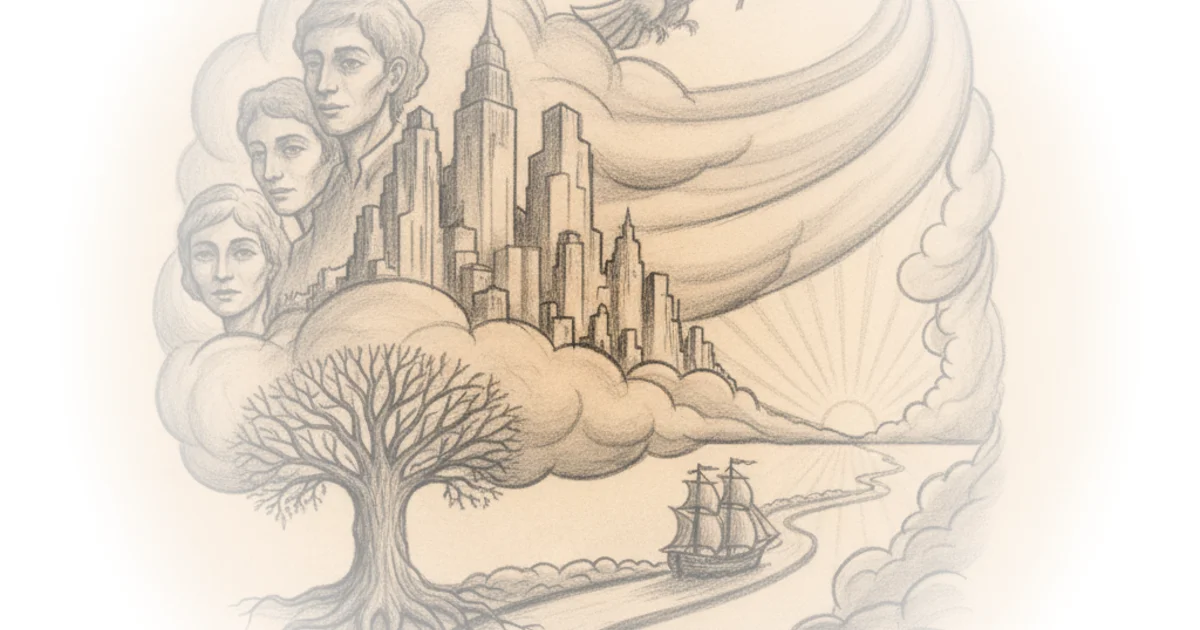
Critics might argue that emphasizing abstract principles over cultural continuity ignores the human need for rootedness and community identity. However, Wayfare counters that rooting national identity in ancestry inevitably excludes those who don't fit a specific demographic mold, turning "home" into a fortress rather than a sanctuary.
"Doing this means rejecting Vance's thesis, because the paradox of the American founding requires that we reject blood and soil nationalism in favor of embracing America as an idea, a set of principles that call us to return again and again to the better angels of our nature."
The Paradox of the Founders
The commentary then shifts to a rigorous historical audit, refusing to let reverence for the founders slide into uncritical worship. Wayfare acknowledges Yale Constitutional Scholar Akhil Amar's description of the US Constitution as the "hinge point of history," moving humanity from rule by kings to self-governance. Yet, the piece insists that this achievement cannot be separated from its profound failures.
The article focuses heavily on Thomas Jefferson, the principal author of the Declaration of Independence, to illustrate the depth of this contradiction. It notes that while Jefferson understood the moral problems of slavery and worked to outlaw the importation of new enslaved people, he simultaneously kept 600 men, women, and children in bondage over his lifetime. Wayfare quotes Jefferson's own words from Notes on the State of Virginia, where he claimed Black people were "in reason much inferior" and their imaginations "dull."
"But this recognition creates at least as many problems as it solves... The very fact that Jefferson was aware of the moral problem of slavery—and the energy he put into pursuing slavery's eventual eradication—make his own words and actions all the more troubling."
This section is crucial because it rejects the "past is a foreign country" defense. Instead, it forces readers to sit with the discomfort of a founder who wrote about liberty while enslaving his neighbors. The piece draws a parallel to the broader treatment of Indigenous peoples and women, noting that the franchise was initially limited to white male landowners, and full enfranchisement for Black men after the Civil War was "largely clawed back by revanchist forces."
"Many aspects of the history of America feature a consistent assault on the rights of those who were powerless in favor of the desires of the powerful."
By weaving in historical context regarding Minerva Teichert's art and the LDS movement's own expulsion from American society, the article suggests that the Church has always been on the margins of this "powerful" narrative. This adds a layer of irony: if the early saints were driven out by the very people claiming to uphold American values, then those values must be defined by something deeper than who holds power at any given moment.
The Paradox of the Founding and the Founders
The editors conclude that the only way to honor the founding is to embrace its paradox: a system born of divine inspiration yet built on human hypocrisy. They argue that the "greatness" of America lies not in the perfection of its founders, but in the principles they articulated—popular sovereignty, federalism, and the rule of law—which provide a standard against which the nation can measure itself.
"Rightly understood, that respect and admiration can inspire us to support and advance the principles that can make the US great. But understood wrongly, that same respect and admiration could turn us toward insularity and even a dangerous and corrosive form of nationalism."
This is a bold move for a publication with strong ties to religious conservatism, as it challenges the prevailing political narrative that equates patriotism with defending the status quo or specific demographic groups. It suggests that true loyalty requires constant vigilance and reform, not just celebration.
"My testimony is that there is greatness and divinity in the American founding—and it is vital for us to understand and support that greatness in meaningful ways."
The piece ends by leaving readers with a challenge: to reject the easy comfort of nationalism in favor of the harder work of aligning the nation's reality with its highest ideals. It implies that the 250th anniversary should be a time of reckoning, not just a parade of flags.
Bottom Line
Wayfare delivers a compelling, theologically grounded critique of modern "blood and soil" nationalism by exposing the deep contradictions in the American founding. Its strongest asset is the refusal to sanitize history, using Jefferson's own words to dismantle the myth of a purely virtuous past. The argument's vulnerability lies in its reliance on an idealized version of "principles" that can feel abstract to those currently suffering under systemic failures, but it successfully reframes patriotism as an active commitment to justice rather than passive loyalty to a tribe.