Samuel Taylor Coleridge wrote one of the most artistically coherent poems in English — and Close Reading Poetry wants you to understand why. This analysis unpacks "Frost at Midnight" as a masterclass in how Romantic lyric poetry actually works.
The Conversation Poem Invention
The piece opens with a claim that feels almost like a secret handshake between poets: Coleridge invented the "conversation poem" — a form consisting of blank verse, unrhymed iambic pentameter lines that feel conversational. Close Reading Poetry writes, "usually consists of blank verse which is unrhymed iambic pentameter lines so we see that each line has roughly five stressed syllables."
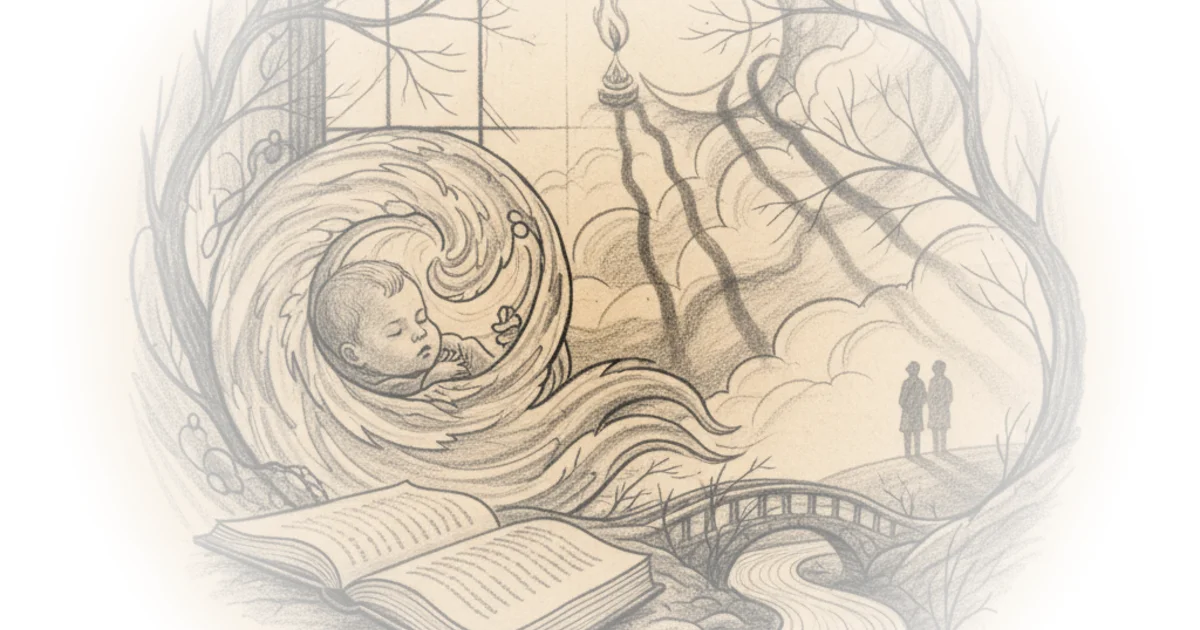
This matters because it reveals how deliberately Coleridge was constructing a new kind of poetry — one that sounds like someone talking rather than performing an elaborate linguistic show. The author emphasizes this is written in "idiomatic language" — consciously reacting against "highfalutin poetic diction." This is what the Romantics were all about: countering artificial, superficial expression in poetry.
The Secret Ministry
The analysis zeroes in on a single word that carries enormous weight: "secret." Close Reading Poetry writes, "it's kind of moving into the secret this this idea of secret which comes from the Latin set apart separate isolated or obscure."
This is where the piece becomes genuinely insightful. The poem begins in extreme isolation and then moves out into community — a pattern that will echo throughout Romantic lyric. The word performs its own "Ministry" (a religious term) while simultaneously doing frost's actual work: "laying the crust of war frost and perhaps the little icicles on the window." Notice how the author frames this: "it's performing and so this poem itself is very interested in performance and form of its own Ministry."
The frost performs its secret Ministry — it's kind of moving into the secret, isolated or obscure.
Temporal Modulation
The most sophisticated move in this analysis is identifying how the poem manipulates time within its first three lines. Close Reading Poetry observes that "we are very much in the moment with him" (present tense) but then "he's describing a prior event" (past tense). The owl's cry came loud, and then — "hark — again loud as before."
The author frames this brilliantly: "really this encapsulates what the poem itself will do." This temporal modulation is the engine of the entire work. Past and present don't just coexist; they interrogate each other. Wordsworth picks up on this later in Tintern Abbey, where he also plays with time as a way of processing memory and presence.
The Silentness That Isn't Silent
One of the most striking word-level observations comes when Coleridge describes his infant's sleep: "this is such a striking word where we would expect silence he uses the word silentness to emphasize the strangeness of this absence of sound."
This is Close Reading Poetry at its best. The author explains that "the word choice is kind of vexing" — we expect "silence" but get "silentness," an almost unnatural expression that highlights just how strange and extreme this silentness is. It's not the absence of noise; it's something present, almost overwhelming.
The Fluttering Film as Symbol
The analysis traces a crucial symbolic thread: the film (soot) on the fireplace that flutters. Close Reading Poetry writes, "this verse paragraph here this section is latching on to this fluttering film as a symbol for thought."
In folklore, this film was called a "stranger" — and when it danced like that, it meant a visitor would come. This connects directly to what follows: Coleridge's memory of school days, watching the flickering flame, dreaming of his sweet birthplace. The author writes, "the film on the great is signaling that oh he will have a visitor too."
The analysis then pivots to Wordsworth, who picks up this exact image in 1802: "My heart leaps up when I Behold a rainbow in the sky" — creating their own lexicon, their own institution of poetry by which they reference each other's work.
The Benediction to the Babe
The final movement is what makes this analysis sing. Coleridge addresses his infant son (Hartley), and Close Reading Poetry captures the shift: "dear babe I suddenly he's addressing something outside the poem just as the greater romantic lyric will do."
But then comes the truly theological dimension: "nature for the babe for Hartley will be a religious experience nature is that Eternal language which thy God utters." The author notes this is very different from Wordsworth — who "seems to be at Great pains to avoid the word god" — while Coleridge "is very much interested in nature as a revelation, as a second Bible."
This distinction matters enormously. Keats and Shelley aren't particularly interested in the Orthodox God, but Coleridge carries this theological resonance even in his earlier, more heterodox Unitarian years. Nature is always the language of God for him.
Counterpoints
Critics might note that Close Reading Poetry sometimes leans heavily on unscrutinized biographical claims — "I was reared in the great City" — without fully establishing whether these references are to Coleridge's actual childhood or a fictional speaker. The analysis also assumes Hartley is Coleridge's son, which simplifies a more complex poetic situation.
Additionally, framing nature as "the language of God" works for Coleridge but might over-clarify what many readers would experience as more ambiguous — the poem's emotional landscape before any explicit theological reading.
Bottom Line
Close Reading Poetry's strongest move is identifying how this poem builds its entire argument through temporal modulation and symbolic threading. The "conversation poem" framing reveals Coleridge as an inventor, not just a poet. The weakest moment is probably the biographical assumption about Hartley — it tells us something but doesn't prove it.
The real payoff: understanding that Romantic lyric isn't just beautiful language; it's a deliberate architecture of memory, time, and hope.