Casey Newton exposes a critical paradox in digital governance: Meta's Oversight Board is racing to adjudicate war crimes in real-time, only to find the company has already rewritten the rules to make its own intervention unnecessary. This piece is essential listening because it reveals that the true crisis isn't just about which videos stay up, but that automated systems and understaffed human teams are failing to distinguish between terrorist propaganda and the raw, horrific testimony of civilians caught in a crossfire.
The Speed of Crisis vs. The Slowness of Justice
Newton frames the Oversight Board's recent move as a desperate attempt to prove relevance during an unfolding catastrophe. The board selected two cases for an expedited review, a drastic departure from its usual three-month timeline. "For the first time, the board said it would conduct its review on an expedited basis — meaning that its decision could come in as soon as 48 hours, and up to 30 days," Newton notes. This acceleration is significant, yet it highlights a systemic failure where the company's reactive measures outpace the very body designed to check them.
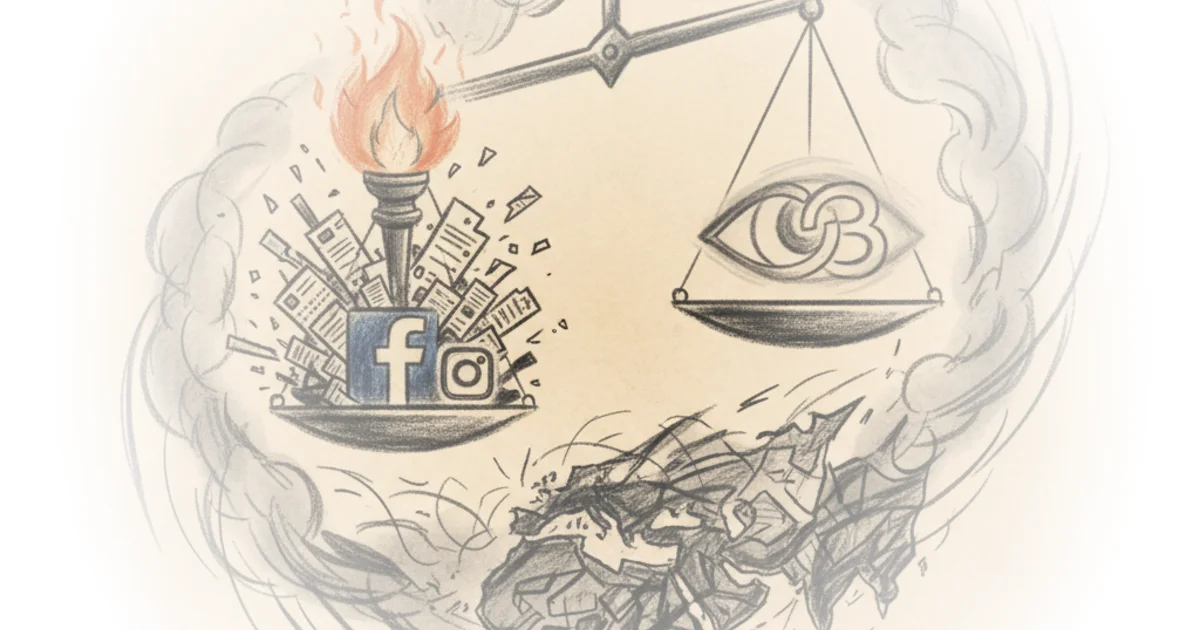
The two cases selected illustrate the impossible tightrope Meta walks. One involved a graphic video of the aftermath of a strike on Al-Shifa Hospital, initially removed for violating rules on violent content. The other showed a hostage being taken by Hamas militants, removed under policies prohibiting the depiction of terrorist incidents. Newton points out the stark contradiction in Meta's enforcement: "The removal of the first post, then, speaks to anxieties that Meta is acting too aggressively in restricting speech by Palestinians who are speaking out about the terrible impact of the war on civilians. The removal of the second post reflects the opposite anxiety: that Meta is acting too aggressively to silence Israelis who are speaking out about the atrocious October 7 attacks and their aftermath."
This duality suggests that the platform's moderation is not a neutral application of rules, but a chaotic reaction to political pressure and algorithmic overreach. The human cost here is invisible to the code; a child's death or a hostage's plea becomes merely a data point to be flagged and deleted.
In any case, neither removal would stand. Meta restored the first post as soon as the board told the company it was selecting it for appeal; the company restored it to Instagram behind a warning screen.
Newton observes that the mere announcement of the board's involvement triggered immediate reversals. This creates a strange dynamic where the board's authority is undermined by the company's pre-emptive capitulation. "If you believe that Meta erred in its initial decisions in the above cases, you should be glad that the board intervened and got them restored to Facebook and Instagram within a few weeks," Newton writes. However, he immediately pivots to the darker implication: "At the same time, Meta's quick action in response to the board could have the odd effect of making the board's expedited review moot."
The Illusion of Policy and the Reality of Failure
The core of Newton's argument is that Meta is confusing an enforcement failure with a policy problem. The company claims its rules are nuanced enough to allow graphic content in the context of human rights abuses. "In the context of discussions about important issues such as human rights abuses, armed conflicts or acts of terrorism, we allow graphic content (with some limitations) to help people to condemn and raise awareness about these situations," Newton quotes from Meta's policy. Yet, the reality on the ground is a flood of errors.
Newton speculates that these errors stem from the sheer volume of content and the trauma inflicted on the moderators themselves. "It seems likely that one of the company's contracted content moderators — or automated systems — made a mistake. It's a deeply unsatisfying answer, particularly given the high-stakes nature of the error." The board has seen appeals triple since October 7, a statistic that Newton argues is a direct result of the company's "layoff-heavy 'year of efficiency'" which slashed moderation teams. Critics might argue that Meta has simply not invested enough in the infrastructure required to handle a global conflict, but Newton suggests the issue is deeper: the design of the system itself.
The designation of Hamas as a terrorist organization creates a structural bias. "Determining which posts in a war zone are coming directly from Hamas, and which are coming from average Palestinians, is difficult, nuanced work," Newton explains. When a platform is hyper-sensitive to accusations of hosting terrorist propaganda, the default setting becomes over-enforcement against the entire population associated with that group. "Moderators being asked to make judgment calls dozens or even hundreds of times a day are bound to make mistakes — and Hamas' status as a terrorist organization all but ensures that over-enforcement of rules against Palestinians will continue."
There is no number of cases the board could take, or speed with which it could adjudicate them, that will alter that basic dynamic.
This is the piece's most sobering insight. The Oversight Board, often criticized for being too slow, is now moving at the speed of light, yet it cannot fix a broken machine. Newton argues that the board risks "mistake[ing] an enforcement issue for a policy problem." The solution isn't just better rules; it's a fundamental re-evaluation of how a profit-driven algorithm handles the suffering of civilians in a war zone.
Bottom Line
Newton's strongest contribution is his refusal to let Meta off the hook with a simple "policy update" narrative, exposing instead a systemic inability to scale human judgment during a humanitarian crisis. The argument's vulnerability lies in the fact that without a radical shift in how platforms prioritize human rights over liability, no amount of board oversight can stop the erasure of Palestinian voices. Readers should watch to see if the board moves beyond restoring individual posts to demanding structural changes in how Meta's automated systems are trained to recognize the difference between a terrorist and a victim.