David Smith delivers a stark warning that Moldova's energy independence is not just a policy goal, but a matter of national survival, revealing how a single drone strike on a power line has forced a country to declare a state of emergency. The piece stands out by moving beyond the immediate outage to expose the fragile, transnational architecture of Moldova's grid, where a strike intended for Ukraine can instantly sever a neutral nation's lifeline.
The Architecture of Vulnerability
Smith anchors his analysis in the specific geography of the crisis, noting that the attack on March 23rd was not a random act of collateral damage but a direct hit on the Isaccea-Vulcănești high-voltage line. He writes, "What happened? Several 'Shahed' drones targeted our energy infrastructure. And as we see in this picture, this is the effect." This visual evidence, paired with the Ministry of Energy's confirmation, shifts the narrative from a generic "war zone" story to a precise technical failure with immediate human consequences. The author effectively uses the timeline to show the speed of the collapse: from Zelenskyy's warning of a massive attack to the lights flickering in Chisinau within hours.
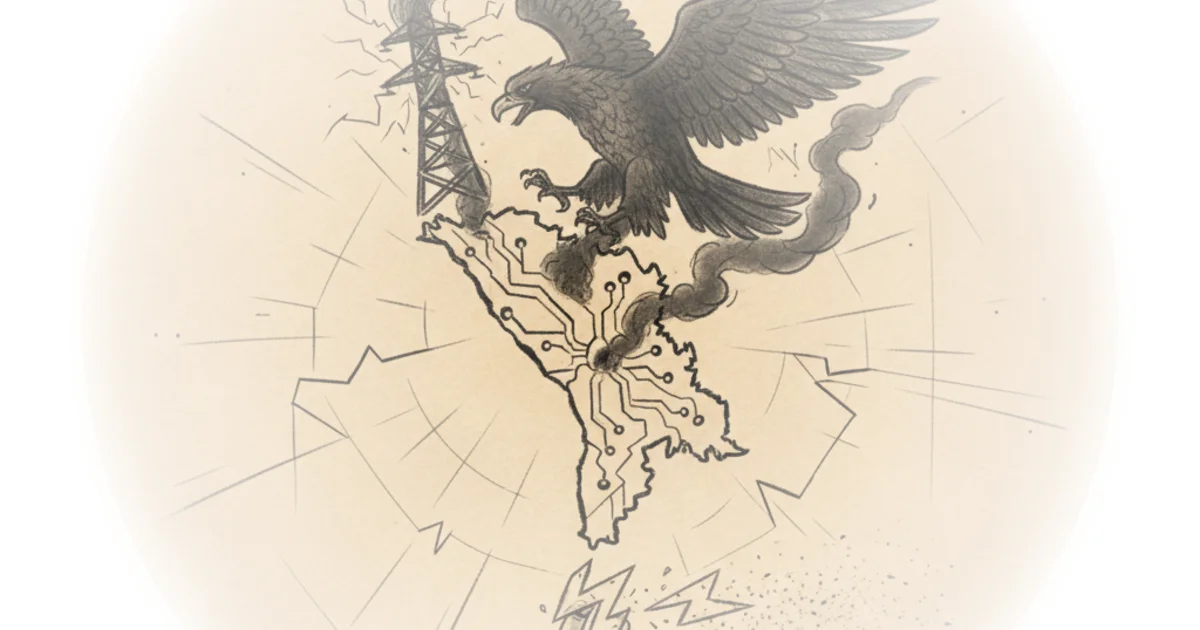
The commentary highlights a critical, often overlooked dependency: Moldova's grid is a loop that runs through Ukraine to reach Transnistria before returning to the capital. Smith explains that "Moldova gets up to 60% of its power from Romania via a line that runs from Isaccea in Romania through Ukraine to Vulcănești in Moldova and then back and forth across the Moldovan-Ukrainian border." This intricate routing means that even as Moldova seeks to decouple from Russian influence, its physical infrastructure remains tethered to the very conflict zone it is trying to avoid. The author notes that while a new direct line to Romania was supposed to be operational, it is "running behind schedule" and would still rely on the vulnerable Isaccea-Vulcănești segment.
"We cannot rule out new attacks, we cannot wait."
This urgency is compounded by the historical context Smith weaves in, referencing a similar blackout on January 31st, 2025, caused by voltage drops in the Ukrainian grid. The recurrence of this failure mode suggests that the system is not merely under stress but is operating on a breaking point. Critics might argue that the focus on infrastructure ignores the political will to accelerate the new connections, yet Smith's data on the 5-7 day repair timeline—delayed by the need for sappers to clear explosive materials—makes the case that speed is currently a physical impossibility.
The Emergency Response and Political Fractures
The declaration of a 60-day state of emergency serves as the article's pivot point, illustrating how the executive branch is forced to manage a crisis that is both military and economic. Smith details the government's drastic measures, from banning elevators during peak hours to restricting fuel purchases to 20-liter jerrycans. He quotes Prime Minister Munteanu, who stated, "The 4 interconnection lines with Romania have been activated, but the situation remains complicated. Starting tomorrow, the estimated deficit will reach 350-400 MW during peak hours."
The political fallout is as immediate as the power loss. Smith points out the irony in the parliamentary vote, where the State of Emergency passed with 72 votes in favor, yet the Socialist opposition refused to support it. The author notes that opposition leader Igor Dodon argued for buying power from the MGRES plant in Transnistria, a move Smith dismantles with technical precision. He writes, "Absent a real solution Dodon is simply parroting simple sounding Russian talking points," explaining that the MGRES plant lacks the coal and gas reserves to function, and even if it did, the cost would be prohibitive compared to Romanian imports. This section effectively exposes how political posturing can dangerously misalign with engineering reality.
The article also broadens the scope to the "Other Energy Crisis," linking the power outage to global supply shocks and rising fuel prices. Smith quotes President Maia Sandu, who warned, "All of the energy shocks... are clearly affecting us through rising prices, both at the household level and across economic sectors." The author connects this to the potential suspension of 80% of public transport routes, a devastating blow to a country where bus travel is a primary mode of mobility.
"It is a very worrying situation if things do not stabilize, if prices do not stabilize in the coming weeks."
Smith's inclusion of the Nistru oil spill cleanup adds a layer of complexity, showing a government that is simultaneously managing a water crisis, an energy blackout, and a fuel shortage. He notes that water supplies were restored through a massive effort involving the National Army and EU partners, yet Mayor Ion Ceban's denial of the spill as a "conspiracy" reveals a deepening trust deficit. This juxtaposition of successful state intervention and public skepticism paints a picture of a nation under siege from multiple angles.
Bottom Line
David Smith's strongest argument is his ability to map the invisible connections that make Moldova vulnerable, proving that a drone strike in Ukraine is a direct attack on Moldovan sovereignty. The piece's greatest vulnerability lies in the political fragmentation that hinders a unified long-term strategy, as seen in the opposition's refusal to support emergency measures based on flawed energy proposals. Readers should watch closely for the completion of the new Romanian interconnection line, as its delay remains the single biggest risk to Moldova's stability in the coming months.