This piece arrives with a jarring premise that immediately demands attention: the author treats the assassination of Charlie Kirk not as a political victory or a partisan tragedy, but as a mirror reflecting our collective failure to protect the very act of speaking. Some Guy constructs a narrative that bypasses the usual political scorekeeping to focus on the raw, unvarnished mechanics of grief and the terrifying normalization of political violence. It is a rare commentary that asks the reader to consider the human cost of their own silence and the systemic rot that allows an "assertive lunatic" to feel emboldened to take a life.
The Architecture of Grief
Some Guy opens with a deeply personal anecdote about the death of Kurt Cobain, using it as a lens to understand the specific horror of a public figure's death. He describes the "ugliest intrusion" his grandfather faced, where private pain was extracted into a "global news juggernaut." The author draws a sharp parallel between that experience and what he imagines the Kirk family is enduring now. "You want loss to be like a movie," Some Guy writes, "There will be a cut scene at any moment, you'll be in a different setting, time will have passed, and somewhere offscreen you became 'better' without having to live through all the pain." This framing is effective because it strips away the spectacle and forces the reader to confront the mundane, grinding reality of surviving trauma. The argument lands hard because it refuses to let the reader off the hook with a simple expression of sympathy; instead, it demands we acknowledge the surreal dissonance of a family trying to eat Belgian waffles while the world orbits their tragedy.
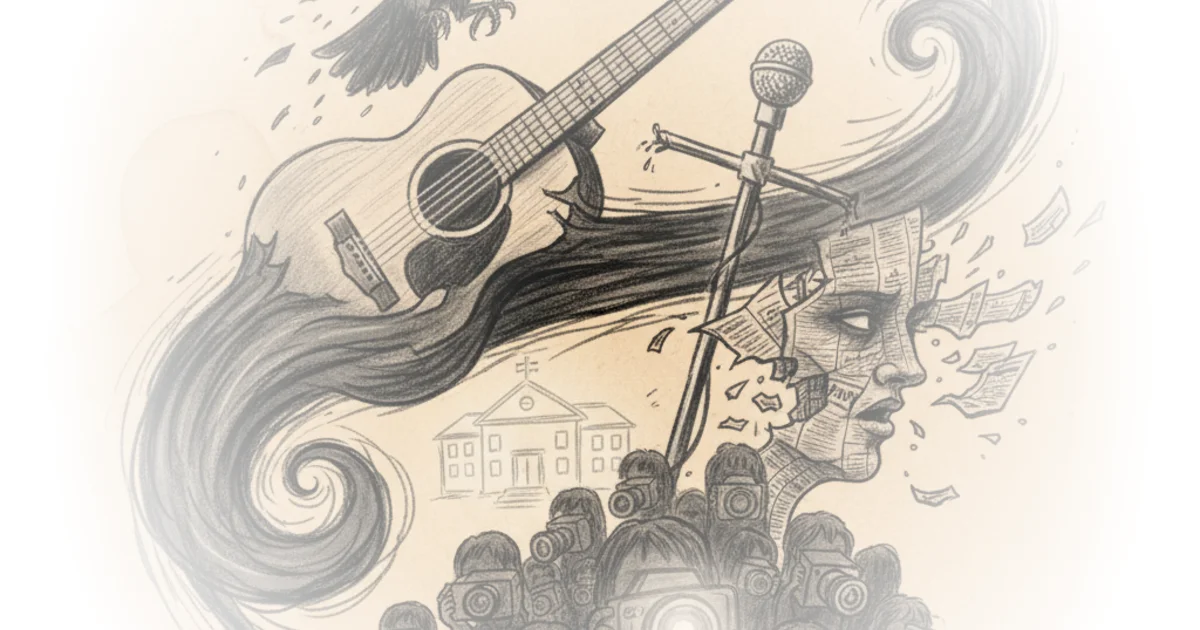
Critics might argue that this focus on the family's emotional state risks sanitizing the political nature of the assassination, but the author insists that the human cost is the only metric that truly matters in the immediate aftermath. "It's one thing to lose someone you loved," he notes, "It's another to have your tragedy be a global news juggernaut that extracts your private grief into public spectacle so you have to constantly explain it to strangers to satisfy their curiosity."
The Failure of Political Discourse
The commentary then pivots to a broader critique of the political ecosystem that created the conditions for this violence. Some Guy argues that most political engagement is performative and shallow, driven by a desire for things to be "better" without a clear roadmap. He makes a bold claim about the necessity of grace, even for those with whom one disagrees. "It isn't at all surprising to me that someone might have a political stance than myself, and I detest the instinct to look up the worst things Charlie Kirk has ever done in a decade long career and apologize for them before condemning his murder." This is a provocative stance in an era of rapid cancellation, yet it serves as the foundation for his argument about the value of free expression. He posits that Kirk's primary contribution was not his specific policy views, but his "unapologetic championship of the free and open exchange of ideas."
The author suggests that the violence is a symptom of a society that has stopped engaging with its neighbors. "The part of you that shirks away in fear when an assertive lunatic invades your space on the internet is at root here," he writes. This is a crucial distinction: the violence is not just the act of the assassin, but the result of a collective withdrawal from civic responsibility. He warns that without a "large scale systemic solution for how we view content online that incorporates enlightenment principles, this will only get worse and worse." While the author admits he is working on such a solution, the lack of concrete policy details here leaves the argument slightly abstract, though the moral urgency remains palpable.
People have to be able to talk to each other honestly and not have their entire life destroyed because they're trying to express their honestly considered moral view of the world.
The Shadow of the 1970s
Looking forward, Some Guy draws a chilling historical parallel, suggesting the nation is entering a period of instability reminiscent of the 1970s. He references the assassination attempt on a former president and the killing of a healthcare CEO as harbingers of a new era where "political violence will become more common." The author argues that the mob feels emboldened by a sense that the status quo is unacceptable, leading to a dangerous dynamic where the "craziest in the mob will feel emboldened to take the assassin's veto." This is a stark warning that the current trajectory is not an anomaly but a trend line. He challenges the reader to consider the future of the children left behind: "Whether or not those kids view their father's death as a tragedy restricted to a certain period of time or an ever-present madness lurking at the heart of the country will tell us whether or not we are succeeding or failing as a people."
The piece concludes with a spiritual call to action, urging readers to maintain hope even when the "sun went out." Some Guy writes, "When you're in the dark, you still have to make all the right steps like the moral light is still there, shining brightly with the path clear before you." This religious framing might alienate secular readers, but it underscores the depth of the author's conviction that the moral order is real, even if obscured. The argument is that we must actively "banish" the "ugly demon" of violence through faith in the possibility of a better future.
Bottom Line
Some Guy's strongest move is reframing the assassination as a collective failure of civic engagement rather than a singular political event, forcing the reader to confront their own role in the ecosystem of violence. The piece's biggest vulnerability is its reliance on a spiritual resolution to a deeply structural political problem, which may feel insufficient to those seeking concrete policy solutions. Readers should watch for how the author's proposed "systemic solution" for online content evolves, as that will be the true test of whether this rhetoric translates into action.