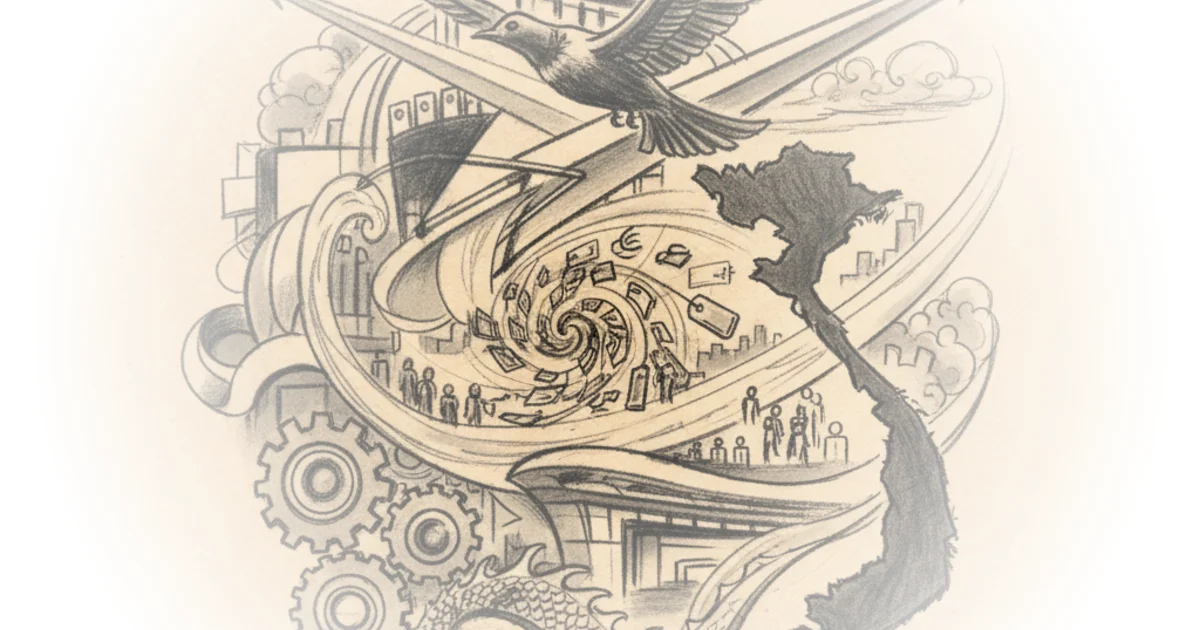
Fred Mills doesn't just report on a new airport; he frames Vietnam's Long Tan project as a high-stakes geopolitical gamble where the prize is dominance over Southeast Asia's exploding air travel market. While the region is already saturated with world-class hubs, Mills argues that the sheer velocity of growth—predicted to triple in two decades—demands a colossus that existing infrastructure simply cannot accommodate. This isn't merely about adding runways; it is a $16 billion assertion that Vietnam intends to be the region's primary gateway, challenging Singapore's long-held crown.
The Race for the Mega-Port
Mills sets the stage by highlighting the frenetic competition across the region. He notes that while Singapore's Changi Airport is already "regularly referred to as the best airport in the world," the pressure to expand is relentless. "$10 billion is being plunged into building a swanky new terminal 5 at this location," he writes, noting that Changi aims to handle 150 million passengers by the mid-2030s. This context is crucial; it establishes that Vietnam isn't building in a vacuum but is entering a crowded arena where neighbors are already spending billions to stay ahead. The author's comparison of Long Tan to London's Heathrow—spanning "more than four times the size" of the British hub—effectively conveys the scale of the ambition.
Critics might note that comparing a future project to an established giant like Heathrow ignores the decades of operational refinement and global connectivity that the latter already possesses. However, Mills uses these comparisons to underscore the sheer magnitude of the engineering challenge rather than to suggest immediate parity.
Engineering the Lotus
The core of Mills' coverage shifts to the technical and logistical hurdles of constructing such a facility on a forested site previously scarred by conflict. He details the grim reality that "a variety of bombs and mines dating back to the Vietnam War were uncovered during excavations," forcing work to halt repeatedly for safe removal. This historical layer adds a unique dimension to the story, reminding the reader that modern mega-projects in this region must contend with the literal ghosts of the past.
"The structure and its attached wings are comprised of a steel frame supported by reinforced concrete columns and beams. Then above it all is this spectacular roof, a clear span design stretching 82 m."
Mills explains that this "clear span" design is vital for creating open, breathable spaces without internal columns, a necessity for high-volume passenger flow. He further describes the roof as a complex assembly of "thousands of tons of steel combining to create five layers" to ensure insulation and waterproofing. The author's focus on the "lotus" theme is not just aesthetic; he points out that "curved architecture is a whole lot more expensive than right angles" because concrete becomes brittle when curved and steel is difficult to manipulate at scale. This insight demystifies why the price tag is so "eyewatering," linking the visual beauty directly to engineering difficulty.
The Human and Environmental Cost
Perhaps the most compelling part of Mills' narrative is his willingness to highlight the severe collateral damage of the construction. He moves beyond the gleaming renderings to describe the "brutal" dust emanating from the red basalt soil, which has created "dramatic clouds of colorful dust" covering residential areas up to 7 km away. "People have been experiencing breathing problems with some residents saying the coughing was worse than at the height of the pandemic," he writes, a stark admission of the human cost.
He also notes the agricultural impact, where crops have been "caked in dust" and unable to photosynthesize, leading to rapid die-offs. This section is effective because it refuses to let the narrative remain purely celebratory. A counterargument worth considering is whether the government's eventual response—building reservoirs and imposing speed limits—was sufficient given that "a lot of the damage had already been done." Mills suggests the government was "slated for a lack of preparedness," adding a layer of political accountability to the engineering feat.
"It feels like a bit of a gamble... But the people of Vietnam can take comfort in the expansion approach. Long is being developed in stages, allowing the government to monitor capacity and passenger demand at each phase of the project."
This phased approach is Mills' key mitigation for the financial risk. He acknowledges that when the project was first proposed in 2006, Vietnam was a different economic landscape, and residents feared the debt would "set the nation back." By breaking the project into phases, the government can scale back if the predicted traffic surge doesn't materialize, a prudent strategy in an uncertain market.
Bottom Line
Fred Mills succeeds in portraying Long Tan not just as a construction project, but as a definitive statement of Vietnam's economic arrival and future aspirations. The strongest part of his argument is the integration of historical context (war remnants) and environmental reality (dust crises) into a story about futuristic infrastructure, grounding the $16 billion price tag in tangible human and physical consequences. The biggest vulnerability remains the sheer assumption of demand; while Boeing predicts a tripling of traffic, the risk of overbuilding in a region with multiple competing mega-hubs is real. Readers should watch whether the phased rollout allows Vietnam to pivot if the "gamble" does not pay off as quickly as the architects hope.