L. M. Sacasas offers a startling reframing of our digital anxiety: the feeling that our phones are listening to us isn't a paranoid glitch, but the symptom of a deliberate historical process. He argues we are witnessing the "enclosure of the human psyche," a structural transformation where our inner lives are fenced off and turned into extractable resources, much like the English commons were privatized centuries ago. This is not just a critique of surveillance capitalism; it is a call to recognize a fundamental shift in human liberty that demands a new form of resistance.
The Myth of the Listening Phone
Sacasas begins by dismantling the popular obsession with whether devices are literally recording our conversations. He acknowledges the visceral reality of these moments, citing the experience of author Merritt Tierce, who noted that even if the technical mechanism is coincidence, the feeling itself is real. "If you feel like it's happening, that is, itself, a happening," Tierce writes, a sentiment Sacasas uses to pivot from technical pedantry to structural analysis. He argues that fixating on the binary of "yes or no" regarding microphone access misses the larger point: the entire technological environment is designed to render us predictable and pliable.
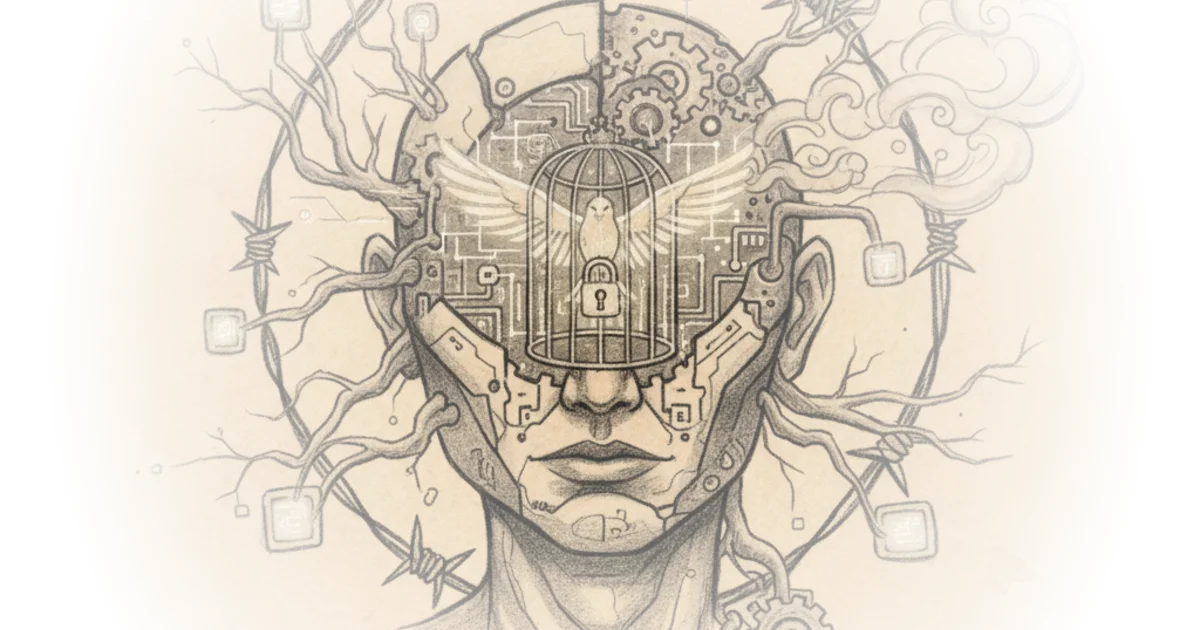
The author suggests that describing this as "the internet reading our minds" is too mystical, obscuring the material reality of data extraction. Instead, he proposes a more grounded analogy. "The whole technological environment is increasingly designed so as to enclose the human psyche not with hedgerows and fences, but with an array of data gathering tools and techniques," Sacasas writes. This framing is powerful because it shifts the blame from a vague, omnipresent algorithm to a specific, historical logic of enclosure. It forces the reader to see the digital landscape not as a neutral tool, but as a contested space where rights are being stripped away.
Critics might argue that the analogy stretches too far, as the "commons" were physical lands essential for survival, whereas the digital realm is often voluntary. However, Sacasas counters this by pointing out that our attention and behavior have become the new currency of subsistence in a digitized economy, making the loss of autonomy just as critical.
If you feel like it's happening, that is, itself, a happening.
The Historical Precedent
To make his case, Sacasas digs into the history of the English enclosure movement, drawing on historian Eula Biss to explain how collective rights were systematically dismantled. He highlights how commoners were redefined as "rough and savage" and their traditional practices labeled as theft. "Gleaning became trespassing, and fishing became poaching," Sacasas notes, illustrating how legal frameworks were rewritten to criminalize customary survival strategies. This historical parallel is the essay's analytical engine, revealing how the rhetoric of "improvement" was used to justify the theft of shared resources for the profit of the few.
The author draws a direct line from this history to our current moment. Just as landowners promised "improvement" by turning communal land into profit centers, the tech industry promises efficiency and personalization while converting our unmonitored thoughts and behaviors into data commodities. "Enclosure wasn't robbery, according to this logic, because the commoners made no profit off the commons, and thus had nothing worth taking," Sacasas writes. This logic is chillingly familiar today: if we aren't monetizing our own attention, the argument goes, then the corporations are merely unlocking its value.
The argument gains weight by exposing the moral justification behind the enclosure. It wasn't just about greed; it was about managing the "unruly" masses. "Commoners were 'rough and savage,' according to eighteenth-century rhetoric," Sacasas explains, suggesting that the modern drive to optimize human behavior follows the same pattern of treating the psyche as something that needs to be tamed and managed for its own good.
The Psychology of Extraction
Sacasas expands the scope of his argument to include the psychological impact of this enclosure. He invokes the work of Marshall McLuhan to suggest that the true danger lies in the surrender of our senses to private manipulation. "Once we have surrendered our senses and nervous systems to the private manipulation of those who would try to benefit from taking a lease on our eyes and ears and nerves, we don't really have any rights left," he quotes. This is the crux of the "enclosure of the psyche": the loss of the internal space where we used to be free from external calculation.
The author connects this to the 19th-century obsession with scientific management, noting that digitization has simply scaled this urge to a planetary level. We are no longer just measuring factory output; we are measuring the very contours of our desires and fears. "Digitization dramatically increased the scope of what it is possible to measure and analyze, fueling the fantasy that we could bring not just observable bodily movements under administration, but also the human psyche," Sacasas writes. This observation lands with particular force because it explains why the feeling of being watched feels so inescapable—it is a structural feature of the system, not a bug.
Once we have surrendered our senses and nervous systems to the private manipulation of those who would try to benefit from taking a lease on our eyes and ears and nerves, we don't really have any rights left.
Bottom Line
Sacasas's strongest contribution is his ability to reframe digital anxiety as a historical struggle for the commons, providing a vocabulary for resistance that goes beyond simple privacy settings. The argument's vulnerability lies in the difficulty of "resisting" a system that is woven into the fabric of modern life, yet his call to recognize the enclosure is a necessary first step. Readers should watch for how this concept of the "enclosed psyche" evolves as new technologies like AI and neural interfaces further blur the line between the self and the machine.