Most analyses of war films get stuck in a binary trap: is this movie pro-war or anti-war? Tom van der Linden argues that this question is the wrong one to ask entirely. Instead, he suggests that the genre's true power lies in exposing the psychological machinery that turns human beings into killers, revealing that our obsession with heroism is often the very engine of our destruction.
The Paradox of the Hero
Van der Linden begins by dismantling the idea that a filmmaker's intent guarantees a specific audience reaction. He notes the contradictory claims of directors like Francis Ford Coppola and Steven Spielberg regarding whether all war films are inherently pro-war or anti-war. The reality, he argues, is far messier. "There appears to be a lot of ambiguity about what it is that war films actually communicate," he writes, pointing out that even classics like Saving Private Ryan are debated for glorifying the very violence they seek to condemn.
The author's most compelling insight is that the problem isn't just bad directing; it's the audience's desire for spectacle. He contrasts Michael Bay's Pearl Harbor, which frames a devastating attack with the same cinematic thrill as a Transformers movie, against the restricted, terrifying perspective of Dunkirk. "Filmmakers can definitely model their own message by not thoroughly considering the effect their images really have," Van der Linden observes. This is a crucial distinction: the medium itself can betray the message. When a film makes war look exciting, it undermines any anti-war thesis, regardless of the director's stated goals.
"The experience is always a simulated one. It is never the same as going through the real thing."
This simulation creates a dangerous distance. Even when a film like Come and See forces the viewer into a subjective, traumatic experience, the viewer remains safe. Van der Linden suggests this safety allows us to consume horror as entertainment, a paradox that complicates the very definition of an "anti-war" film.
The Psychology of Immortality
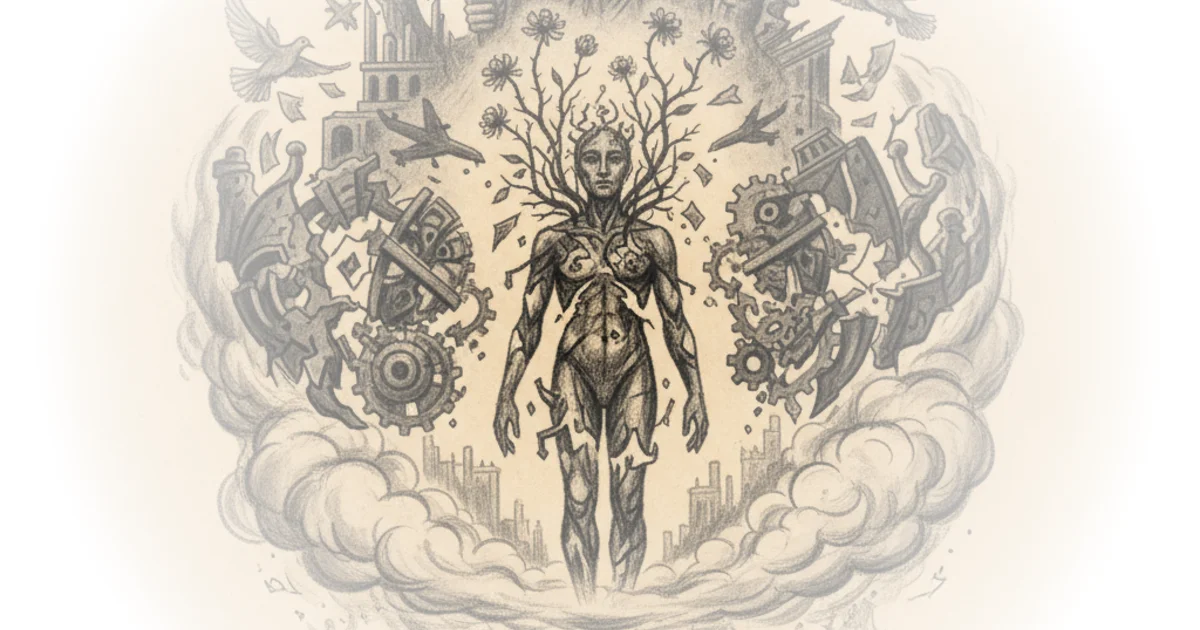
To understand why we are drawn to these films, Van der Linden pivots from cinema to existential philosophy, drawing heavily on the work of Ernest Becker. He posits that human culture is fundamentally a "hero system" designed to help us escape the terror of our own mortality. "Cultures provide us with meaningful actions and virtues which through their realization allow us to symbolically transcend death," he explains. In this view, the soldier isn't just fighting for a nation; they are fighting to achieve a form of symbolic immortality.
This framework brilliantly explains the allure of the war film. The hero on screen embodies the triumph over extinction, offering the audience a vicarious victory over death. Van der Linden illustrates this with a scene from Band of Brothers where a decisive captain rallies his men, making them feel "invincible" even as they charge into a slaughter. "In such a social structure the sacrifice of one's physical being is but a small price to achieve symbolic immortality," he argues.
However, this hero system contains a fatal flaw. The drive to transcend death requires the denial of our own animal nature and vulnerability. Van der Linden writes, "Heroism also functions as a denial of our physical limitations and animal nature which Becker described as the negative which is incompatible with the absolute values we're striving towards." This denial creates a psychological "shadow" that must be projected outward. We cannot accept our own capacity for evil, so we project it onto an enemy.
The Banality of Evil
The argument culminates in a chilling connection between heroism and atrocity. Van der Linden explains that hero systems inevitably lead to scapegoating. By uniting against a perceived external evil, a group absolves itself of its internal struggles. "Scapegoating has always been an effective tool to organize people on their hero systems," he notes, citing the rise of Nazi Germany as the ultimate example of a society mobilized by a promise of heroic victory over "devils" within their midst.
This leads to a re-examination of Hannah Arendt's concept of the "banality of evil." Van der Linden suggests that the most terrifying evil isn't committed by monsters, but by ordinary people trying to fit into a hero system. "The banality of evil then was coined to point out this thoughtlessness with which evil acts can be committed," he writes. In films like The Bridge on the River Kwai, the British officer becomes so obsessed with building a monument to his own heroism that he forgets he is building it for the enemy, ultimately destroying his own side. "The result is a tragedy for pretty much everyone involved," Van der Linden concludes, noting that the officer's delusion is a direct result of his need for symbolic immortality.
Critics might argue that this psychological reductionism ignores the geopolitical or material causes of war, focusing too heavily on individual psychology. Yet, Van der Linden's strength lies in explaining why rational people commit irrational acts of violence; it is not a failure of logic, but a success of a flawed psychological need to escape death.
Bottom Line
Van der Linden's piece succeeds by shifting the debate from "what is this film saying?" to "what is this film doing to us?" The strongest part of his argument is the link between the desire for heroism and the projection of evil, offering a profound explanation for why war films often glorify the very things they claim to critique. The biggest vulnerability is the heavy reliance on existential philosophy, which may feel abstract to readers looking for concrete film criticism, but the synthesis of Becker's theories with cinematic examples is masterful. The takeaway is clear: until we confront our own need for heroism, we will never truly understand the horror of war.