Derek Muller has spent years explaining how scientists actually captured humanity's first images of black holes — and his latest piece reveals the technique that makes it possible: connecting radio telescopes across Earth itself. The claim isn't just that we took these pictures, but that no single telescope could do it alone.
How They Actually Took These Pictures
The challenge is almost impossible to comprehend. Muller writes that "there is no optical telescope on earth that could produce such an image" — and he's not exaggerating. The black holes at the center of our galaxy appear so tiny in the sky that it's "equivalent to taking a picture of a donut on the moon." This is the core of what makes VLBI so remarkable: individual radio telescopes lack the resolution to see the ring structure, but combining them creates something better than any single dish could achieve.
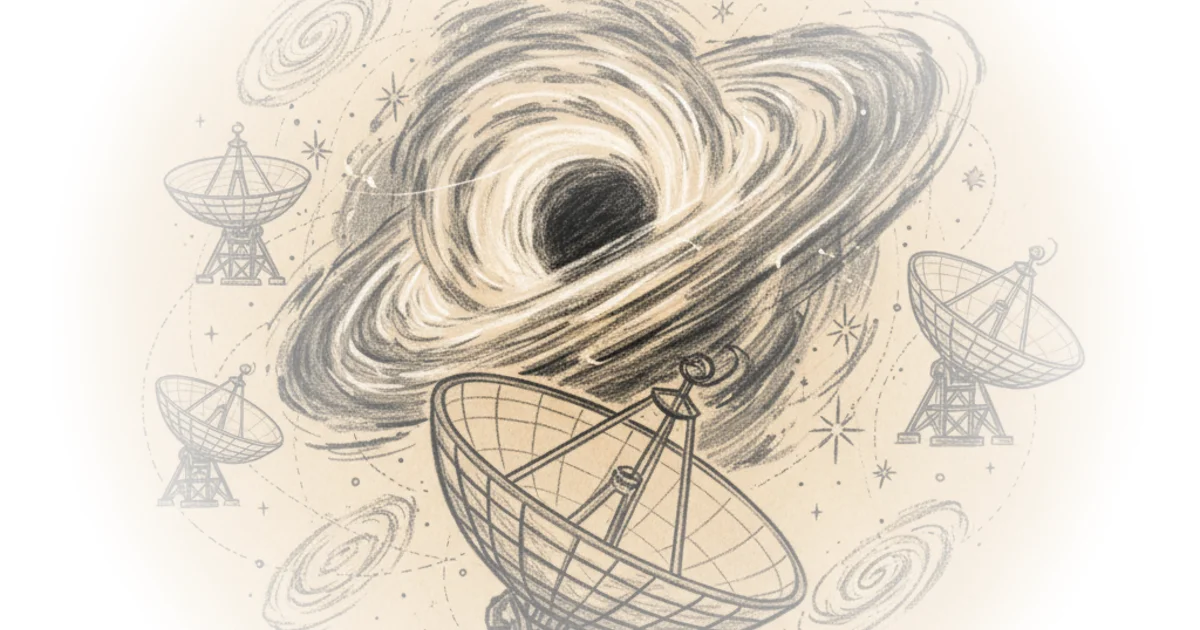
The key insight is how they solved the math problem. Muller explains that "the telescope you'd need would have to be the size of the earth in order to see the ring of a black hole which is obviously impossible" — but then reveals there's a workaround. The technique uses not a complete dish, but scattered radio telescopes across the planet: "you don't need a complete dish the size of the earth, just pieces of it." This is Very Long Baseline Interferometry in action.
The logistics are almost absurd. Muller describes how each telescope records signals at its location with precise timing down to the femtosecond — then the data is so massive that "the fastest way to do it was actually to carry hard drives as hand luggage to centralized locations." This is science done with physical storage devices, not transmitted digitally. The image of researchers carrying petabytes of data across borders feels almost quaint for a project requiring planetary coordination.
What Are We Actually Looking At?
The most compelling section unpacks what the famous "shadow" actually shows. Muller explains that when we look at this image, we're seeing light rays that graze the photon sphere at 2.6 Schwarzschild radii and escape to infinity — anything closer gets warped into the black hole itself. The shadow is 2.6 times bigger than the event horizon.
Muller writes: "the whole back side of the event horizon mapped onto a ring on this shadow" — meaning we actually see the entirety of the black hole's event horizon from our single vantage point. But it gets stranger: light can come in, go around the back, and get absorbed in the front, creating additional images. "You get another image of the entire horizon next to that and another annular ring and then another one after that" — infinite images approaching the edge.
This is where Muller earns his conclusion: the black hole warps spacetime, bending light rays so they don't go in straight lines. The visualization requires understanding that we're seeing warped geometry, not just a dark circle against bright gas.
You get basically infinite images of the event horizon as you approach the edge of this shadow.
Why This Works As Explanation
Muller's strongest move is making the invisible visible through concrete analogies. The "donut on the moon" comparison captures how tiny these objects appear — dividing the sky into degrees, then arc minutes, then arc seconds until you're looking at something equivalent to a hole only 40 microarcseconds across. The description of carrying hard drives as luggage feels human-scale against the cosmic scale.
The piece's real power is in what it doesn't do: it avoids treating black holes as simple objects and instead shows how our view is constructed from gravitational lensing, photon spheres, and warped spacetime — all the physics that makes these images so difficult to interpret. The explanation of why we see 2.6 times the event horizon rather than just the dark hole itself connects directly to how light behaves near extreme gravity.
Bottom Line
Muller delivers on explaining both how they did it and what we're seeing — but the "how" is where the piece excels. VLBI represents an extraordinary solution to an impossible observational problem: making Earth itself into a lens by combining signals from scattered telescopes worldwide. The explanation of the photon sphere and warped light rays adds depth, though readers wanting more on what this tells us about black hole physics might wish for additional context.
The strongest part of the argument is the technique: no single telescope could see the ring structure, so they built a global network that acts as an Earth-sized dish without actually being one. The vulnerability is that Muller moves quickly through the observational challenges before fully unpacking what we're seeing — some readers may want more time with the physics before reaching the conclusion.