In a world racing toward algorithmic governance, a 38,000-word document from the Vatican offers a startlingly humanist counter-narrative. The Pillar's guide to Pope Leo XIV's first encyclical, Magnifica humanitas, does not merely summarize a religious text; it frames a pivotal moment where the Church attempts to reclaim the definition of "human" before technology rewrites it entirely. This is not a retreat into the past, but a strategic deployment of 19th-century social theory to dismantle 21st-century transhumanism.
The Historical Mirror
The piece anchors its analysis in a deliberate historical echo. Pope Leo XIV, the first U.S.-born pontiff, explicitly chose his regnal name to invoke Leo XIII, who addressed the industrial revolution in 1891. The Pillar reports that Leo XIV stated, "In our own day, the Church offers to everyone the treasury of her social teaching in response to another industrial revolution and to developments in the field of artificial intelligence that pose new challenges for the defense of human dignity, justice, and labor." This parallel is not accidental; it mirrors the way Marie Curie, decades later, would navigate the ethical complexities of her own scientific breakthroughs, insisting that discovery must serve humanity rather than enslave it.
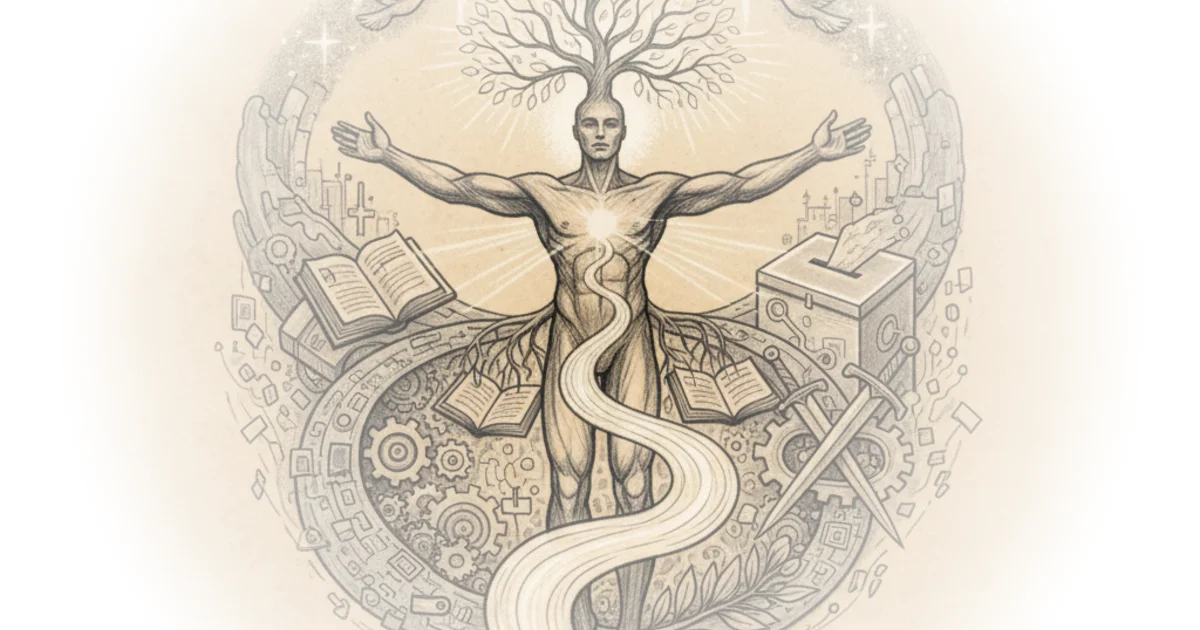
The argument gains weight by positioning the encyclical as a "living corpus of truth" rather than a static rulebook. The editors note that the document defines social doctrine as something that "safeguards and interprets humanity's vocation to a full and just life," rejecting the notion that it is merely "an inert set of concepts." This framing is crucial for busy readers who might dismiss religious texts as outdated; it reframes the Church's role as an active participant in the "shared discernment process" required to navigate digital transformation.
"Humanity, created by God in all its grandeur, is today facing a pivotal choice: either to construct a new Tower of Babel or to build the city in which God and humanity dwell together."
The Architecture of the Common Good
Moving beyond abstract theology, the piece details how the encyclical applies these principles to the modern "technocratic paradigm." The Pillar highlights the Pope's warning against the "Babel syndrome," characterized by greed and the illusion of a single, dominant language or system. Instead, the text urges a "way of Nehemiah," where the city is reborn through "shared responsibility of all." This distinction is vital: it rejects the centralized, opaque power structures of big tech in favor of decentralized, communal accountability.
The coverage is particularly sharp when dissecting the encyclical's stance on the digital economy. Leo XIV acknowledges the Church's historical failure to condemn slavery quickly, a moment of humility that the piece notes is "striking." He then pivots to the present, calling for new efforts to eliminate "slave-like conditions in the digital economy." This connects the historical struggle for labor rights—similar to the educational reforms Maria Montessori championed by focusing on the dignity of the child's development—to the modern struggle for data sovereignty.
The Pillar reports that the Pope insists AI is "merely imitative," lacking the capacity to "undergo experiences," "feel joy or pain," or "know from within what love, work, friendship or responsibility mean." This is the document's core philosophical firewall. By denying AI a moral conscience, the encyclical strips it of the authority to make ethical decisions, forcing the responsibility back onto human creators.
Critics might argue that this binary view of human versus machine intelligence ignores the potential for AI to augment human moral reasoning or that the definition of "experience" is too narrowly theological. However, the piece suggests that the danger lies not in the technology itself, but in the "concentration of power" where a few private companies define "conditions for access, rules of visibility, forms of interaction, and even economic opportunities."
The Limits of the Algorithm
The commentary also addresses the practical governance of these systems. The Pillar notes the encyclical's call for "measured and vigilant" engagement, warning users against forming emotional bonds with algorithms that simulate empathy. The text argues that while AI's "words of advice, empathy, friendship and even love" can be "engaging and at times genuinely helpful," they ultimately trick users into believing they are connecting with a "real personal subject."
This section of the analysis is grounded in the principle of subsidiarity. The editors explain that the state must respect the freedom of individuals and families, a principle that becomes even more critical when private entities monopolize "expertise, data, and decision-making authority." The encyclical posits that the "universal destination of goods" applies not just to material wealth, but to "immaterial and cultural goods" as well, suggesting that data and algorithms should serve the common good rather than a select few.
"So-called artificial intelligences do not undergo experiences, do not possess a body, do not feel joy or pain, do not mature through relationships, and do not know from within what love, work, friendship or responsibility mean."
Bottom Line
The strongest element of this coverage is its refusal to treat AI as a purely technical problem, instead framing it as a crisis of human identity and social structure. The encyclical's vulnerability lies in its reliance on a theological framework that may not resonate with secular technocrats, yet its call to reject the "technocratic paradigm" offers a necessary corrective to the unchecked speed of innovation. Readers should watch for how this "way of Nehemiah" translates into actual policy, as the gap between spiritual discernment and legislative action remains the ultimate test of this vision.