Most people assume the skeletons in their medical textbooks are synthetic props or the result of dignified, modern donations. Rohin Francis shatters that illusion by tracing a dark, centuries-long supply chain where human remains were treated as a global commodity, sourced from the poorest communities in India and sold to the world's most prestigious institutions. This is not just a history lesson; it is an exposé of how the modern medical establishment was built on a foundation of unconsented exploitation that continues to operate in the shadows today.
The Anatomy of a Global Trade
Francis begins by dismantling the romanticized view of medical education, noting that while synthetic models are common now, they lack the critical variations found in real human bodies. "For hundreds of years doctors have depended on real human bones to learn from," he writes, setting the stage for a historical deep dive. The narrative quickly pivots from the well-documented grave robbing of 19th-century Britain to a more insidious, industrialized operation in colonial India. Francis explains that while the UK passed the Anatomy Act in 1832 to curb local theft, the demand simply shifted east, creating a "fresh business model" in India where the disposal of the dead was outsourced to the poorest members of society.
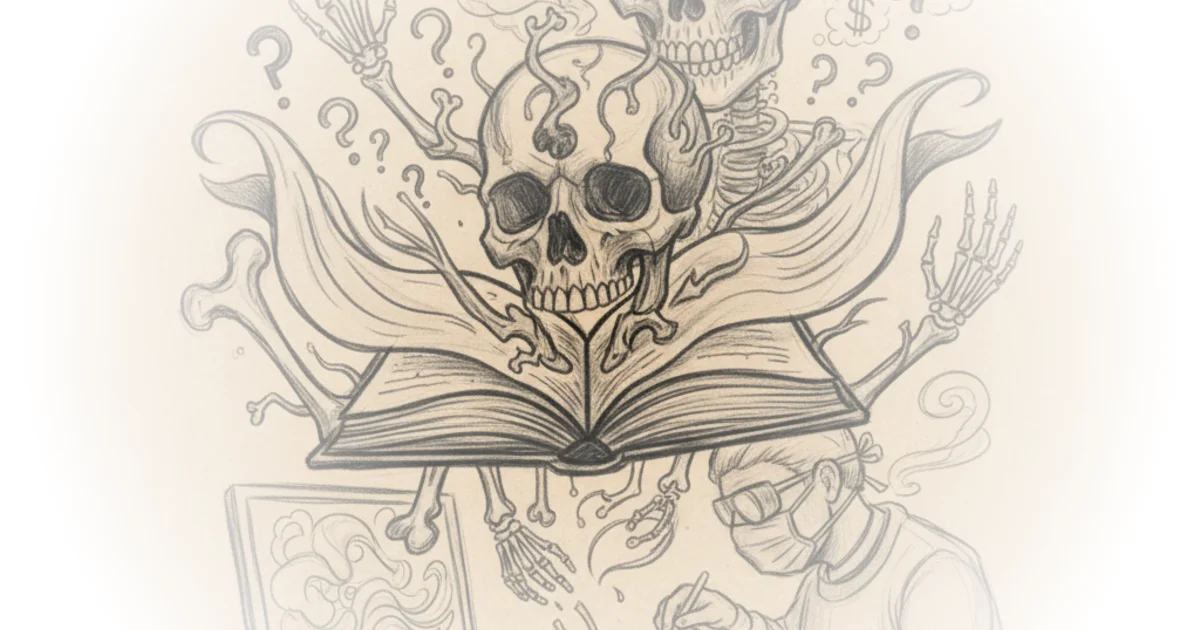
The scale of this operation was staggering. Francis highlights that the city of Kolkata became the epicenter of this trade, with vendors developing a reputation for producing "high-quality fully articulated complete skeletons bleached to a brilliant white." The author points out a chilling disconnect between the buyers and the source: "Buyers didn't ask where the skeletons came from nor did the vendors say." This willful ignorance allowed the trade to flourish, with one company, Shanker Sen, becoming the world's largest exporter of "human goods." The argument here is compelling because it reframes the history of Western medicine not as a triumph of science alone, but as a system that relied on the systematic dehumanization of the colonized.
Medics at least here in the UK will be familiar with the name Adam Hui as the makers of just about every anatomical model found in hospitals across the country but they started by selling real human teaching specimens.
Francis draws a disturbing line from these historical facts to the present day, suggesting that the bones used to teach generations of British doctors were likely those of Bengalis. "I find it quite remarkable that between the 1930s and 1990s British medical students especially right here in London where Adam Hui was based learned their Anatomy almost exclusively from the bones of Bengalis that had seen better days," he observes. The implication is that the very foundation of modern anatomical knowledge in the West is built on a specific, unacknowledged tragedy. Critics might argue that the provenance of every single skeleton is impossible to verify, but Francis's point stands: the systemic nature of the trade makes it statistically probable that many specimens were obtained without consent.
The Ban That Never Was
The narrative takes a turn when Francis addresses the 1985 ban on exporting human remains from India, triggered by the scandalous discovery of 1,500 child skeletons. While the law was passed, Francis argues it was largely performative. "Sixteen years after the export ban it was as if the law had never taken effect," he writes after recounting a police raid that seized two rooms full of skeletons and shipments destined for the US, Europe, and Brazil. The author's investigative journey to Kolkata reveals a business that simply went underground, moving from open warehouses to clandestine operations behind closed doors.
Francis's personal attempt to purchase a skeleton illustrates the enduring nature of this black market. Posing as a lecturer, he encounters a vendor who claims the bones are from "unclaimed bodies," a justification Francis finds deeply suspicious given the demographics of the city. "I asked are they unclaimed bodies or are they donated with consent to which he said yes so I tried to clarify so you're saying that these are all unclaimed bodies," he recounts. The vendor's vague assurances and the refusal to provide contact details highlight a culture of "Don't Ask Don't Tell" that persists among medical professionals and suppliers alike. The author notes that while there is no evidence of people being murdered for their bones today, the "understaffed and underfunded police in India turn a blind eye to what they probably consider a minor crime."
The victims are dead after all and this is just a purely personal observation here but in Hindu and many other Eastern philosophies human remains are not as taboo as they are in the West.
This cultural context is crucial to Francis's analysis. He suggests that the difference in how death is viewed in Eastern philosophies—where the body is an empty vessel after the soul departs—may have facilitated the trade in a way that Western taboos might have prevented. However, this cultural relativism does not absolve the systemic exploitation. The author acknowledges that while the workforce is now a "skeleton crew" compared to its glory days, the trade continues to supply medical schools domestically and potentially abroad. The piece effectively argues that the ban was a regulatory failure, not a moral victory.
The Global Shadow Market
Francis broadens the scope to show that India is not an anomaly. He references Scott Connelly's book The Red Market to illustrate that the trade in human parts is a global phenomenon, from organ harvesting in China to the removal of organs from babies in the UK without consent. "While the illegal trade in kidneys and similar solid organs has become a common trope in Bollywood films I had never really given any thought to where the bones that we learned from a medical school came from," he admits. This admission serves as a powerful pivot, connecting the specific case of Indian skeletons to a wider, more terrifying reality of human commodification.
The author also touches on the legal landscape, noting that buying and owning human remains remains legal in the US, UK, and India, despite the ethical quagmire. "There are plenty of vendors online although I will tell you now they're not cheap," Francis writes, pointing out that while eBay banned the sale in 2016, the market has simply migrated. The piece concludes with a reflection on the irony of the situation: the very institutions that claim to uphold the highest ethical standards in medicine are often the ones consuming the products of this illicit trade. The author's framing is effective because it forces the reader to confront the uncomfortable reality that their own education, or that of their doctors, may be rooted in this dark history.
Bottom Line
Francis's investigation is a masterclass in connecting historical dots to expose a persistent, systemic failure in global medical ethics. The strongest part of the argument is the detailed evidence of how the 1985 ban was circumvented, proving that regulatory changes without cultural and enforcement shifts are meaningless. The biggest vulnerability lies in the difficulty of proving specific provenance for every skeleton currently in use, yet the sheer scale of the historical trade makes the risk undeniable. Readers should watch for how modern medical schools are responding to these revelations, as the demand for "real" anatomy continues to clash with the imperative of ethical sourcing.