Mark Koyama tackles a quiet but explosive rift in how we understand the past: why social scientists keep using the word "feudalism" while medieval historians have largely banned it from their vocabulary. The piece is notable not for rediscovering history, but for exposing a deep methodological divorce between economics and history that leaves both fields speaking past each other. For anyone trying to understand why political stability diverged between Europe and the Middle East centuries ago, this is the missing context.
The Data vs. The Definition
Koyama begins by highlighting a landmark 2013 study by Lisa Blaydes and Eric Chaney, which uses ruler duration as a proxy for political stability. The findings are stark: "First, ruler duration in Western Europe statistically diverged from duration in the Islamic world during the medieval period. Second, this divergence was driven, in part, by a reduced probability of monarchical overthrow in Western Europe." Koyama notes that this divergence happened long before the famous economic split, suggesting a political cause.
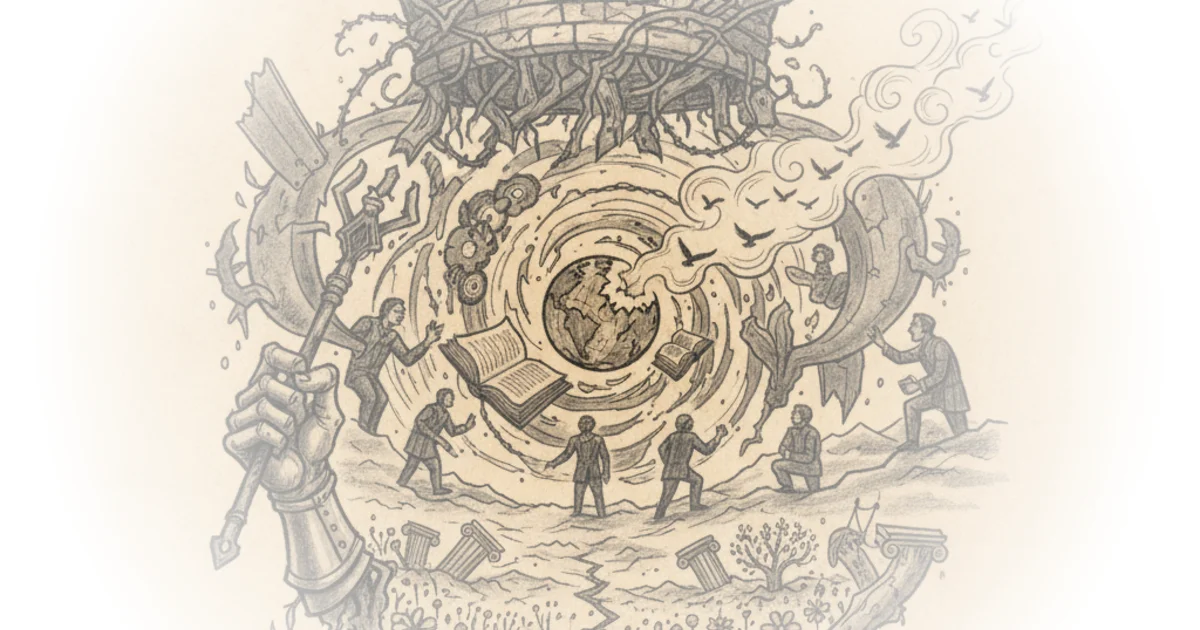
To explain this, Blaydes and Chaney point to the "Feudal Revolution." They argue that as the Roman fiscal system collapsed, cash-strapped kings like Charlemagne could no longer tax their way to an army. Instead, they relied on land grants to equip mounted warriors. "The technological innovation of the stirrup meant that 'mounted shock combat' became the norm in warfare and the large investment required to purchase a horse and armor for battle meant that monarchs needed to recruit individuals with wealth to serve as the mounted military elite." This created a system where large landowners held autonomous power bases, fundamentally altering the balance of power.
The logic here is compelling for a political economist: a shift in military technology and fiscal capacity drove a structural change in governance. However, Koyama points out a glaring gap. While this paper has been cited hundreds of times in economics and political science, it has been "totally ignored by historians." Why? The barrier isn't the data; it's the label.
"'Feudalism' has become an 'F-word' at some professional conferences for medieval historians, only uttered ironically or with the intention to provoke."
The Historian's Rejection
The core of Koyama's commentary lies in explaining why historians have turned against the concept. He traces this back to Elizabeth Brown's 1974 critique, which argued that the term was too flexible to be useful. Brown noted that the "variety of existing definition of the term and the general unwillingness of any historian to accept any other historian's characterization of feudalism constitute a prime source of confusion." Was it a legal system? A military one? A stage of history? The term was applied to everything from pre-Meiji Japan to Tsarist Russia, often with little in common.
The debate intensified with Susan Reynolds' 1994 book, Fiefs and Vassals. Reynolds argued that the neat legal relationship between lords and vassals was largely a later invention by lawyers, not a reflection of medieval reality. Koyama quotes her sharp assessment: "What the concept of feudalism seems to have done since the sixteenth century is not to help us recognize the creatures we meet but to tell us that all medieval creatures are the same so that we need not bother to look at them." For historians, the term acts as a "protective lens" that flattens the "dazzling oddities and varieties" of the actual past.
Critics of Koyama's approach might argue that he underestimates the damage done by the term. If a concept obscures more than it reveals, as Reynolds claims, then social scientists using it are building models on a foundation of sand. Koyama acknowledges the validity of Reynolds' technical arguments but suggests the historians' reaction has become an ideological overcorrection.
Can the Concept Be Saved?
Koyama argues that social scientists should not be "hostage to scholarly fashions in another field." He contends that the specific critiques Brown and Reynolds leveled—against using feudalism as a moral standard or a rigid "Ideal Type"—are not relevant to how economists use the term today. "Another problem is the inclination to employ the idea of fully developed, classical, or perfectly formed feudalism as a standard by which to rank and measure areas or societies," Brown wrote, but Koyama suggests modern researchers aren't making that mistake.
He asserts that "feudalism remains a useful concept if properly used," citing his own recent work with Desiree Desierto which argues that medieval Europe did have a "distinctive system of government" that warrants the label. The challenge, he admits, is not the concept itself, but the "conceptual barrier" that prevents dialogue. He writes that "good historical social science should be in dialogue with the most up-to-date historical scholarship," yet the demands of publishing often force researchers to strip away the very nuances that historians demand.
"The concepts of vassalage and of the fief, moreover, as they have been developed since the sixteenth century, originated in the work of the sixteenth-century scholars rather than in the late medieval texts they studied."
Bottom Line
Koyama's strongest move is reframing the "feudalism" debate not as a factual error, but as a communication breakdown between two disciplines with different incentives. His argument holds that the term can be a powerful analytical tool if stripped of its 19th-century baggage, but his biggest vulnerability is assuming that historians will ever accept a definition that they have spent fifty years dismantling. The path forward requires social scientists to do the hard work of engaging with the messy, specific reality of the Middle Ages, rather than relying on a convenient shorthand that the experts have rejected.