"Compact Magazine delivers a startling revelation: the global rush to monetize nature is not just failing to save the Amazon, but actively fueling a sophisticated financial grift where non-existent forests are traded as billion-dollar assets. This piece moves beyond the usual climate doom to expose how speculative capital, enabled by state policy, is turning the world's largest rainforest into a casino for fraud."
The Phantom Forest
The article opens with a jarring image from Apuí, a town in southern Amazonas that somehow held $8.5 billion in assets on the São Paulo stock market. "Carbon credits are a very particular type of asset," Compact Magazine reports, noting that while their value is supposedly tied to real carbon sequestration, "these tokens are essentially a form of speculative capital." The piece argues that the wealth generated here was "entirely fictitious," derived from a project called Fazenda Floresta Amazônica that never existed.
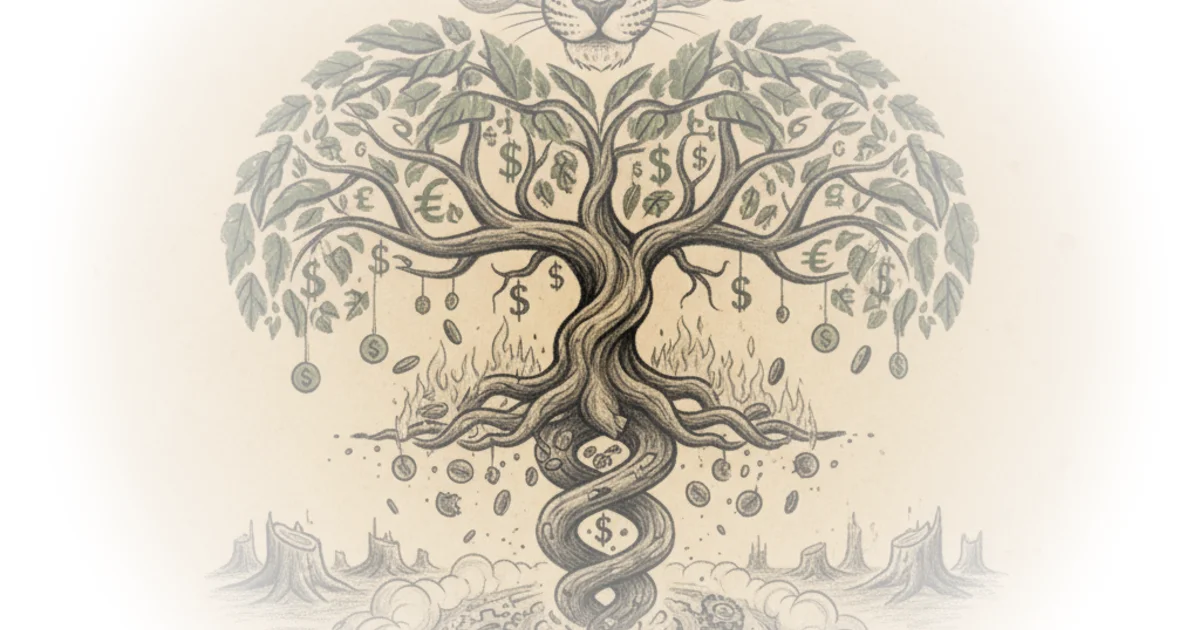
This is a crucial distinction for listeners to grasp. The article details how deeds were fabricated with dates predating Brazil's legal framework for private land ownership, with one document referencing a municipality that wouldn't be founded for another 26 years. "The deeds marshaled by the owner... were blatantly fraudulent," the editors note. This isn't just a case of bad accounting; it is a structural failure where the financial system rewards the appearance of conservation over the reality of it. The connection to historical land grabbing is stark here, echoing the "greenwashing" tactics seen in earlier REDD+ (Reducing Emissions from Deforestation and Forest Degradation) initiatives, where the promise of payment often preceded any actual protection of the land.
"Through the magic of the carbon offset, an ordinary forest or swamp is transformed into a tradeable financial asset, capable of redeeming the emissions of polluting companies from Hamburg to Hangzhou."
The commentary suggests this transformation is less about ecology and more about "conjuring" value out of thin air. The article traces the money to powerful entities like the Master Group and Reag, revealing a "dark money hydra" that implicated even the son of the sitting president. Critics might argue that focusing on a single collapsed bank distracts from the broader, systemic issues of international climate finance. However, the piece effectively uses this collapse to illustrate how easily the system can be gamed when oversight is weak.
The Green-Finance Nexus
The argument shifts to the political machinery enabling this fraud. Compact Magazine posits that this is not an anomaly but a "national project" driven by both right-wing and left-wing administrations. "The scale of these crimes is owed first to brute geography," the piece argues, acknowledging the difficulty of policing a region twice the size of Western Europe. Yet, it quickly pivots to the more uncomfortable truth: "it is a mistake to see land fraud as a consequence of the state's absence. On the contrary, it is fueled by state policies."
The analysis highlights a disturbing continuity in policy. The previous administration removed barriers to land titling, leading to a surge in land-grabbing, while the current administration has doubled down by creating a "green-financial nexus" to plug Brazil's ecological assets into global markets. "Lula has given the boom a new impetus by way of the green economy," the editors write. This reframing is powerful; it suggests that the push to brand Brazil as an "ecological superpower" is inadvertently providing a "sheen of legitimacy for new modes of sucking up land into rich men's portfolios."
The piece notes that between 2017 and 2020, the state issued more land titles than in the previous decade, a policy that "aimed to undermine the land-owning elite's longstanding rural opponents: the landless, indigenous, and ecological movements." Now, under the banner of sustainability, these same mechanisms are being repurposed. "What we are seeing now is land-grabbing with a green face," the article concludes, a phrase that captures the perverse irony of the situation.
"This marriage of speculative capital and loose land markets bodes ill for Brazil."
The editorial voice here is sharp, pointing out that even the agribusiness lobby is eager to regulate the carbon sector not out of altruism, but to secure their own financial interests. "Who said global warming was bad for business?" the piece asks rhetorically, highlighting how the "corporate wing" of the agricultural sector is lining up to profit from the climate crisis.
Bottom Line
The strongest part of this argument is its unflinching exposure of how "phantom carbon" relies on the very state institutions meant to prevent it, revealing a continuity of exploitation across political divides. Its biggest vulnerability lies in the complexity of the financial web described, which may obscure the specific policy levers a reader could actually pull to fix the problem. The reader should watch for how the Brazilian government responds to the collapse of the Master Group, as the outcome will determine whether this green finance boom becomes a tool for genuine conservation or merely a new vehicle for elite enrichment.