This piece strips away the sterile abstraction of medical logistics to reveal the visceral, high-stakes reality of organ transplantation. Asimov Press does not merely describe a surgery; they document a frantic, cross-country race against time where the difference between life and death hinges on the texture of an organ and the legal status of a stranger. For a reader seeking to understand the hidden infrastructure of modern healthcare, this narrative offers a rare, unvarnished look at the moment a body becomes a gift.
The Logistics of Life
The narrative begins not in an operating room, but in the back of an ambulance and the cabin of a private jet, immediately establishing the extraordinary resources required for a single transplant. Asimov Press writes, "I felt like the President, walking up an airstair as part of an entourage as midnight approached." This juxtaposition of elite travel with the grim reality of a brain-dead donor creates a striking tension. The author highlights that while the recipient is being prepped for a life-saving procedure, the donor is often a forgotten figure in the system.
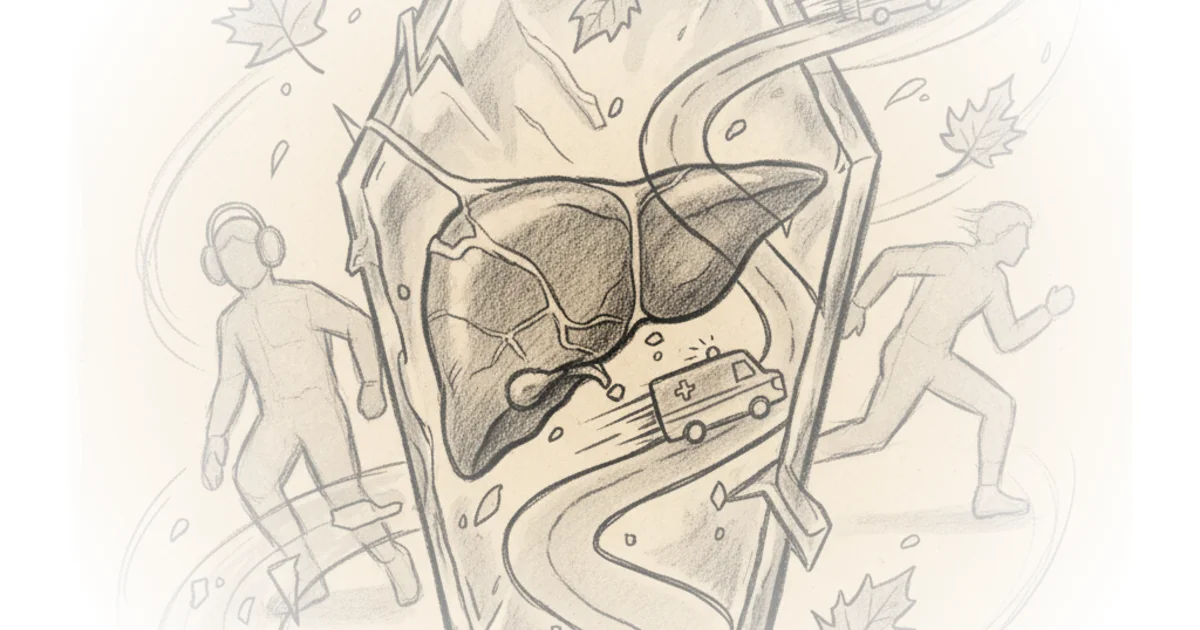
The piece underscores the sheer unpredictability of the mission. The team travels to a hospital they have never visited, changing into scrubs bought from a vending machine, illustrating the ad-hoc nature of these procurements. Asimov Press notes, "On a liver procurement, Dr. Lee explained, you rarely know where you're going." This lack of control is central to the drama; the surgeons are not just fighting disease, but navigating a chaotic, decentralized system.
The human liver is huge — a great rust-colored wedge, with a hint of purple in its shiny surface.
The description of the organ itself is grounded in sensory detail, moving away from clinical detachment. The author captures the physical reality of the liver, describing it as something that must be judged by touch, not just scans. This emphasis on human expertise over technology is a recurring theme. Asimov Press argues that while technology can identify tumors, "that is a secret only a trained human eye and hand can grasp." This framing elevates the surgeon's role from a technician to a critical gatekeeper of human life.
The Ethics of the Unclaimed
A significant portion of the commentary focuses on the legal and ethical complexities surrounding the donor, John. The author explains that John was brain-dead but had never signed up to be a donor, and his family could not be located. In the U.S., the system relies on "donation" as a gift, requiring explicit consent, unlike the "presumed consent" model common in Europe. Asimov Press writes, "Legally, a donated organ is considered a 'gift' that an individual makes to another, and the decision to make that gift is entirely the donor's own."
This legal framework creates a precarious situation where the coroner must authorize the donation for an unclaimed body. The author observes the stark contrast between this bureaucratic necessity and the emotional weight of the procedure. "If science is truly in the process of replacing religion, then we might call this his eulogy," Asimov Press notes, referring to the nurse's recitation of John's vital statistics. This moment of silence, devoid of the family's letters or music often present in other cases, highlights the isolation of the unclaimed donor.
Critics might note that the U.S. reliance on explicit consent contributes to the organ shortage, a systemic issue that the piece touches on but does not fully explore. The narrative focuses on the immediate procedure, leaving the broader policy debate about opt-out systems for the reader to infer. However, the human cost of this system is made clear through the description of John's body, which is treated with reverence despite the lack of a personal connection.
The Anatomy of a Procurement
The technical description of the surgery is rendered with a clarity that makes the complex accessible. The author details the "warm dissection," a process where the donor is still warm and the heart is still beating, a concept that challenges conventional notions of death. Asimov Press explains, "The concept of 'brain death' was developed in the 1960s to solve two problems... The first stemmed from the invention of the ventilator... The second was that doctors needed terminology for telling families that... they were, in fact, 'gone.'"
This historical context is crucial for understanding the ethical landscape. The author describes the moment of the "cross-clamp," when circulation is severed and the organ is flushed. "John's blood spilled into the canoe of his abdomen until it was just a clear solution, and a gray pallor climbed up his chin," Asimov Press writes. The imagery is vivid and unflinching, forcing the reader to confront the physical reality of death and the transformation of a body into a life-saving resource.
The narrative also touches on the anatomical variations that complicate the surgery. Dr. Lee discovers an anomaly in the hepatic artery, a variation found in 90% of people. "Because scans often don't show this, Dr. Lee is used to feeling around for rogue blood pipes," the author notes. This detail reinforces the theme of human skill and intuition being indispensable in a high-tech field.
It's the abortion question at the other end of life.
This quote, attributed to a medical ethicist, encapsulates the profound ethical dilemma at the heart of the piece. The definition of death is not just a medical fact but a social construct that allows for the continuation of life in others. The author's choice to include this perspective adds a layer of philosophical depth to the narrative.
Bottom Line
Asimov Press delivers a masterful account of the organ procurement process, blending technical precision with deep human empathy. The strongest part of the argument is its ability to humanize the abstract concepts of brain death and organ donation, making the reader feel the weight of the decision. The biggest vulnerability is the lack of broader policy analysis, which leaves the systemic issues of organ shortage and consent models somewhat in the background. However, for a reader seeking to understand the immediate, visceral reality of saving a life, this piece is essential reading.