Shirvan Neftchi delivers a stark assessment of the region's new reality: the Cold War-style deterrence that kept the Middle East in a tense stalemate has shattered, replaced by direct, hot conflict between Israel and Iran. What makes this analysis essential for the busy reader is not just the timeline of events, but the geopolitical chess move Neftchi identifies beneath the explosions—the deliberate targeting of the Islamic Revolutionary Guard Corps to fracture Iran from within, while Israel gambles that a prolonged war might collapse the Israeli government through domestic pressure. This is not a simple tit-for-tat; it is a high-stakes bid for regime change on both sides, executed through asymmetric warfare and proxy dynamics.
The Anatomy of a Decapitation Strike
Neftchi opens with a dramatic declaration that sets the tone for the entire piece. "The Cold War has turned hot overnight," he writes, describing the pre-dawn Israeli strikes that lit up Tehran and struck strategic sites in Isfahan and Natans. The author argues that the initial 24 hours were a disaster for Iran, with Israeli jets flying "almost uncontested" and intelligence operatives moving freely to target key systems. This framing is crucial because it shifts the narrative from a defensive response to an offensive campaign of attrition. The evidence presented—satellite imagery showing damage and the specific targeting of nuclear and military complexes—supports the claim that this was a coordinated decapitation effort rather than a random retaliation.
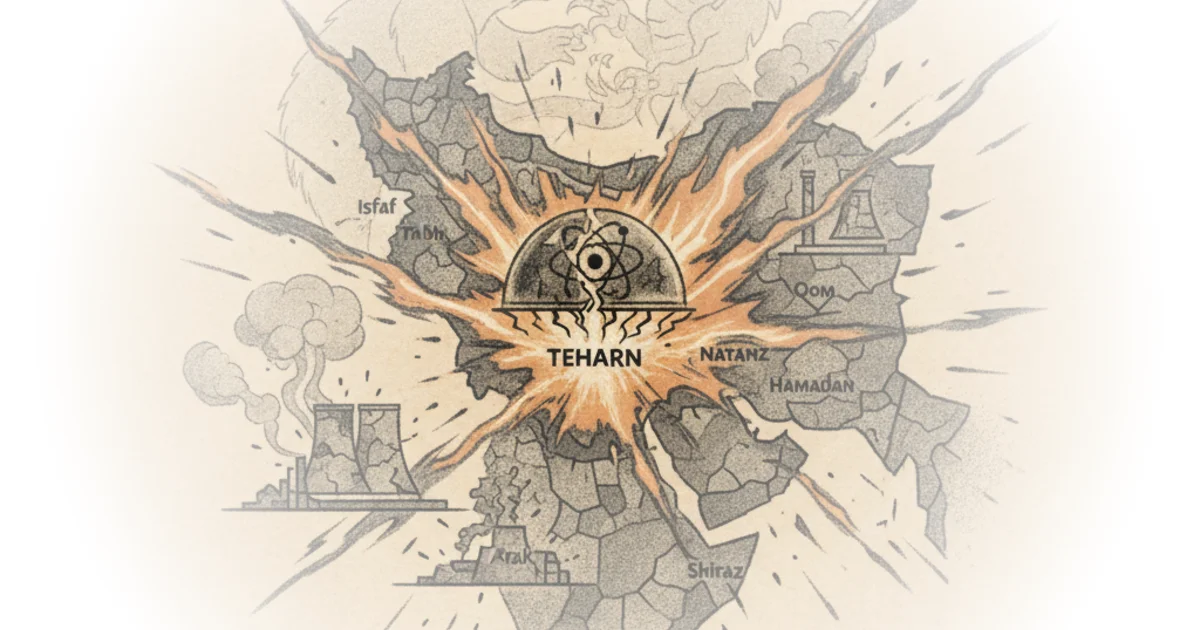
The author's most provocative claim is that Israel's objective extends beyond halting nuclear enrichment. "Israel's actions suggest a deeper objective, regime change," Neftchi asserts, pointing to the operation's name, "Operation Rising Lion," as a symbolic nod to pre-revolutionary Iran. The logic follows that by specifically degrading the Islamic Revolutionary Guard Corps (IRGC) while sparing the regular armed forces, Israel is attempting to "provoke internal friction" and encourage the regular military to turn against the revolutionary guards. This "divide and rule" strategy is a sophisticated reading of the conflict's tactical nuances, suggesting that the battlefield is as much about Iranian internal politics as it is about missile trajectories.
By degrading the IRGC, Israel may be trying to provoke internal friction, perhaps even encouraging the regular military to turn against the revolutionary guards in a bid for power.
Critics might note that assuming the regular Iranian military would defect is a significant gamble; the regular forces have long been integrated into the state's security apparatus and may view the IRGC as a necessary shield against external threats. However, Neftchi's focus on the distinct political and economic dominance of the IRGC provides a plausible, if risky, rationale for this specific targeting strategy.
The Iranian Dilemma: Sustainment vs. Escalation
As the analysis shifts to Iran's response, Neftchi outlines a complex strategic calculus. Iran cannot match Israel's air power directly, so its strategy relies on a mix of missile barrages and political pressure. "The Iranians know they can't change Netanyahu's mind, but they might just be able to collapse his government by building up domestic pressure," he explains. The goal is to inflict enough damage on Israeli infrastructure and military targets to trigger a vote of no confidence, a political victory that would allow Tehran to save face without necessarily winning a total military war.
This section highlights the fragility of the current situation. Neftchi notes that while Hezbollah remains on the sidelines due to its weakened state and the risk of dragging Lebanon into another war, Iran still has other levers. "Iran can try to wear down Israeli defenses, fire enough missiles at enough targets, and some will inevitably get through," he writes. The author emphasizes that Israel's stockpile of interceptors is finite, creating a war of attrition where Iran's sheer volume of ballistic missiles could eventually overwhelm defenses. This is a sobering reminder that technological superiority has limits when faced with a determined adversary willing to absorb losses.
The commentary also addresses the role of the United States, noting that the administration has chosen not to intervene directly, with officials insisting they had no role in the initial strikes. Yet, Neftchi warns that "dismantling Iran's nuclear program entirely would require direct American involvement." Without US air power, Israel can at best delay Iran's progress by a year or two. This distinction is vital for understanding the ceiling of Israel's military options and the potential for Iran to accelerate its nuclear ambitions as a deterrent.
Even if Israel's next wave of attacks is tactically successful, dismantling Iran's nuclear program entirely would require direct American involvement. Without US involvement, Israel can't do it.
The Nuclear Threshold and Regional Blowback
The most volatile variable in Neftchi's analysis is the potential for a nuclear test or a strike on Gulf oil infrastructure. He argues that if Tehran feels its survival is at stake, the Supreme Leader may decide that the cost of a nuclear test is worth the risk. "A nuclear test would force the Israelis and Americans to weigh the risk of turning a conventional conflict into a nuclear one," he writes. This is the ultimate escalation ladder, moving the conflict from conventional warfare to an existential threat that could draw in the US military directly.
Alternatively, Neftchi suggests Iran could target oil facilities in Saudi Arabia or the UAE, or ships in the Strait of Hormuz. "Attacking the oil and gas infrastructure in the Gulf region... would almost certainly cause oil prices to surge," he notes, potentially forcing Gulf leaders to pressure the US to rein in Israel. This strategy of "going through someone else's backyard" is a high-risk maneuver that could fracture Iran's recent diplomatic gains with Arab neighbors. The author acknowledges the contradiction: such an attack might achieve short-term leverage but would likely end the improving diplomatic ties Iran has worked to build.
The piece concludes with a warning about the loss of control. "Precision strikes rarely end with precision outcomes," Neftchi writes, emphasizing that every strike and counter-strike narrows the window for de-escalation. The behavior of both sides will depend on a mix of military, political, and strategic factors, where a single shift—like a US statement of support—could trigger massive ripple effects. The analysis leaves the reader with a clear sense that the region is in a fragile, volatile moment where the margin for error has vanished.
Precision strikes rarely end with precision outcomes.
Bottom Line
Neftchi's strongest contribution is the reframing of the conflict from a tactical exchange of fire to a strategic bid for regime change on both sides, revealing the deep political calculations driving military actions. However, the argument's vulnerability lies in its reliance on the assumption that internal Iranian fractures or Israeli domestic pressure will be the decisive factors, rather than the sheer destructive capacity of the weapons involved. Readers should watch closely for any shift in US involvement or a move toward a nuclear test, as these are the variables that could turn a regional war into a global crisis.