In a livestream that blends culinary absurdity with high-stakes geopolitical analysis, Chris Chappell uses a Domino's boba pizza to illustrate the unique cultural and political identity of Taiwan. While the premise involves eating a sweet, syrupy pizza topped with tapioca pearls, the underlying narrative delivers a sharp critique of Chinese Communist Party influence operations and the resilience of Taiwanese democracy. This is not merely a food review; it is a case study in how soft power and disinformation campaigns collide on the world stage, framed through the lens of a 74% voter turnout that defied external pressure.
The Absurdity of the Apology Tour
Chappell opens by addressing a technical failure from a previous election broadcast, turning a logistical error into a thematic opportunity. He introduces the "boba pizza" not just as a novelty, but as a symbolic "apology tour" for the previous stream's poor quality. "I thought you know this could be our apology tour the quality of our last election live stream," Chappell explains, setting a tone that is self-deprecating yet purposeful. The choice to consume this culinary oddity on camera serves as a metaphor for the messy, sometimes confusing nature of navigating cross-strait relations.
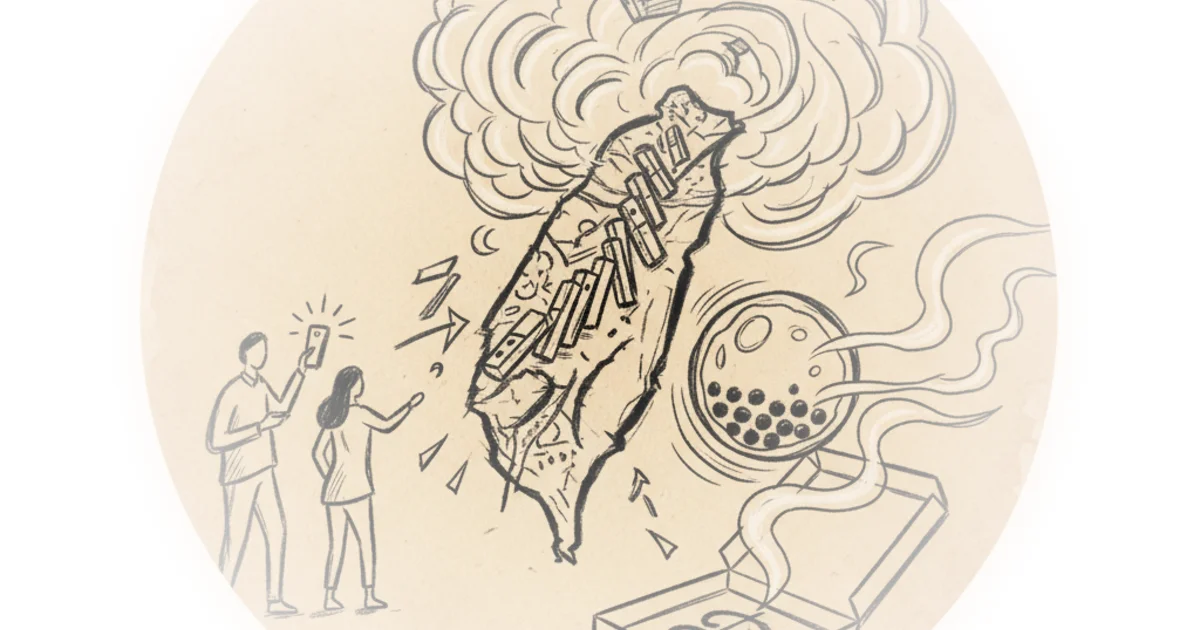
The description of the food itself highlights the clash of flavors that mirrors the political tension. "Just imagine somebody took the perfectly good cheese pizza put tapioca balls on it and smothered it in syrup," Chappell notes, capturing the sensory dissonance. He admits the experience is overwhelming, questioning his own life choices as he navigates the "overpowering" sweetness that masks the cheese. This sensory overload is a clever setup for the heavier political discussion to follow, suggesting that the reality of Taiwan's situation is often as jarring and unexpected as a dessert pizza.
"I really questioning my life decisions they have led me here."
The Mechanics of Influence and the Sunflower Movement
Once the culinary chaos subsides, Chappell pivots to the core of the broadcast: the recent election results and the broader context of Chinese interference. He highlights the massive voter turnout, noting that "Taiwan is a super huge voter turnout 74% the spouse's ton insane," emphasizing the democratic engagement of the electorate. The central argument is that this turnout was a direct rejection of the Chinese Communist Party's influence campaign, which Chappell describes as a "massive disinformation campaign" aimed at swaying voters toward the Kuomintang (KMT) party.
Chappell traces the historical arc of this influence, pointing to the previous administration's attempts to normalize relations with the mainland. He recalls the historic meeting in Singapore between the leaders of the two sides, where the former KMT president suggested, "we're all Chinese people like blood is thicker than water." Chappell contrasts this with the current administration's stance, arguing that the electorate has shifted decisively away from the idea of unification. The turning point, he argues, was the Sunflower Movement, where students occupied the legislature to protest a trade agreement they feared would "sell out Taiwan to China."
The most striking part of Chappell's analysis is his observation on how effectively the Chinese Communist Party has subverted traditional political institutions. He points out the irony that the KMT, the party that originally fought a civil war against the communists and was forced out of mainland China in 1949, has been co-opted. "If they can take the KMT party the want the party that fought a civil war against China and got kicked out of the country if they can turn those guys into CCP supporters that just shows you how well the Communist Party is able to subvert an institution from the inside," Chappell asserts. This reframing of the KMT's current stance as a result of successful subversion rather than organic political evolution is a powerful lens through which to view the region's dynamics.
Critics might note that the characterization of the KMT as entirely "subverted" overlooks the complex internal debates within the party regarding cross-strait relations, which range from cautious engagement to outright opposition to unification. However, Chappell's point remains that the external pressure from the mainland has significantly altered the political calculus for the party.
Cultural Identity as Political Resistance
The commentary weaves in the cultural elements of the broadcast to reinforce the political message. The presence of election swag, including a bobblehead of the incumbent president, is used to illustrate the vibrant, albeit quirky, nature of Taiwanese democracy. Chappell contrasts the "adorable" nature of the DPP (Democratic Progressive Party) merchandise with the more serious implications of the election results. He notes that the election was a moment where "the Taiwanese people standing up and saying that we don't want really a lot to do with the Chinese Communist Party especially their influence."
The discussion also touches on the global implications of these events. Chappell argues that the effectiveness of the Chinese Communist Party's influence campaigns should be a concern not just for Taiwan, but for allies like the United States, Australia, Japan, and South Korea. "That's why everyone in the US and Australia and Japan South Korea everyone should be concerned about CCP influence because it's pretty effective," he concludes. This connects the local election to a broader geopolitical strategy, suggesting that the battle for Taiwan's sovereignty is part of a larger contest for influence in the Indo-Pacific region.
"If they can take the KMT party... and turn those guys into CCP supporters that just shows you how well the Communist Party is able to subvert an institution from the inside."
Bottom Line
Chappell's commentary succeeds in using a bizarre culinary experiment to anchor a serious discussion about democratic resilience and foreign interference. The strongest element of the piece is its ability to link the historical subversion of the KMT to the current political landscape, offering a clear warning about the reach of authoritarian influence. The biggest vulnerability lies in the reliance on a somewhat chaotic format that may distract from the nuance of the political arguments, but the core message about the importance of Taiwan's democratic choice remains sharp and urgent.